Get Full Government Meeting Transcripts, Videos, & Alerts Forever!
Wake County board reviews multiple state-driven policy revisions; moves several items to consent
Summary
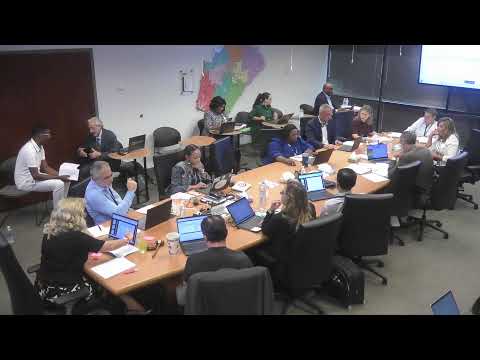
The Wake County Board of Education on an agenda packed with statutory updates heard staff explain changes required by recent session laws and voted to place several revised policies on the board's consent docket for the Sept. 16 meeting while asking staff to return with clarifications on others.
The Wake County Board of Education on an agenda packed with statutory updates heard staff explain changes required by recent session laws and voted to place several revised policies on the board's consent docket for the Sept. 16 meeting while asking staff to return with clarifications on others.
Board members and staff spent the afternoon moving through a batch of policy revisions that district attorneys and staff said were required by state law overrides or new session laws that took effect this school year. The most detailed discussions involved residency language for military families, districtwide rules on contractor criminal‑history checks and a new set of procedures for parental restrictions on library books and religious‑based classroom exemptions.
Why it matters: Many of the revisions are mandatory to keep Wake County Schools compliant with newly revised state statutes; others are district-level clarifications that determine how families and contractors interact with schools (for example: whether a military family may enroll a child before moving into the county, how parents can block their child from checking out specific library books, and how contractor background checks will be handled).
Emergency epinephrine policy Staff told the board that session law 2025-60 changed statutory language from references to “auto‑injector devices” to broader “epinephrine delivery systems.” Kelly Creech, the district’s senior director of health services, told the board that Wake County Schools already stores auto‑injectors through a program called “EpiPens for Schools” and that each school maintains two junior and two adult devices where student emergency medicines are kept.
"We do. We do. There's a general statute that supports that. So we have auto injectors now through a program called EpiPens for School ... which provide 2 junior and 2 adult in each school," Creech said.
Residency and enrollment for military families (policy 4100) Staff reviewed statutory changes that create greater flexibility for military families during transfers. The revisions discussed would allow district staff to begin enrollment for a student based on "anticipated domicile" or temporary housing while proof of residency is provided later, and to allow students who enroll as juniors or seniors to remain through graduation despite later changes in residency.
District counsel walked the board through a recommended clarifying sentence to add at the end of the residency section: “This policy governs admission to the Wake County Public School System, not enrollment in particular schools. For information about assignment to specific schools, please consult policy 4150.” Dr. Crane confirmed the district will add that sentence.
Neil Ramey, speaking for legal staff, urged a minor technical edit to mirror the statute and suggested the district add the clarifying phrase "whichever is longer" to reflect legislative intent in a couple of timing options for anticipated domicile.
Board members asked for follow‑up about what "anticipated domicile" means in practice (for example, whether temporary addresses outside Wake County would qualify). Dr. Crane and legal staff said the statute and the district…
Already have an account? Log in
Subscribe to keep reading
Unlock the rest of this article — and every article on Citizen Portal.
- Unlimited articles
- AI-powered breakdowns of topics, speakers, decisions, and budgets
- Instant alerts when your location has a new meeting
- Follow topics and more locations
- 1,000 AI Insights / month, plus AI Chat