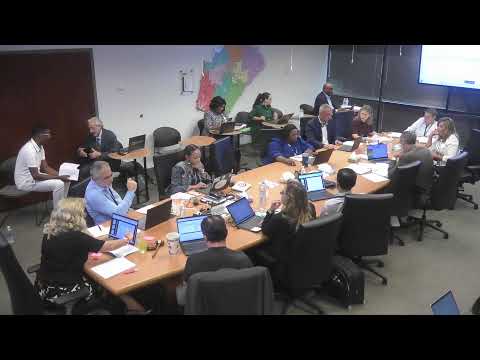
Wake County board reviews multiple state-driven policy revisions; moves several items to consent
Loading...
Summary
The Wake County Board of Education on an agenda packed with statutory updates heard staff explain changes required by recent session laws and voted to place several revised policies on the board's consent docket for the Sept. 16 meeting while asking staff to return with clarifications on others.
The Wake County Board of Education on an agenda packed with statutory updates heard staff explain changes required by recent session laws and voted to place several revised policies on the board's consent docket for the Sept. 16 meeting while asking staff to return with clarifications on others.
Board members and staff spent the afternoon moving through a batch of policy revisions that district attorneys and staff said were required by state law overrides or new session laws that took effect this school year. The most detailed discussions involved residency language for military families, districtwide rules on contractor criminal‑history checks and a new set of procedures for parental restrictions on library books and religious‑based classroom exemptions.
Why it matters: Many of the revisions are mandatory to keep Wake County Schools compliant with newly revised state statutes; others are district-level clarifications that determine how families and contractors interact with schools (for example: whether a military family may enroll a child before moving into the county, how parents can block their child from checking out specific library books, and how contractor background checks will be handled).
Emergency epinephrine policy Staff told the board that session law 2025-60 changed statutory language from references to “auto‑injector devices” to broader “epinephrine delivery systems.” Kelly Creech, the district’s senior director of health services, told the board that Wake County Schools already stores auto‑injectors through a program called “EpiPens for Schools” and that each school maintains two junior and two adult devices where student emergency medicines are kept.
"We do. We do. There's a general statute that supports that. So we have auto injectors now through a program called EpiPens for School ... which provide 2 junior and 2 adult in each school," Creech said.
Residency and enrollment for military families (policy 4100) Staff reviewed statutory changes that create greater flexibility for military families during transfers. The revisions discussed would allow district staff to begin enrollment for a student based on "anticipated domicile" or temporary housing while proof of residency is provided later, and to allow students who enroll as juniors or seniors to remain through graduation despite later changes in residency.
District counsel walked the board through a recommended clarifying sentence to add at the end of the residency section: “This policy governs admission to the Wake County Public School System, not enrollment in particular schools. For information about assignment to specific schools, please consult policy 4150.” Dr. Crane confirmed the district will add that sentence.
Neil Ramey, speaking for legal staff, urged a minor technical edit to mirror the statute and suggested the district add the clarifying phrase "whichever is longer" to reflect legislative intent in a couple of timing options for anticipated domicile.
Board members asked for follow‑up about what "anticipated domicile" means in practice (for example, whether temporary addresses outside Wake County would qualify). Dr. Crane and legal staff said the statute and the district revisions govern admission to the district but do not override the board's authority to assign students to specific schools; staff will seek additional legislative clarification and bring policy 4150 back for a future committee discussion.
Public records retention and employee compensation disclosures Staff presented revisions required by session law 2025-73. Among the changes: a new confidentiality statement for certain retirement‑system reports (citing general statute 135-8) and expanded, more specific items defined as public in personnel files, including total compensation across funding sources and dates/amounts of compensation changes.
Criminal‑history checks for contractors and transportation drivers (policies 7100, 5022 and related) The board reviewed two related changes tied to session law 2025-47: updated criminal‑history and registered‑offender screening requirements that apply to contractors, contractor staff who perform duties normally done by school personnel, and individuals contracted to provide transportation under general statute 115C‑253.
Staff explained that the statute allows a local board to accept a criminal history check performed in another North Carolina school system within the last three years, but Wake County's practice is not to rely on other systems' checks. That language was struck from the draft because staff recommended the district keep its own checks. Board members raised multiple implementation questions, including frequency of checks, how contractors will report new hires, and whether the district should require contractors to cover the cost of checks. Staff and board agreed to take more time: the board asked staff to regroup with HR and legal and return with recommended language that addresses (1) frequency (annual vs. five years was discussed), (2) reporting of new contractor employees, and (3) whether contracts should require contractors (and their employees) rather than occasionally allowing exceptions.
Driver checks: staff noted a companion change requiring that any individual acting as a driver under a 115C‑253 contract submit to the district's criminal‑history check before performing driving duties.
Library books: parental restrictions and searchable catalog (policy 3210/3210 series referenced as 32 10 in materials) The board considered a new state requirement allowing parents or guardians to prohibit their child from borrowing specific library or classroom titles. Staff described how the district's library catalog system (Destiny) can already publish searchable school catalogs and how the district will add a link and parent authentication that uses parent email addresses from the student information system.
Staff framed the change narrowly: it applies to voluntary check‑out from school or classroom libraries, not to assigned curricular materials. Staff also proposed removing the word "all" from a draft definition that said "all instructional materials," because the statutory language does not contain the word and the district did not want to expand the scope beyond what the law requires.
Andrew Cook and library staff explained the implementation: parents will authenticate via an email access code tied to the address on file in the student information system, then identify titles they do not want their child to borrow. The system, once set, will block checkouts for identified titles when a student attempts to borrow them.
Religious‑based exemptions for classroom discussions and assigned readings (new policy required by HB 805) The board reviewed a new policy implementing the state law (House Bill 805) that establishes a process for students or parents/guardians to request a religious‑based exemption from a specific classroom discussion, activity or assigned reading that the requester believes imposes a substantial burden on religious beliefs or calls attention to the student's religion.
Staff recommended that the request be submitted in writing to the classroom teacher and the school principal, who will consult and the principal will review the request under constitutional and statutory standards. If a statutory accommodation is required, the principal must provide it; if the law does not require accommodation, the principal may nonetheless grant one after weighing "the interest of the child, the impact on other students, and the availability of alternative activities or materials." Appeals would follow the district's parent/student complaint or grievance procedures.
Human resources and staff discipline policies; extra duty and nonrenewal A batch of HR policies was presented for migration from School Board Association model policies and for local clarification. Topics included the extra‑duty/extra‑curricular pay structure (policy 7602), recruitment and selection, demotion and dismissal procedures for certified (professional) and classified employees (policies 7930 and 7940), and a migrated policy addressing nonrenewal for noncareer teachers with five or more years (policy 7950).
Board members spent considerable time debating documentation practices for supervisors. Several members asked staff to adjust the draft language to ensure that performance concerns that could underpin a recommendation for demotion or dismissal are documented and preserved so that staff and any later reviewers have a verifiable record. Board discussion distinguished routine informal coaching (which may be handled orally) from formal performance concerns that must be reduced to writing and supplied to HR when demotion or dismissal is contemplated.
"When performance concerns arise, supervisors should communicate clearly in oral or written form," reads the draft; several board members and HR staff recommended tightening that standard so that evidence supporting a recommendation for demotion or dismissal is documented and kept in the personnel record that accompanies any recommendation to the superintendent or the board.
Board direction and next steps • For contractor criminal‑history checks and related language in policy 7100/5022/6340, the board asked staff and legal counsel to return with clearer, implementable language addressing frequency of checks, reporting of new contractor hires, and how costs will be assigned in transportation contracts.
• For the residency changes affecting military families, staff will add the clarifying sentence that admission to the district is not a promise of assignment to a particular school (policy 4150 will be the assignment policy) and will seek minor technical statutory corrections with legislative counsel.
• For library catalogs and parental restrictions the district has activated a searchable catalog link on the Wake County Public School System homepage and is working to scale classroom library collections into the same searchable system.
Votes at a glance (motions recorded during the session) - Motion to approve minutes from June 25 (procedural): motion made and seconded; chair called the vote and members said "Aye"; no opposition recorded; motion adopted. (No individual roll‑call recorded in transcript.)
- Motion to place several minor statutory updates (emergency epinephrine references) on consent for Sept. 16: motion made and seconded; board voted "Aye," no opposition recorded; item moved to consent.
- Motion to place residency policy 4100 (with the staff amendment clarifying district admission vs. school assignment) on consent for Sept. 16: motion made, seconded and approved; "Aye," no opposition recorded.
- Motion to adopt part 1 of public records retention revisions for consent (pages 1 and 2): Miss Mahaffey moved; Mr. Hershey seconded; board voted "Aye," no opposition recorded.
- Motion to place policy 3210 (parent restrictions on library books) on the consent agenda for Sept. 16 with edits (change to "parent/guardian" and removal of the word "all"): motion made, seconded; vote "Aye," no opposition recorded.
- Motion to place the new religious‑exemption policy on consent for Sept. 16 (with edits to reference teacher+principal and appeal routing): motion made, seconded; vote "Aye," no opposition recorded.
- Motion to place extra‑duty policy 7602 on consent: motion made, seconded; vote "Aye," no opposition recorded.
- Motion to bring demotion/dismissal policies 7930 and 7940 back to action on Sept. 16 for board discussion (not consent): motion made and seconded; voted to take to action on Sept. 16.
- Motion to place policy 7950 (nonrenewal for noncareer teachers) on consent for Sept. 16: motion made, seconded; vote "Aye," no opposition recorded.
(Transcript records "Aye" votes on multiple motions with no roll‑call counts or recorded 'no' votes during the items the board approved for consent. Where a specific mover/second is named in the transcript the article records those names.)
What the board asked staff to do next Staff were directed to return with clarified text on contractor background checks, to coordinate review of assignment policy 4150 tied to the residency changes for military families, to proceed with the live library catalog parent portal implementation for checkouts, and to bring back draft improvements to HR documentation language for the demotion/dismissal policies so the board can consider firmer wording about when and how performance concerns are documented.
Ending note Board members and staff repeatedly noted the compressed timeline created by recent session laws and said they will continue to refine draft language with legal counsel and the superintendent’s office before formal adoption at the Sept. 16 meeting where most of the items will appear on consent or action as noted above.