Lifetime Citizen Portal Access — AI Briefings, Alerts & Unlimited Follows
Committee recommends PSYPACT for Maui and state 2026 legislative packages to expand telepsychology access
Loading...
Summary
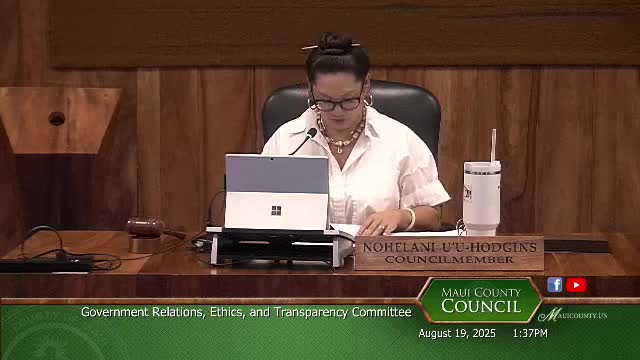
The Maui County Government Relations, Ethics and Transparency Committee on Aug. 19 recommended including the Psychology Interjurisdictional Compact (PSYPACT) in both the 2026 Hawaii State Association of Counties package and the county's 2026 legislative package, voting 8-0 on the state-resolution recommendation and 7-0 on the county-resolution recommendation; both items advance to full council.
The Maui County Government Relations, Ethics and Transparency Committee on Aug. 19 voted to recommend that the council include the Psychology Interjurisdictional Compact (PSYPACT) in the 2026 Hawaii State Association of Counties (HSAC) legislative package and in the county's own 2026 legislative package. The committee recommended adoption of Resolution 25-153 (state package) by an 8-0 voice vote and Resolution 25-154 (Maui County package) by a 7-0 voice vote; both items will go forward to the full council for consideration.
PSYPACT is an interstate compact intended to reduce regulatory barriers to telepsychology and to allow qualifying psychologists to provide temporary in-person services across state lines. Member Senenci, the introducer of the resolutions, told the committee the compact "aims to improve mental health services by promoting professional mobility for psychologists" and described two PSYPACT credentials: the authority to practice interjurisdictional telepsychology (APIT) and the interjurisdictional practice certificate (IPC) for limited in-person practice.
The compact, as explained by Janet Orwig, MBA, CAE, executive director of the compact commission, is voluntary for psychologists. "It is volunteer. Psychologists apply for the authorization to the commission," Orwig said. She described the APIT as having no time limit for telepsychology practice across participating jurisdictions and said the IPC allows temporary in-person practice "for up to 30 days per year" in other PSYPACT states, noting that "any part of a day counts as a day." Orwig said the commission maintains a searchable directory so consumers can find authorized providers by specialty, language and population served.
Committee members discussed practical implications for Maui. Member Senenci cited data from a UHERO report on post-wildfire recovery to underscore local mental health needs, saying, "these findings call for continued investments and suicide prevention strategies, peer support networks, and culturally responsive crisis services, accessible across the Island." The report excerpts presented to the committee include elevated rates of depressive symptoms, anxiety and suicidal thoughts in the Maui West sample compared with pre-fire baselines and statewide figures.
Members asked about insurance coverage and regulation. Orwig said PSYPACT focuses on licensure and regulation rather than insurance, and that whether a provider's PSYPACT authorization is accepted by an insurer will be decided case-by-case between the provider and the insurer. She noted a Medicare (CMS) notification that treats compact privileges as equivalent to licensure, which may help third-party payers evaluate claims.
Several lawmakers also noted legislative history: House Bill 839 and Senate Bill 32 were introduced earlier in the year and passed first reading but did not receive committee hearings, prompting renewed effort for the 2026 package. Orwig told the committee that 43 jurisdictions have enacted PSYPACT and 42 of those enactments are effective; Montana enacted the compact this year and will become effective Oct. 1.
Committee procedural items and next steps included the committee's unanimous agreement to close oral testimony for the two resolutions while continuing to accept written testimony. The chair designated Janet Orwig as a research person under council rules because of her subject-matter expertise. Member Paltin asked that proponents or other advocates be available during HSAC and state hearings if the package is adopted; she cautioned that state hearing notices can be short and local advocates may not always be available.
An anonymous testifier identifying as a member of the Royal House of Hawaii asked about culturally specific services for historical and intergenerational trauma; Member Senenci and Orwig acknowledged that the PSYPACT directory can include specializations such as indigenous or generational trauma so consumers can search for culturally appropriate providers.
Votes at a glance
- Resolution 25-153 (recommend inclusion in 2026 HSAC legislative package): recommended by committee, motion made by Member Senenci and seconded by Member Sugimura; tally 8 ayes, 0 nos, excused Rollins Fernandez; outcome: motion carries and item advances to full council.
- Resolution 25-154 (recommend inclusion in 2026 Maui County legislative package): recommended by committee, motion made by Member Sugimura and seconded by Member Senenci; tally 7 ayes, 0 nos, excused Rollins Fernandez and Chair Lee; outcome: motion carries and item advances to full council.
The committee record shows the items will move to full council for final action; written testimony will remain open and staff will accept further material for the council record.