Get Full Government Meeting Transcripts, Videos, & Alerts Forever!
Get email alerts on the Hospital Financing topic
No spam. Unsubscribe anytime.
Senators Press Guam Memorial Hospital on $28M Operations Shortfall; Amendment Would Shift $3.65M from DOC
Summary
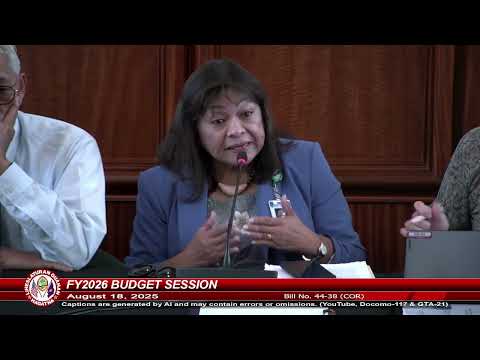
A Committee of the Whole hearing on Monday focused on the fragile finances of Guam Memorial Hospital (GMH) and a proposed amendment to redirect $3,650,000 from the Department of Corrections (DOC) to the hospital’s general fund.
A Committee of the Whole hearing on Monday focused on the fragile finances of Guam Memorial Hospital (GMH) and a proposed amendment to redirect $3,650,000 from the Department of Corrections (DOC) to the hospital’s general fund.
Senator Sabrina Salas Montanani proffered amendment SSM L18P40 to increase the GMH general‑fund appropriation by $3,650,000 and remove the same appropriation from DOC, saying the change would “ensure that these funds are allocated efficiently and used specifically for the hospital’s needs, bypassing potential delays or misallocations within the Department of Corrections budget.” The amendment was read and discussed but not voted on by the end of the transcripted session.
Why it matters: GMH officials told senators the hospital faces a multi‑part shortfall that they say threatens payroll, vendor payments and facility upkeep. Hospital witnesses described large outstanding receivables, utility arrears, and capital needs while urging the legislature for immediate and sustained support to keep inpatient services running while a new hospital is planned.
Most important facts
- GMH officials said social‑case receivables total about $55,000,000 and that roughly 20 inpatients qualify as “social cases” (patients who remain in hospital care for non‑medical reasons). GMH described a per‑patient room and board charge of about $2,000 per day, which totals roughly $40,000–$50,000 per day for the current social‑case census. The transcript identified the social‑case count as “about 20, 21” patients.
- Utilities arrears reported to the committee: power about $1,600,000 (owed from January to the current month) and water about $250,000 (owed to May). Hospital staff said they had received a disconnection notice for power and were negotiating payments; partial monthly payments of about $250,000 were described as the typical stopgap.
- GMH told the committee it faces an operating gap of about $28,200,000 for fiscal 2026 (the figure was described as the difference between planned operating needs and expected revenues/net patient revenue). Separately, officials listed capital improvement project (CIP) needs of about $29,300,000 and accounts‑payable aging near $25,000,000. GMH witnesses said those three categories are separate funding pressures.
- Hospital leaders warned of near‑term staffing risk if the gap persists and said they are trying to avoid furloughs; they listed recruitment and retention costs for nurses and other clinical and nonclinical staff as ongoing budget pressures.
- Officials described outpatient services (cardiology, gastroenterology, pulmonary, outpatient rehab, radiology, and laboratory) as part of GMH’s current operations that support inpatient care and patient follow‑up. GMH said some outpatient work is not the hospital’s primary mission but is provided because community alternatives are limited.
Discussion of foreign doctors and reimbursement
Committee members and GMH staff also discussed draft legislation on allowing foreign‑trained physicians to practice at GMH. GMH representatives cautioned about Medicare reimbursement rules: committee testimony said Medicare will not reimburse certain hospital charges unless the treating physician is trained in the United States, which is why hospital staff suggested focusing any foreign‑physician hiring initially on pediatrics and obstetrics/gynecology, fields they said typically do not bill Medicare.
The amendment and the DOC MOU/consent‑decree issue
SSM L18P40 would move a $3,650,000 appropriation currently placed in Chapter 5 (DOC) to the GMH appropriation in Chapter 3. Senator Sabrina Salas Montanani explained the bill language would strike the DOC pass‑through and appropriate the money directly to GMH. Supporters said the change would avoid pass‑through delays; at least one committee member raised a concern that the original arrangement was tied to a prior federal finding and a consent decree requiring DOC‑administered clinic services.
Lester Carlson of the Bureau of Budget and Management Research (BBMR) confirmed that the amendment’s intent was to move the current DOC appropriation to GMH and explained that the committee had bookmarked the DOC line so the offset could be made when the legislature reached Chapter 5. DOC/GMH witnesses and staff told senators that GMH has been receiving payments under the MOU but that pass‑through timing and verification at DOC have slowed some disbursements. A hospital witness also said an unusually large drug expense in July caused a spike in MOU pass‑through costs.
Procedure and status
The amendment was introduced, debated and bookmarked for linkage to Chapter 5. Committee members requested BBMR and DOC officials for additional clarification on whether transferring the appropriation would conflict with any consent decree obligations tied to the DOC clinic MOU. The session recessed before a recorded vote on the amendment; committee leadership asked the author to prepare the offset language for Chapter 5 so the panels could consider the measures together.
Other funding avenues discussed
GMH representatives and senators discussed other possible funding sources that had been raised in separate meetings, including a $35,000,000 appropriation in the fiscal 2025 budget that some members said might be reallocated, applications to Community Development Block Grant Disaster Recovery funds (CDBG‑DR) and the so‑called “20 First Century Health Care Center of Excellence” fund (witnesses said no deposits had been made to that fund). Hospital staff warned that CDBG‑DR timing and award schedules are uncertain and likely would not provide funds in FY 2026.
What committee members asked for next
Committee members sought clarification on (1) whether moving the DOC appropriation would breach any consent decree or other legal requirement tied to the DOC clinic MOU, (2) a clear, simultaneous show of the offset in Chapter 5 if the amendment is adopted, and (3) BBMR confirmation of the fiscal impact on the overall budget if the appropriation is reallocated. The chair instructed staff to pull the Chapter 5 language into the record so the committee could consider the offset if the amendment passed.
No committee vote on SSM L18P40 was recorded in the transcripted portion.
Ending
Hospital officials asked the legislature for immediate operational funding and for longer‑term solutions to modernize GMH’s electrical, IT and infrastructure systems while the territory plans a new hospital. Committee members signaled urgency but also noted structural revenue limits and competing priorities; the amendment to transfer $3,650,000 from DOC to GMH remained under consideration at recess.