Get Full Government Meeting Transcripts, Videos, & Alerts Forever!
Get email alerts on the Water Quality Monitoring topic
No spam. Unsubscribe anytime.
Santa Barbara creeks staff win committee backing for FY26 water-quality research and monitoring plan
Summary
The Creeks Advisory Committee voted to support a staff proposal for the fiscal year 2026 water-quality research and monitoring plan, which funds continued permit monitoring, microbial source tracking capacity, a microplastics street-sweeper study and additional sampling tied to Clean Water Act 303(d) listings.
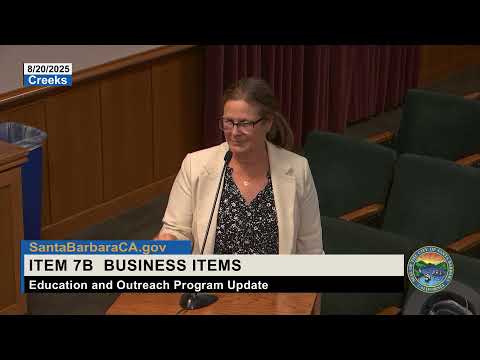
At its Aug. 20, 2025 meeting, the Creeks Restoration and Water Quality Improvements Citizens Advisory Committee of the City of Santa Barbara voted to support staff’s proposed fiscal year 2026 water-quality research and monitoring plan.
The plan, presented by Creeks Division staff, funds required monitoring tied to permits and grants, advances microbial source tracking (MST) capacity, continues long-term sampling and special studies (including investigation of foam observed in the Arroyo Burro estuary), and supports a multiyear microplastics study of street-sweeper effectiveness.
Committee member Laurie Gaskin, filling in as chair, said staff’s proposal is adaptive and draws on input from city staff, scientists, the Water Board and residents. “The purpose of our research plan is to develop strategies for water quality improvement,” she said.
Why it matters: the plan supports the city’s obligations under its stormwater permit and provides additional data to the regional water board’s 303(d) impaired waters assessments. Staff said additional sampling can clarify whether some listings were based on limited data and help prioritize projects to reduce pollutant loads.
Key elements of the plan
- Permit and long-term monitoring: Staff will continue general permit-required outfall testing, biweekly and quarterly sampling, bioassessment and project assessments at sites including Arroyo Burro/Arroyo Burro Estuary, Mission Creek and Barger Canyon.
- Microbial source tracking (MST): Staff said they have purchased one instrument that provides rapid indicator-bacteria results and are renting a second DNA-based instrument (rental with option to buy) to measure human-waste genetic markers. Jill Marie, Creeks supervisor, said the two instruments will be compared against commercial lab results before the city relies on them for routine work. “We are building our in-house capacity for microbial source tracking,” she said.
- Wet- and dry-weather beach risk work: Staff described a wet-weather beach swimming risk assessment done in partnership with UCSB that sampled four beaches on seven dates (winter and summer, wet and dry). Filters were in-house prepared and sent to the Los Angeles County Sanitation District for DNA-marker analysis as part of a regional project (BIGHT 23) led by the Southern California Coastal Water Research Project.
- 303(d) sampling: Staff described the Clean Water Act section 303(d) listing process and said some local impairments added in 2022 were based on a small number of samples. They plan additional targeted sampling and coordination with the Central Coast Regional Water Quality Control Board to improve the data supporting listings or future assessments.
- Foam investigation: Staff noted recurring foam events in the Arroyo Burro estuary and upstream creeks. They said some foam is likely natural (plant-derived saponins and proteins) and some may be surfactant-related (including cationic surfactants associated with slurry seal). The division has purchased a photometer and surfactant test cartridges to distinguish cationic, anionic and nonionic surfactants.
- Clean Streets, Clean Seas microplastics study: Staff summarized a controlled field test conducted with UCSB and Cascade Water Resources in which street surfaces were spiked with known mixtures of microplastic and sediment, sweepers ran predetermined passes/speeds, and residuals were quantified. Staff said the city’s participation should conclude after this year’s seasonal sampling and synthesis work.
Questions, uncertainties and implementation risk
Committee members pressed staff on how to distinguish natural foam from pollutant-derived surfactants and on performance risk for the rented DNA-based instrument. Jill Marie characterized the rental as “high risk, high reward” and said the city can return the unit if it does not perform to expectations. Staff estimated the purchase price of a comparable DNA instrument at roughly $25,000 and noted the rental is expensive but could expand local sampling capacity and responsiveness if it works as promised.
Committee action and vote
A motion to support staff’s recommendation to implement the proposed FY26 research and monitoring plan was moved and seconded; the committee voted unanimously in favor. Recorded members present and voting yes were Todd Rulon Miller, Stephanie Morais, Laurie Gaskin and Lee Heller. The motion passed and staff may proceed with the items described in the plan.
Next steps
Staff said they will finalize sampling plans for storm monitoring, the MST comparison study and 303(d) sampling, complete planned seasonal sampling, and return to the committee in December with fiscal year 2025 results and an update on instrument performance.