Get Full Government Meeting Transcripts, Videos, & Alerts Forever!
Get email alerts on the Federal Grants And District Budget topic
No spam. Unsubscribe anytime.
Federal grant review forces Highlands County schools to freeze positions, shift funds
Summary
District officials said a federal programmatic review and reduced FEFP and Title I allocations have led to frozen vacancies, reassigned staff and a $9.2 million annual maintenance transfer to cover operations; officials urged community advocacy to press legislators for funds.
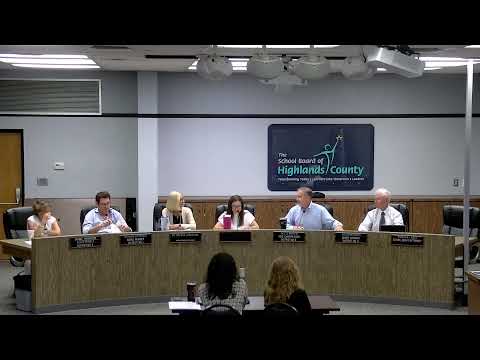
Highlands County School District officials said at a July workshop that a sudden federal programmatic review and lower-than-expected state funding will force the district to freeze vacancies, shift staff funding into the general fund and reduce some program allocations for the coming school year.
"In March, we were notified that we would be receiving our federal dollars...on June 26 we did receive our final FEFP, and those dollars were $150,000 less than what we had expected to see," Superintendent Dr. Longshore said. He told the school board that on June 30 the district also learned Title I allocations would be reduced by $38,000, and on July 1 several federal grants were placed under a programmatic review with no timeline for release.
That programmatic review affects Title I, Title II, Title III and Title IV awards the district had budgeted to staff and programs. Angelica Tenagiero, the district's finance lead, summarized the district's planned use of the contested awards: Title I Part C (migrant education) $685,000 to fund 9.5 positions and related expenses; Title II Part A $653,000 for 6.5 positions and professional development; Title III $83,000 for one ESOL position; and Title IV $368,000 for 2.25 positions and student supports. Tenagiero said the four grants under review total roughly $1.8 million.
Tenagiero told the board the district is still expecting to receive several other federal grants not under review, including Title I Part A at $4.8 million (about 55.5 positions), an IDEA K–12 entitlement of $3.4 million (about 80 positions) and smaller grants such as a pre‑K award of $96,000 and a Title IX homeless education grant of $65,000.
Faced with uncertainty about the programmatic grants, the district has moved some positions that had been grant-funded into the general fund and frozen other vacancies. "At this point, we only have 13 instructional positions across our district that are not filled and 5 non instructional positions that are not filled," Dr. Longshore said, adding that some staff who would have been supported by the reviewed grants have taken other roles within the district.
To help cover district costs, Tenagiero explained an annual maintenance transfer that uses allowable capital revenue to reimburse the general fund for maintenance and school-bus operator salaries. She said this year the district completed a $9.2 million transfer — the maximum she calculated under the statute and the district's expenditures — to offset general fund obligations for maintenance and transportation salaries.
Board members and district leaders highlighted the operational and programmatic consequences of the funding shortfall. Melissa Blackman of Student Support Services said the redistribution of responsibilities and frozen positions should not slow required testing and staffing processes, but board members warned reductions at the district level and in federal programs could reduce campus supports such as campus monitors, coaches and paras that helped drive recent gains in student performance.
Several board members urged public advocacy to pressure state and federal officials to release funds. Board member Mr. Wittenberg suggested seeking a "groundswell" of constituent contacts to U.S. Rep. Scott Franklin and other officials; Dr. Longshore and others said the district would publish addresses and encourage parents and residents to contact legislators. "It is hurting kids," Dr. Longshore said. "I do encourage the community, parents, our staff...to let our voices be heard."
District leaders also raised procedural uncertainties if federal funds are restored. Tenagiero and Dr. Longshore said state guidance on "supplanting" — reinstating positions moved to the general fund after federal funding returns — is unresolved and that any decision to restore positions would be returned to the board for action.
Officials reported the district's projected unassigned fund balance will close at about 3.8 percent this year, which leaders said leaves limited flexibility. Tenagiero reviewed capital funding sources and rules, including Fund 3600 (state capital aid), the district half‑cent sales tax allocations and Fund 3700 (local capital improvement) and reiterated that capital revenue generally cannot be used for operating salaries except under specific annual maintenance transfer rules.
The board asked for follow-up material, including departmental returns on investment for programs housed in district buildings (virtual school, alternative programs, pre‑K), a breakdown of Highlands Virtual School and other program expenditures, and a timeline for enrollment and staffing decisions once additional guidance or funds arrive. The workshop concluded with district leaders continuing to urge coordinated advocacy and caution about long-term staffing commitments while grant outcomes remain uncertain.