Get Full Government Meeting Transcripts, Videos, & Alerts Forever!
Get email alerts on the Land Use Rezoning topic
No spam. Unsubscribe anytime.
Nashville council adopts Nations neighborhood rezoning and UDO after heated public debate
Summary
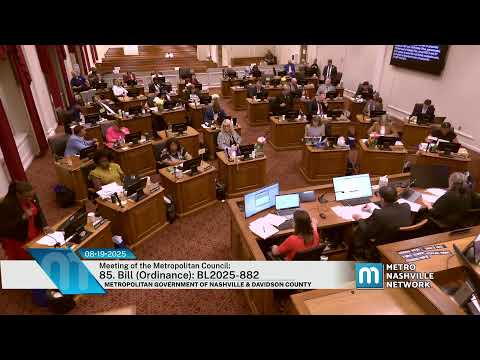
The Metropolitan Council voted to approve a zoning and urban-design package for the Nations neighborhood — ordinances BL2025-830, BL2025-831 and a technical companion — after amendments and extensive public testimony on Aug. 19, 2025.
The Metropolitan Council voted to approve a zoning and urban-design package for the Nations neighborhood — ordinances BL2025-830 (rezoning), BL2025-831 (urban design overlay) and related technical companion BL2025-832 — after amendments and extensive public comment on Aug. 19, 2025. The rezoning ordinance passed on third reading 25–9–1; the urban-design overlay and its companion passed 27–6–2.
The package, sponsored by Councilmember Roland Horton, is a locally driven redevelopment plan the sponsor said reflects nearly two years of neighborhood meetings and changes made in response to resident feedback. “It's something we've been working on, collectively over the last almost 2 years now,” Horton told the council before the final vote.
Supporters said the plan balances more housing choices with neighborhood protections. “This plan better protects our trees, improves stormwater mitigation, and keeps building heights consistent with the neighborhood character,” said Woody Baum, a Nations neighborhood association board member who spoke in favor during the public comment period. Resident Grama Skinner told the council the proposal “is a step in the right direction” for housing affordability and neighborhood stability.
Opponents said the final UDO language still does not match assurances they say they received from the sponsor and the planning process. “All we are asking for is that the UDO actually reflects these items,” said Lauren Magley, who urged a deferral so UDO text could be rewritten to reflect community promises on unit counts, height and corridor scale. Several speakers asked that the rules be changed so residential areas allow up to four units per 50-by-150-foot lot, maintain a two-story, 35-foot scale, and keep taller buildings to the corridors only.
The council adopted two amendments on the floor before the final vote. Amendment 1 clarified treatment of existing short-term-rental permits by prohibiting new short-term rentals in residential character areas while preserving existing permits as required by state law. Amendment 2 asked that multimodal master-plan review be added to the project review to address cumulative traffic impacts on corridor streets; planning staff told the council that NDOT had planned similar review as part of its master planning work.
Planning staff and the sponsor also said the package includes stricter limits on impervious surface and other tree- and stormwater-protection measures the neighborhood requested. Councilmember Delicia Porterfield and other members pressed for clarity that the plan would not make neighborhood flooding worse; Horton and planning staff said the UDO imposes impervious-surface-ratio limits to reduce runoff and requires tree preservation and replacement strategies.
The meeting grew contentious at times, with members and members of the public loudly disputing one another during debate; the chair called a brief recess and restored order before votes. Planning and Zoning Committee Chair Gamble said she supported much of the package but remained uncomfortable voting yes that night without additional time to clarify impacts for some directly affected homeowners.
Votes at a glance: BL2025-830 (rezoning) — passed 25 yes, 9 no, 1 abstention. BL2025-831 (urban design overlay) and companion BL2025-832 — passed 27 yes, 6 no, 2 abstentions. The ordinances now take effect according to the standard schedule for zoning amendments unless otherwise provided.
Council members and planning staff said follow-up engagement and technical reviews would continue as the city implements stormwater, tree protection and multimodal recommendations included in the UDO and in coordination with Metro Water and NDOT.