Get AI Briefings, Transcripts & Alerts on Local & National Government Meetings — Forever.
Board sends 1922 De La Vena Street mixed-use project back for more design work
Summary
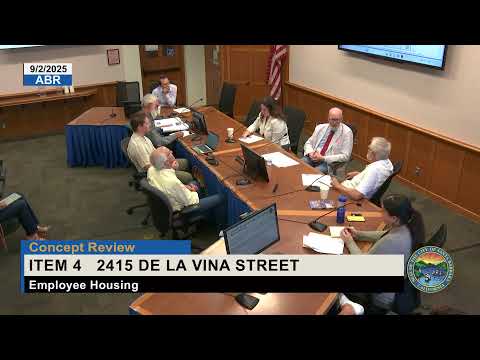
The Architectural Board of Review continued concept review of a proposed 39-unit mixed-use development at 1922 De La Vena Street to the full board for additional refinement, asking the design team to simplify facades and emphasize horizontal organization and consistent openings.
The Architectural Board of Review on Sept. 2 continued concept review of a proposed 39-unit mixed-use development at 1922 De La Vena Street, directing the project team to simplify building composition and clarify the elevations before returning to the full board.
The project team — led by BW Design and RRM Design Group — sought input on changes made since the project was last reviewed, including massing reductions, a smaller courtyard, stacked floorplates and revised fenestration. Applicants said the revisions reduced the project’s visual bulk and clarified unit layout, and emphasized a “kit of parts” approach to create variety across the façades.
Board members applauded reductions in upper-floor massing but repeatedly urged the team to simplify the elevation language and adopt a clearer, more consistent pattern for windows, balconies and roof shapes. Several members said the current collection of gabled ends and varied window types created a visually cluttered effect; they recommended larger continuous groupings of openings and a stronger horizontal expression on long elevations.
Vice Chair Whelan asked the team to show clearer section drawings that demonstrate how the four‑story massing sits in relation to adjacent one‑story neighbors and recommended returning examples of Santa Barbara architecture that better match the project scale. Board member Sixx and others requested more consistent window proportions and simplified balcony treatments to avoid a fragmented appearance.
The board voted to continue the item indefinitely to the full board for further work; the motion included two specific requests: simplify the architecture to emphasize horizontal order and reduce the number of distinct window and roof types, and preserve the massing reductions the team recently made (including the reduced courtyard width and stacked floorplates). The board also asked applicants to return with clearer sections showing adjacent properties and revised design studies that test larger, simpler openings and less repetition of gable ends.
The project is proposed as a mixed-use development with 39 residential units, 29 vehicle parking spaces, 44 bicycle parking spaces and one commercial loading space. The team said the project will pursue state density bonus approval and city design review; applicants also noted they are close to seeking Project Design Approval (PDA) with further refinements.
The board also discussed but did not require story poles for the proposed four‑story portions at this concept stage; the motion that carried recommended returning to the full board for additional concept refinement and documentation prior to PDA submission.
What’s next: The applicant will revise elevations, consolidate window and balcony types, provide clearer cross-sections that show adjacent properties, and return to the full Architectural Board of Review for continued concept review.