Get Full Government Meeting Transcripts, Videos, & Alerts Forever!
Get email alerts on the Education Legislation topic
No spam. Unsubscribe anytime.
PGCPS policy committee narrows 2026 legislative priorities to special education, multilingual learners, facilities and school safety
Summary
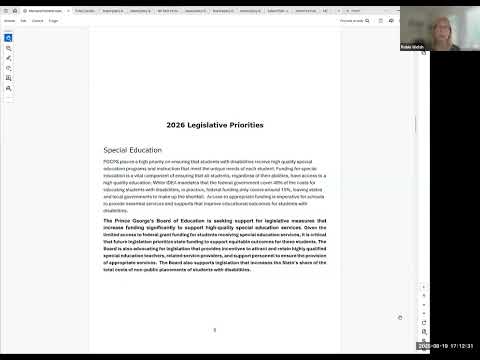
The Policy and Governance Committee of the Prince George's County Board of Education on Aug. 19 reviewed and approved a draft legislative platform that pulls four top priorities for the 2026 session: special education funding and workforce incentives; programs and funding for multilingual students; construction and facilities repairs and new buildings; and measures to keep school campuses safe and secure.
The Policy and Governance Committee of the Prince George's County Board of Education on Aug. 19 reviewed and approved a draft legislative platform that pulls four top priorities for the 2026 session: special education funding and workforce incentives; programs and funding for multilingual students; construction and facilities repairs and new buildings; and measures to keep school campuses safe and secure.
The platform, presented by Robin Welsh during the committee’s first meeting of the 2025–26 school year, is meant to serve two functions: to tell county legislators what Prince George's County Public Schools (PGCPS) will prioritize in Annapolis and to give board members guidance on positions the board can take quickly if bills arise between monthly full-board meetings.
"The platform gives a lot of guidance on what the position will be of the board for the different bills that are introduced," Welsh said during the presentation.
Why it matters: committee members and staff said the four focus areas reflect operational needs that would require state-level funding or statutory changes to address at scale. Committee members and Dr. Ron Watson, senior adviser to the superintendent, urged more specificity — dollar amounts, location-by-location lists, and measurable timelines — so legislators can determine how proposed measures would affect their districts and budgets.
Special education: committee discussion centered on funding and workforce shortages. Welsh told members that federal funds historically promised to cover roughly 40% of special education costs have not materialized (federal funding has been closer to around 15%, she said), and PGCPS must absorb substantial costs for smaller classes, related-service providers and out-of-district placements. The platform asks for legislation that would provide incentives to attract and retain special education teachers and service providers.
"If there were any funding that could support, like, financial incentives, that could be extremely helpful to attract teachers to come to Prince George's County," Welsh said. Dr. Watson pressed for clarity on whether the ask is for new programs, additional staff, higher pay or some combination; he said legislators need concrete costs and priorities to act.
Multilingual students: the committee highlighted that about 40.1% of PGCPS students were identified as multilingual on the 2024 enrollment count and that the population includes both newcomers with no prior U.S. schooling and long‑term English-learners who need interventions. Welsh said the district needs multilevel, targeted programming — including academic interventions and mental-health supports — and corresponding funding.
Construction and facilities: Welsh noted roughly half of PGCPS school buildings are more than 40 years old and that aging HVAC, electrical systems and other critical infrastructure force frequent school closures and divert capital funds from larger renovation or replacement projects. The platform asks for state support and recognizes the district’s public–private partnership (P3) work as a longer-term path to new buildings.
Safety and security: the platform asks for funding both for reactive measures — metal detectors, digital cameras and sensors — and for preventive strategies, such as restorative-practice programs and safe‑passage coordinators to work with county and state transportation agencies. Welsh told the committee the district saw a roughly 31.35% reduction in weapons incidents at high schools where safety devices and sensors were deployed, and that PGCPS is piloting vape detectors and upgrading analog cameras to digital systems.
"When I talk about school security, what's more important? Digital cameras or securing the doors without metal detectors?" Dr. Watson asked as he urged the platform be specific about costs and priorities.
Committee members also discussed the mechanics for using the platform on legislative day. Board member Walker described a working meeting in September where small groups will match priorities to bills, identify where legislators are already engaged and produce tangible next steps for the board and delegates.
What comes next: the committee agreed to take the four priorities forward as the top asks for legislative day but asked Welsh and staff to return with a crisper, bulletized platform that ties asks to concrete costs, metrics and district-level effects. Board lobbyist Jontel Green — introduced by the chair during the meeting — will continue to work with staff and legislators to refine bill language and strategy.
Evidence excerpts from the meeting where the platform, priorities and legislative-day plan were presented are part of the meeting record and were used to summarize committee direction.
—