Get Full Government Meeting Transcripts, Videos, & Alerts Forever!
Get email alerts on the Land Use Permit Validation topic
No spam. Unsubscribe anytime.
Hearing examiner leaves record open after neighbor raises runoff, tree loss and mosquito concerns in Hoffman Brothers permit dispute
Summary
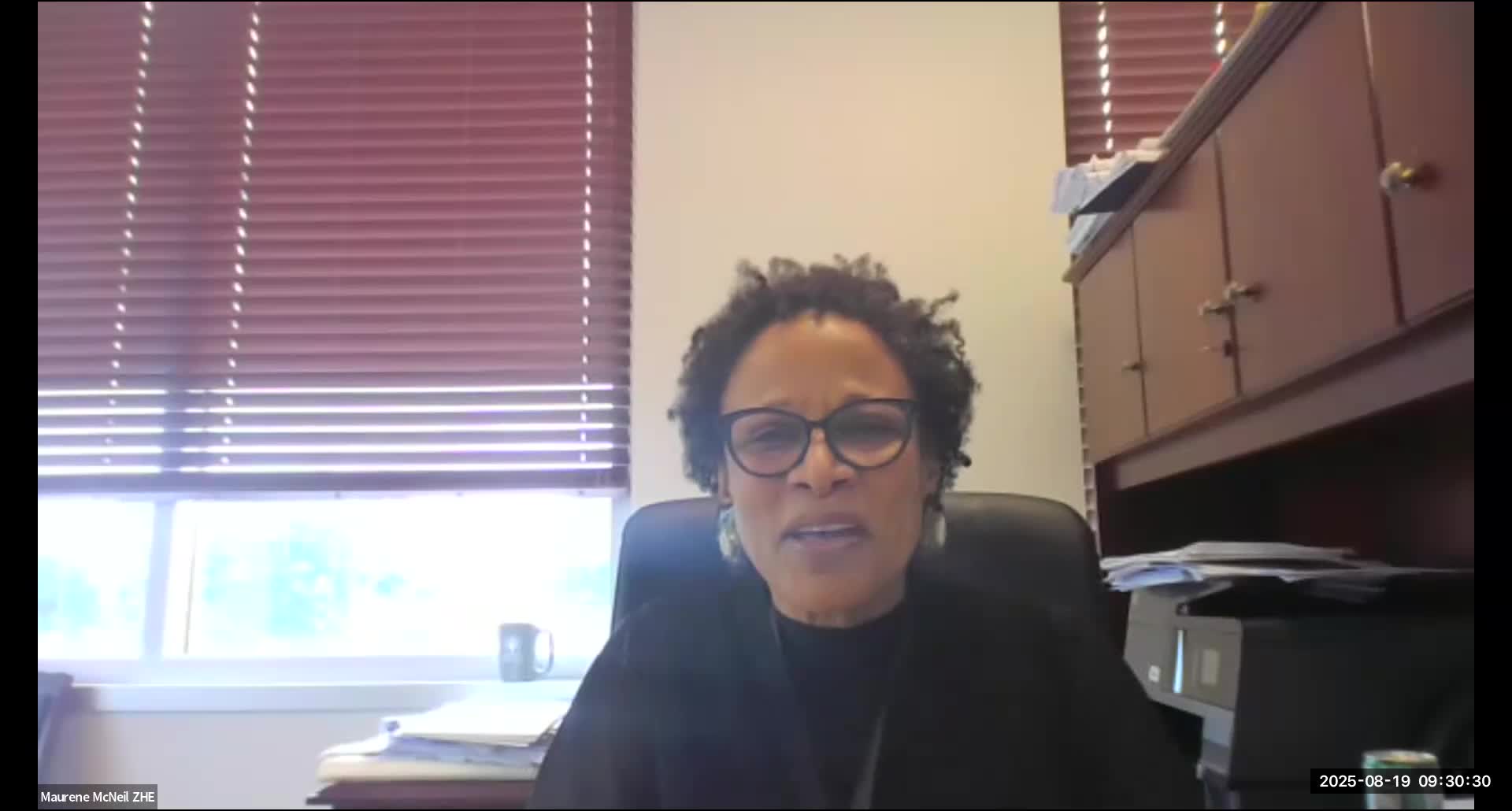
Maureen McNeal, hearing examiner for Prince George's County, presided Aug. 19 over a continuation of Case ERR0012025, in which Hoffman Brothers Towing and Used Cars seeks validation of a 1967 use-and-occupancy permit (U14196) that the petitioner says may have been issued in error.
Maureen McNeal, hearing examiner for Prince George's County, presided Aug. 19 over a continuation of Case ERR0012025, in which Hoffman Brothers Towing and Used Cars seeks validation of a 1967 use-and-occupancy permit (U14196) that the petitioner says may have been issued in error.
The petitioner’s attorney, Abdullah Hejazi, told the examiner the lot “was actually started, from what we can tell, in the early 19 fifties,” and that the last use-and-occupancy (U&O) permit on file was issued about 1967. Hejazi said county planners could not certify the lot as a nonconforming use because staff could not trace the use to a time when it met the zoning code’s requirements, leaving validation as the petitioner’s available route.
Homeowner Thomas Harrah, who lives at 15612 Muse Court directly behind the Hoffman property, testified during public testimony about site conditions he said have worsened since the early 1990s. “I moved to the property in September 1992,” Harrah said, and described successive expansions of the sales and storage areas, including asphalt paving added near a sales trailer. Harrah testified that runoff from the lot drains toward the lower-elevation houses on Muse Court, that he has observed a rusty orange, “slimy, gooky” substance in an open storm drain at the site’s northeast corner, and that he believes the runoff has contributed to the loss of trees. “We have lost a total of 12 pine trees,” Harrah said.
Harrah also raised public-health concerns about long-stored damaged vehicles on the lot, saying they create standing water where mosquitoes can breed; he noted that in 2019 the Maryland Department of Agriculture stopped spraying the area after saying spraying was ineffective where vehicles and debris create continuous mosquito habitat.
County staff witness Gerald (Diaz) Campbell testified he had reviewed permitting records and identified environmental engineering permits from 1992 and 1993 (record numbers 3400854-1992-0 and 2811389-1993-0) that coincide with the period Harrah described and that appear to have been issued for sales-lot expansion. Campbell also said a later increase in paved area occurred in 2006 but, by his measurement, was less than 5,000 square feet and therefore would not have required a grading permit.
During legal argument, attorney Stan Brown (People's Zoning Council) emphasized the narrow issues the examiner and District Council may decide on a “permit issued in error” case. “The only issues in a permit issued in error case are whether or not the applicant received an approved permit from the county in error,” Brown said, and whether the applicant “has done nothing improper, nothing fraudulent, and it has expended money, based upon that erroneous permit.” Brown and the examiner both noted that while neighborhood impacts Harrah described are relevant to later remedies or conditions, they are not the core legal question in this type of validation.
A separate legal issue arose about which zoning code controls the certification. The petitioner filed under the county’s post-April 2022 zoning ordinance and referenced Section 27-3615(e) of that ordinance in its statement of justification. Brown and the examiner flagged that the permit at issue predates the 2022 ordinance and that the validation should be decided under the ordinance in effect at the time the permit was issued. The examiner instructed the petitioner to supplement the record to address the prior (pre‑2022) ordinance criteria or explain why the current ordinance should apply.
The hearing concluded with the examiner leaving the record open for the petitioner to file either a supplemental statement of justification or a written closing argument addressing the ordinance choice and any other matters the parties wish to put on the record. No final decision was made at the hearing.
Procedural and evidentiary notes from the hearing record include: the petitioner acknowledges the 1967 U&O describes towing, wrecked-vehicle storage and used-car sales; county staff located environmental permits from 1992–1993 that align with observed paving; a 2006 paving increase measured at under 5,000 square feet; and the petitioner agreed to file supplemental filings addressing whether the validation must be decided under pre‑2022 code sections.
The examiner also recorded the presence of several counsel and participants for the record, including petitioner counsel Abdullah Hejazi and co-counsel Bruce Marcus, People’s Zoning Council representative Stan Brown, county staff witness Gerald (Diaz) Campbell, and resident/witness Thomas Harrah. The record will be supplemented and remain open for the submissions the examiner requested.