Get Full Government Meeting Transcripts, Videos, & Alerts Forever!
Get email alerts on the Mental Health Response topic
No spam. Unsubscribe anytime.
SA COR teams report 4,486 dispatches and expanded follow-up care in co‑response mental‑health effort
Summary
MetroHealth chief mental‑health officer Jesse Higgins reported SA COR dispatched to 4,486 calls through July, with 2,303 individuals engaging follow-up clinicians; the program aims to reduce arrests by routing persons to care and expanding outpatient services.
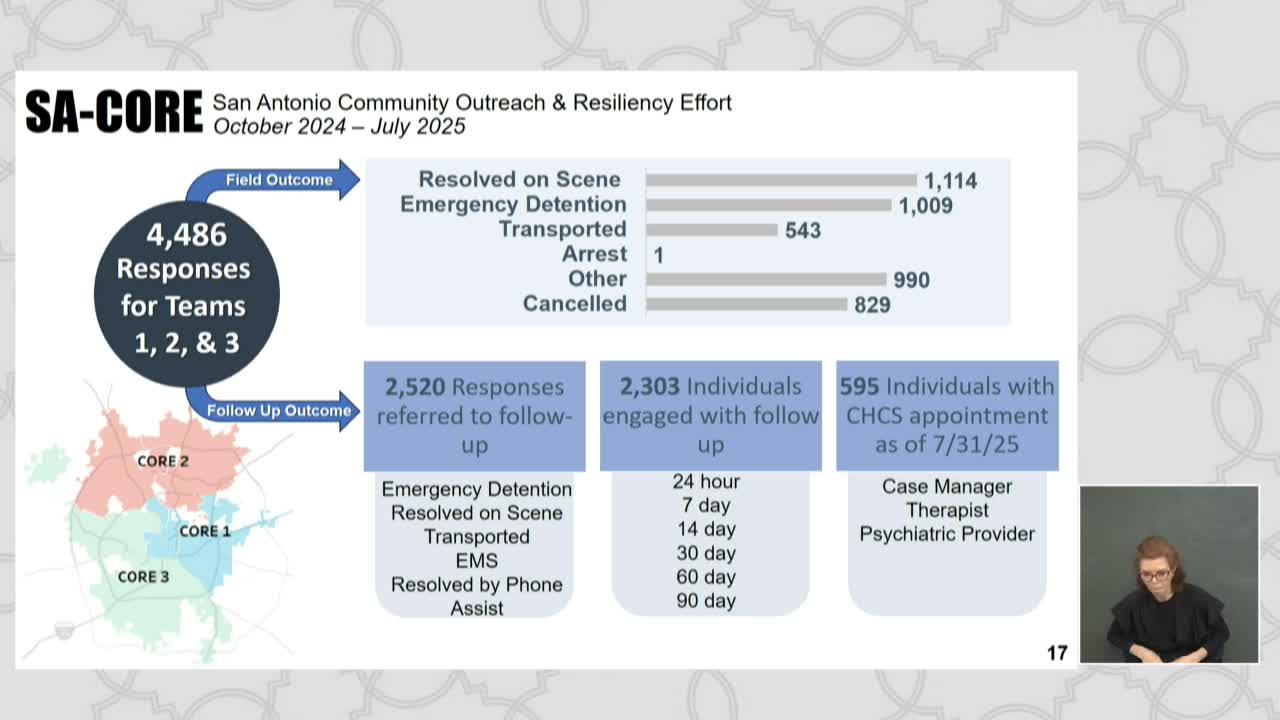
Jesse Higgins, chief mental health officer with MetroHealth, told the council that the San Antonio Community Outreach and Resiliency program (SA COR) — a multi‑agency co‑response effort operating 24/7 — was dispatched to 4,486 calls through July in the current fiscal year.
Higgins said 1,114 incidents were resolved on scene by deescalation and referral to follow-up clinicians, 1,009 resulted in emergency detention, and 5,543 were transported either voluntarily to behavioral-health facilities, to outpatient clinics or by EMS for physical-health needs. He said 2,303 individuals engaged with follow-up clinicians and 595 had appointments with the Center for Healthcare Services (CHCS) or other providers; he reported one arrest associated with SA COR responses.
Why it matters: Council members and presenters framed SA COR as part of a broader public-safety approach that routes behavioral-health calls to clinicians when appropriate, reduces unnecessary arrests and connects people to ongoing services to prevent repeated crises.
Program details: Higgins described clinician follow-up contact at 24 hours, 7, 14, 30, 60 and 90 days after an event. He said the program expanded from a single central-substation team in April 2022 to three teams covering the city 24/7. The program partners include SAPD, the fire department, the Southwest Texas Regional Advisory Council (STRAC) and the Center for Healthcare Services (CHCS).
Council interest and follow-up: Council members praised the program’s deescalation and follow-up results and asked how the model could expand into other City programs, including in‑house hospital or crisis‑diversion capacity. Members requested continued data on outcomes, program expansion costs and integration with police dispatch.