Get Full Government Meeting Transcripts, Videos, & Alerts Forever!
Get email alerts on the Public Safety Police topic
No spam. Unsubscribe anytime.
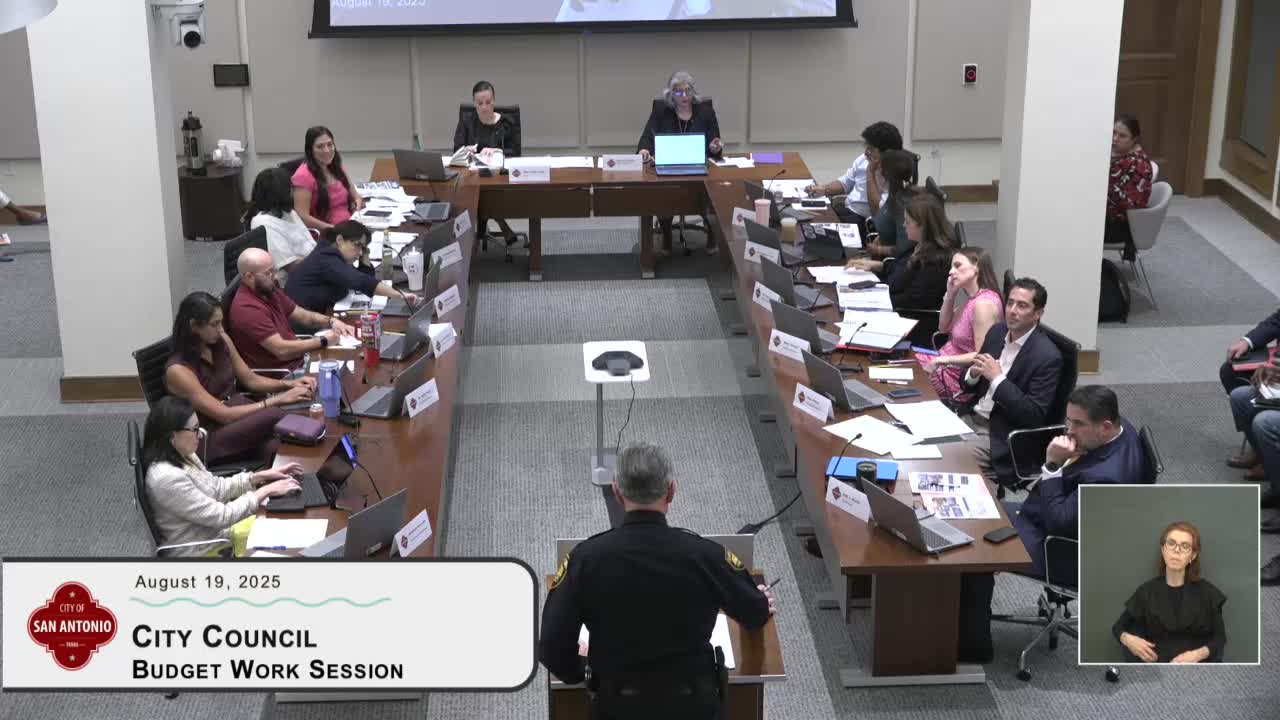
SAPD seeks to expand patrol, fund technology pilots and continue violent-crime strategy in FY2026 budget
Summary
Chief McManus presented a proposed police budget that funds recruitment, a 360-officer long-term staffing target with an immediate push for 25 additional officers this year, investments in patrol and specialized units, new revenues from alarm and off-duty fees, and pilot technology including AI camera analytics and automated report tools.
Chief McManus told the City Council the SAPD proposed FY2026 request focuses on patrol staffing, operations support, technology and sustaining recent crime reductions. He said the department’s FY2026 proposal—including general fund and restricted funds—aims to sustain patrol capacity during city growth and invest in technology and community-based responses.
Staffing, crime trends and goals: McManus described a multi-year staffing target of adding 360 officers “over the next three to five years” to shift patrol toward a 60% proactive/40% reactive workload. He said total department positions supported by the budget would be 4,070 and that the department has added 446 officers since 2019. McManus said total reported crime through July 2025 is down compared with 2024, with violent crime down “nearly 10%” and property crime down “almost 20%,” while “crimes against society” (drug, weapon, public-order offenses) rose about 11.5%.
Immediate additions and costs: The presentation included a request for funding 25 new officers this year; staff provided a council-requested estimate for adding another 40 officers (for a total of 65): McManus’ slide cited an FY26 incremental cost of about $2,100,000 for the 40 additional positions and a second-year cost of about $5,900,000 (these are staff estimates provided during the session). Council members urged consideration of funding the full 65 in the budget.
Programs and partnerships: McManus credited the UTSA partnership on a violent-crime reduction plan that uses hotspot policing (phase 1), problem-oriented place-based policing (phase 2) and a forthcoming focused-deterrent phase (phase 3). Maria Vargas of the Integrated Community Safety Office described the POPB work at Rosemont Apartments (1303 Rigsby Ave.) and The Reserves at Pecan Valley (4032 E. South Cross Blvd.), noting code enforcement activity and compliance deadlines at the latter property.
Co-response and mental-health teams: The SAPD presentation and partner testimony highlighted SA COR (San Antonio Community Outreach and Resiliency), a multi-agency co-response program run in partnership with MetroHealth and the Center for Healthcare Services (CHCS). Jesse Higgins of MetroHealth reported SA COR teams were dispatched to 4,486 calls this fiscal year through July; 1,009 resulted in emergency detention, 5,543 were transported by team or EMS, and 2,303 individuals engaged with follow-up clinicians. Higgins said only one arrest had resulted from SA COR responses.
Technology and revenue changes: The department proposed pilots for real-time crime-center camera monitoring, AI-powered analytics, automated report-writing tools and digital forensics platforms intended to reduce officer time on paperwork. McManus outlined revenue adjustments including updated alarm permit fees (commercial alarm renewals projected to yield about $1.4 million), doubling an unpermitted commercial robbery fee to $500, and raising the off-duty surcharge to $10 per officer per hour (projected to add about $210,000). He also listed grants the department expects to pursue or receive, including COPS grants, JAG, REACT and TAG.
Council requests and concerns: Council members asked for district-level breakdowns of crime reductions and response times, asked staff to clarify the staffing study methodology behind the 60/40 goal, and requested follow-up on the cost and timeline for adding additional officers. Concerns were raised about privacy and policy for camera and AI pilots, and council members asked for briefings on who will access data and retention policies.
Ending: McManus and staff committed to providing follow-up materials, and council members pressed for options to accelerate officer hires and for additional information on pilot technologies and grant timing.