Get Full Government Meeting Transcripts, Videos, & Alerts Forever!
Get email alerts on the Homelessness And Public Space Enforcement topic
No spam. Unsubscribe anytime.
McKinney council discusses citywide no-camping, downtown sit/lie and aggressive-panhandling rules
Summary
City staff presented draft changes to the McKinney Code of Ordinances proposing a citywide ban on camping in publicly accessible places, a downtown-specific prohibition on sitting or lying in pedestrian rights of way, and a new offense for aggressive panhandling.
City staff presented draft changes to the McKinney Code of Ordinances on Tuesday proposing a citywide ban on camping in publicly accessible places, a downtown-specific prohibition on sitting or lying in pedestrian rights of way, and a new offense for aggressive panhandling.
The proposals, compiled by the city manager’s office with legal, police, code services and housing staff, would add definitions and enforcement tools to chapters 70 and 78 of the Code of Ordinances. Under the draft, "camping" would be prohibited between 7 p.m. and 7 a.m. on publicly accessible property except in designated park camp areas (Erwin Park), and property owners could be cited if they knowingly allow camping on publicly accessible portions of their land.
The code change for sitting and lying down would apply to a defined downtown area that aligns with the McKinney Town Center zoning boundary (about 212 acres), making it unlawful to sit or lie where an area is not intended for that use unless the sitting place is an exception such as a city-supplied bench. The aggressive-panhandling provision would not ban solicitation outright — which staff said would be a First Amendment concern — but would target blocking, physically interrupting patrons, or using threatening language.
Why it matters: council members said the measures are intended to give officers a clearer legal footing to engage individuals who are obstructing sidewalks, endangering patrons or creating chronic problems in the downtown core. Supporters at public comment urged action to improve safety and business conditions; opponents urged caution, saying the proposals risk criminalizing poverty and removing low‑barrier shelter options such as vehicle sleeping.
Public comment and council questions
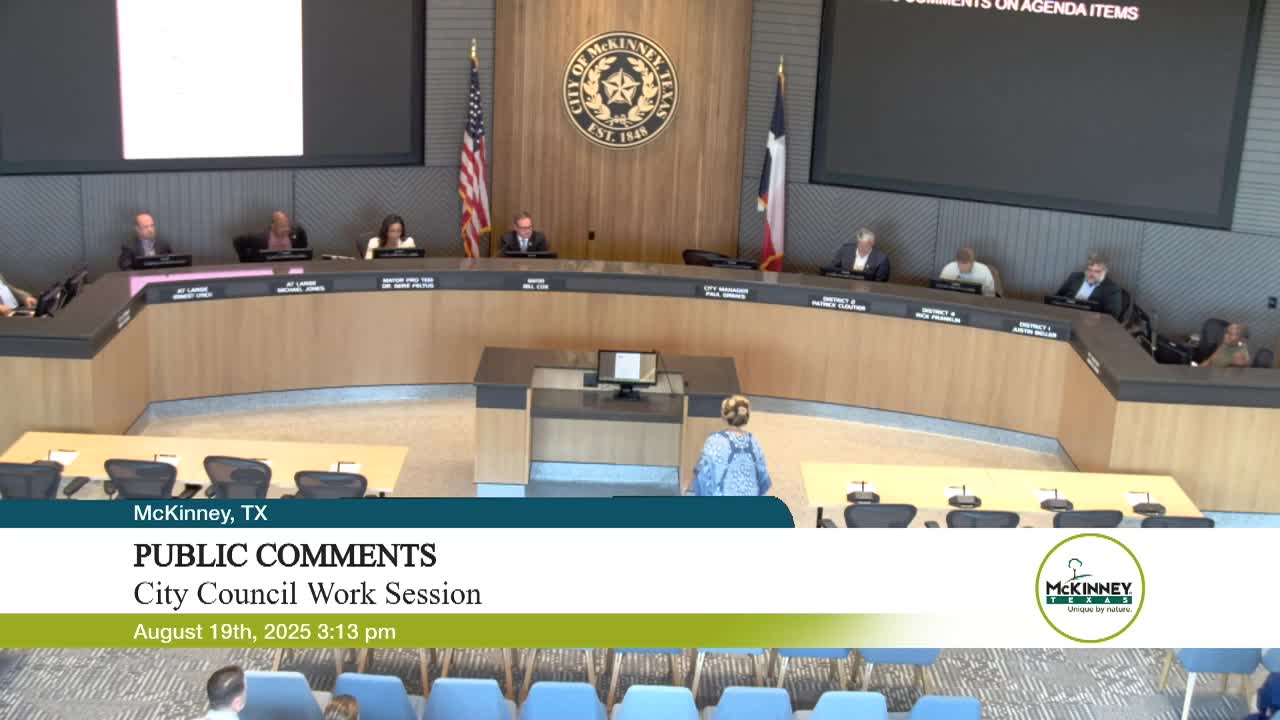
Several residents addressed the council before the staff presentation. Molly Brown, who said she had experienced sleeping in a vehicle while working multiple jobs, urged the council to reject changes that would make sleeping in personal vehicles an offense and argued the amendments “punish people for visibly existing in poverty” rather than addressing housing affordability. Brown cited a local workforce housing shortage and warned that removing vehicle-sleeping options would strip a form of shelter.
Paul Ballesteros, founder of Emmanuel Labor, and downtown business owner Matt Hamilton also spoke. Ballesteros said he did not expect the ordinances to “move the needle” on homelessness but urged further conversation and relationship-based interventions. Hamilton described repeated problems with trash, drug paraphernalia and repeated encampments on or near his properties and said he supports giving police tools to address impacts on businesses.
Staff summary and legal scope
Jennifer Arnold, assistant city manager, said staff are presenting these drafts to request council direction, not to adopt ordinances. Arnold told the council the drafting team included the police, legal, code services and housing departments and that the draft provisions are meant to be one tool among many, including services and outreach, to address visible public-safety and nuisance concerns.
City attorney staff clarified the scope of the overnight-parking language. Jeremy Page, city attorney’s office, said the overnight-parking prohibition as drafted would apply to public streets and public parking lots; it would not prohibit a private property owner from allowing someone to sleep in a vehicle on private property (for example, a Walmart parking lot) if the owner permits it. Page and staff emphasized that “publicly accessible” can include private property that is open to the public and that the drafts remain subject to refinement.
Key clarifications and carve-outs discussed
- Erwin Park: the draft preserves designated camping in Erwin Park if done through the parks department’s reservation process; council members noted the number of approved camping areas in Erwin Park is limited. - Private parking: staff stated the draft would not reach private parking lots where a property owner explicitly permits overnight vehicle sleeping; enforcement focus would be public streets and public parking lots. - Property-owner liability: the draft creates an offense for property owners who knowingly allow camping in publicly accessible areas of their property; staff said enforcement tools would include citations and criminal-trespass processes where appropriate. - Downtown sitting/lying: the draft is targeted to the McKinney Town Center zoning area; staff acknowledged existing downtown features (low walls, steps or “pony walls”) are ambiguous in the draft and said they would clarify whether those elements are intended as seating exceptions.
Enforcement, services and review
Police and community services staff said the ordinances are intended to provide an opportunity for engagement and voluntary compliance most of the time; Chief Ellenberg and a police representative said officers frequently obtain voluntary compliance and that the community services unit and homeless coalition provide casework and referrals when individuals request help. Staff and council discussed practical constraints of enforcing class C misdemeanors against indigent people and noted fines are often not effective where defendants are indigent.
Multiple council members asked staff to include a sunset or mandatory reevaluation provision; staff said they would return an evaluation after one year to measure impacts and provide a path to modify or repeal the ordinances if they do not produce the expected outcomes.
Remaining questions and next steps
Council members and staff identified areas for redrafting before any ordinance is brought back for formal consideration: clearer definitions (camping versus overnight vehicle sleeping), explicit carve-outs for private-property permission, treatment of downtown walls and steps that are functionally seating, and a required annual review of effectiveness. No formal vote on the draft ordinances occurred during the work session; staff requested direction on whether the council wants staff to continue refining the drafts.
Ending
Staff emphasized the package is part of a broader set of responses including housing and services; the council signaled interest in pursuing downtown-targeted provisions with clarified exceptions and a built-in review, while also urging continued investment in outreach and service connections for people experiencing homelessness.