Get Full Government Meeting Transcripts, Videos, & Alerts Forever!
Get email alerts on the Public Safety Fire topic
No spam. Unsubscribe anytime.
San Antonio Fire Department proposes squad expansion, drones and $1.4 million needs assessment in FY2026 budget
Summary
Fire Chief Frosto presented a $443.6 million fiscal 2026 general-fund request that funds two new two-person squads, a drone purchase, a $1.4 million needs assessment and continued station design work; current staffing, ISO accreditation and medical call volume framed the department’s priorities.
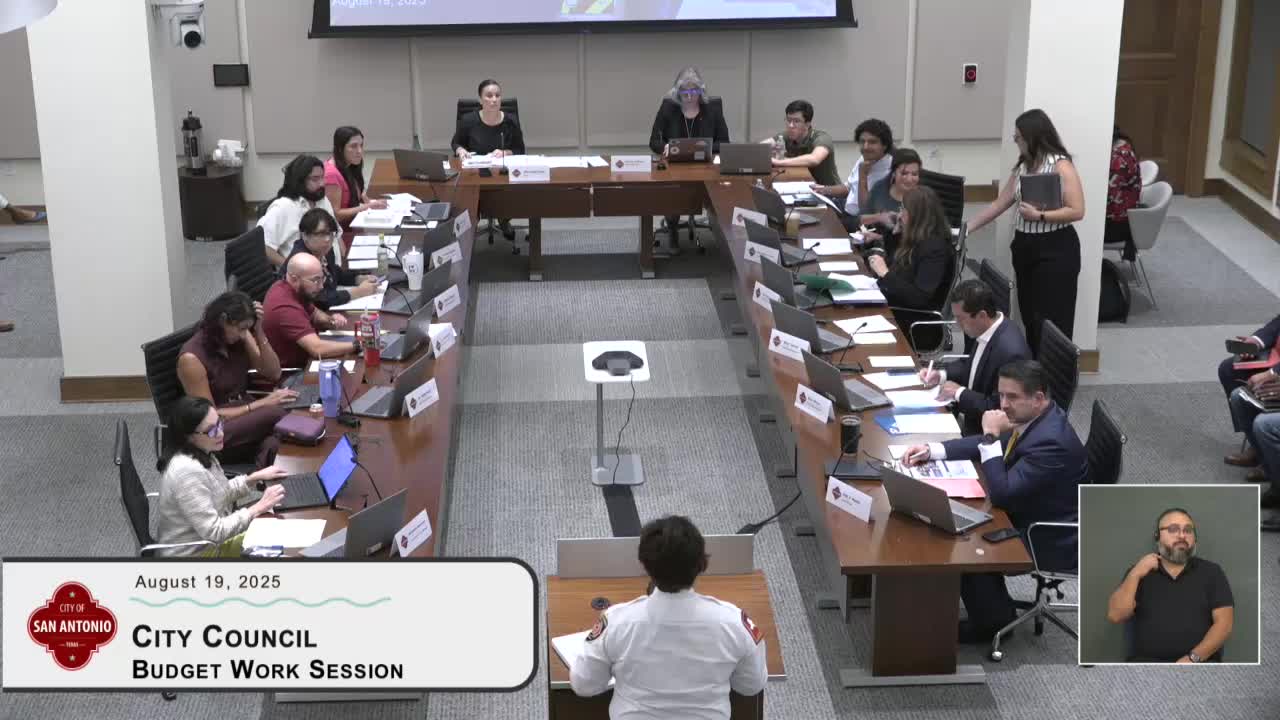
Fire Chief Frosto told the City Council during the Aug. 19 budget work session that the San Antonio Fire Department’s proposed fiscal 2026 general-fund budget is $443,600,000 and focuses on staffing, equipment and facilities to preserve public safety.
Frosto said the department is proposing two new two-person squad units and 12 uniformed positions “designed to reduce response times, lighten the workload on frontline units, and enhance service in high-demand areas.” The presentation says the two squads would be housed at Station 10 and Station 21 and — if approved — would come online in July 2026.
Why it matters: Frosto described medical calls as roughly 80% of total incidents and said increasing unit capacity in busy locations can reduce wear on engines and free heavy apparatus for major emergencies. He cited Engine 44 and Engine 24 as historically busy units that saw reduced unit responses after squads were placed at other stations.
Key details: Frosto said the department employs about 1,900 uniformed and 129 civilian staff operating out of 54 stations, with 39 uniform and 14 civilian vacancies reported at the time of the presentation. He outlined recent and projected academy classes (two cadet classes in FY25, projecting two cadet classes and one EMS class for FY26) and highlighted the department’s ISO Class 1 rating and CFAI accreditation as evidence of its capabilities.
Capital and technology items in the request include a proposed $1,400,000 comprehensive needs assessment “to focus on staffing, equipment and facilities” and a one-time purchase of drones at $291,000. Frosto said staff has researched platforms and FAA guidelines, and that the department already has two licensed operators; the drones were presented for incident scene awareness and search-and-rescue purposes.
Reductions and efficiencies noted in the presentation include a $1,000,000 overtime-management target, elimination of a civilian athletic trainer position with services contracted externally, restructuring of recruit fitness conditioning to lower cost, and line-item realignments to match historic spending. Frosto stated the department expects those reductions to have no impact on core service delivery.
Facilities and timeline: Frosto listed ongoing infrastructure projects including permanent replacements for temporary facilities at Stations 52 and 53 and design/build progress for Stations 10, 21 and 33. He closed by framing the proposal as focused on readiness: staffing, equipment and facilities to serve the community.
Council requested additional data: Council members asked for breakdowns of medical-call types by age and geography and for analysis linking medically underserved populations and service demand. Frosto offered to provide the top five medical call types for FY24 and the department’s response data for follow-up.
Ending: Council members praised the department’s ISO Class 1 rating and commended the needs assessment; several said they would follow up on station locations and requested that the presentation provide district-level response-time and call-volume maps.