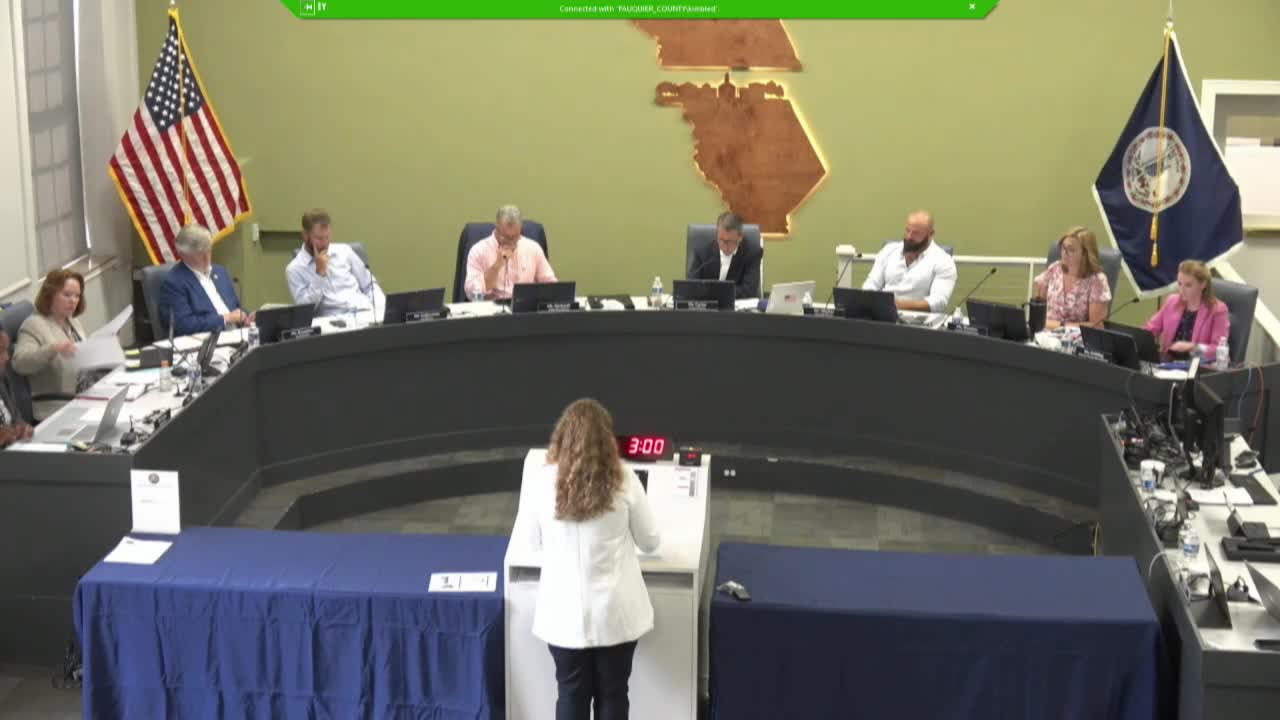
Fauquier supervisors hear safety, land-use concerns over proposed 100 MW Remington battery storage project
Loading...
Summary
Dominion Energy seeks a special exception and siting agreement to build a 100-megawatt battery energy storage system at its Remington power station; supervisors and staff pressed the company on fire risk, water contamination and visual impacts.
Dominion Energy this week asked the Fauquier County Board of Supervisors to approve a siting agreement and amend an earlier special exception to allow a 100-megawatt battery energy storage system at its Remington power station.
The application seeks authority to place batteries and related infrastructure on about 72 acres of the roughly 225.5-acre site off Lucky Hill Road, expanding the previously approved development area from 60 acres. The company proposes about 174 individual battery enclosures, each roughly 20 by 8 by 9.5 feet, plus access roads, screening, stormwater controls and an interconnection substation.
County staff told the board the Planning Commission unanimously recommended conditions including limiting the site to 72 acres, incorporating prior conditions from the 1998 approval, requiring compliance with county standards for battery systems, capping enclosure height at 10 feet, a 25-foot setback from wetlands and floodplains, landscaping and screening, pre‑ and post‑construction road evaluations and maintaining emergency access.
“The proposal for a 100 megawatt battery energy storage system includes a 174 individual battery enclosures … with top-mounted HVAC equipment,” county planning staff said during the meeting.
Why it matters: Board members and at least one public commenter raised safety and environmental questions after hearing that similar facilities have experienced thermal-runaway fires in other states. The project is immediately adjacent to existing electrical infrastructure and planned development, and staff estimates the applicant projects roughly $9 million in revenue over 20 years, an estimate the county’s commissioner of revenue has not verified.
Board discussion focused on fire risk, potential water and soil contamination from firefighting runoff, visual impacts in the rural land use designation and timing for state and federal permits. Supervisor Broadus asked whether the board could delay a vote to investigate a reported battery facility fire in Monterey County, California; Dominion’s representatives said they were aware of some incidents and had brought a fire-safety expert to answer technical questions.
Ron Hart, representing the applicant, and Dominion’s fire-safety consultant told the board that emissions from a battery fire are primarily hydrogen, hydrocarbons and carbon monoxide, and that the most significant consequences are local to the site. Dominion’s consultant said, “We’re not looking at heavy metals, being burned. It’s just a class C type, electrical fire,” and added that thermal runaway events are difficult to suppress because the cell’s chemical reaction continues to expel gases.
The consultant said Dominion operates two battery sites in Virginia with no fires reported and that Dominion provides training for local first responders, including HAZMAT teams and EMS. He said thermal-runaway incidents documented in industry studies are rare — roughly two to three events worldwide per year — and that setback distances, screening and response training reduce risk to neighbors.
The applicant proposed several voluntary measures in the draft siting agreement, including a $500,000 voluntary payment to be split between the start of construction and commercial operation and a commitment to reimburse expenses incurred by fire and rescue in the event of a facility fire. County staff noted the economic-impact estimate includes real estate and other taxes but has not been verified by the commissioner of revenue.
Public comment: County staff reported receipt of a letter from Clean Fairfax County (CFFC) raising concerns about fire safety and potential water contamination. Several supervisors asked for more information and the opportunity to consider additional precautions before taking final action.
Next steps: The resolution before the board would authorize execution of the siting agreement and approve the special exception. The zoning ordinance requires the use be established or diligently pursued within one year of approval; the applicant has requested two years to accommodate permitting. The board left the matter open for further questions and indicated it may be considered at the regular evening meeting with more public input and applicant responses.
Ending: County staff and the applicant said there will be further opportunities during the evening public hearing and at subsequent meetings for residents and the board to question technical details, revise conditions and consider any additional mitigation measures.