
Alabama Department of Education posts comprehensive instructional‑support plans; universities present new specialist programs
Get AI-powered insights, summaries, and transcripts
Subscribe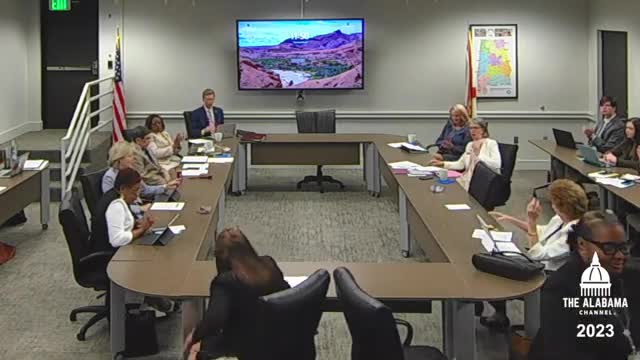
Summary
Department leaders unveiled a live set of comprehensive plans for literacy, numeracy and school improvement, described how supports will be delivered to low‑performing schools, and hosted presentations from the University of Alabama and UAB proposing new graduate certification programs (math specialist and school psychology).
The Alabama State Department of Education presented a new online, consolidated set of comprehensive plans for instructional supports — including literacy (ARI), numeracy (OMI), school improvement (OSI), and related coaching and technology supports — and described how those programs will coordinate work in low‑performing schools. University of Alabama faculty presented a National Science Foundation–funded math teacher‑leader/specialist program (designed to become an online credential after the grant period), and the University of Alabama at Birmingham proposed a 30‑hour online school‑psychology certification program for state approval.
Department staff described a single “master” document on the department website that links each office’s comprehensive plan, giving a consistent “elevator” explanation plus deeper resources for practitioners. Staff said the plans are intended to create consistent language across coaching, professional learning, and school audits so schools and districts receive aligned supports rather than duplicative, mixed messages. The department made live copies of the comprehensive plans available during the meeting and said it would circulate the document to board members and post it publicly.
Highlights and numbers the department cited in the briefing:
- ESSA/CSI: The department said it currently identifies roughly 50 schools under federal Comprehensive Support and Improvement (CSI) criteria (lowest performing schools by a weighted set of indicators) and reported summary metrics showing many schools had improved since earlier identifications. - Literacy: Under the state Literacy Act, the department identified about 40 full‑support schools (plus one feeder pattern) that receive targeted reading supports and an $80,000 allocation to fund an onsite reading specialist if districts meet the law’s job‑description commitments. - Numeracy: The department said the Numeracy Act identifies 19 “full‑support” schools and 64 “limited‑support” schools (83 total) and that the office has procured building‑based math coaches to be placed this fall and trained this summer.
Staff also described operational changes: regional coordinators and state coaches will be LETRS‑trained for literacy coaching and the department is assembling video exemplars, short professional modules and a searchable resource library (including the existing Atlas resource of classroom videos and a newly approved contract to create instructional videos) to let teachers and substitutes access brief, on‑demand examples of instruction aligned to state standards. The department said coaching and audit calendars are tracked centrally and that staff can report how many support events were delivered to targeted schools and the domains addressed.
University presentations: The University of Alabama team described an NSF‑funded project that supported an in‑person math teacher‑leader program (a 30‑hour graduate/EDS‑style certification) with cohorts of teachers and local partnerships; the university asked the board to approve an innovative math specialist credential that could transition to an online offering after the grant ends. Jeremy Zikowski and colleagues said the grant supported multi‑year work with participating teachers (20–22 teachers from about nine districts) and that the program aims to prepare teacher leaders who can coach and lead math instruction in districts. The team said capacity could expand and that, after the grant, the program would be offered online to reach rural parts of Alabama and neighboring states; they estimated a cohort could be about 40 teachers every other year, with capacity expandable if demand grew.
UAB presentation: Tashar Walker presented a 30‑hour online school psychology program proposal; UAB said it has an existing online school‑psychology enrollment in regional students and proposed to begin enrollment as soon as state approval is granted, and that the program would likely start fall intake contingent on board approval and faculty hiring (UAB said it would need at least two faculty to run the program initially).
Board members asked about implementation details and monitoring. Department leaders said they track school visits and support events weekly for turnaround staff; they described a data dive and progress‑monitoring approach that uses benchmark assessment results given three times a year plus additional monitoring reports and the ACAP timeline for summative results. In response to board questions, staff said school improvement teams visit schools weekly (for full‑support turnaround work) and that supports are jointly provided by OSI, ARI, OMI and partner organizations so districts get aligned supports rather than fragmented one‑off visits.
Several board members asked the department to publish a concise “one‑page” summary for legislators and the public that explains the plans in plain language while preserving links to the more detailed, hyperlinked documents for practitioners. Department staff said they will publish that elevator summary and circulate the comprehensive plans to board members and stakeholders; they also agreed to return in August with more granular metrics and updates to the rollout (coaches in place, program enrollments, and early results from summer work).