Get Full Government Meeting Transcripts, Videos, & Alerts Forever!
Get email alerts on the Land Use Temporary Use Permit topic
No spam. Unsubscribe anytime.
Resident proposes 'stay-and-build' temporary-use permit to allow homeowners to live on lot while new house is built
Summary
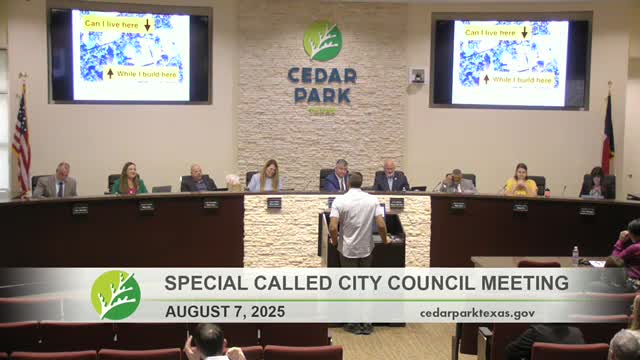
At a Cedar Park City Council meeting, resident Michael Enders urged council to consider a temporary-use permit that would let homeowners remain on their property while a replacement house is constructed, citing moving costs, school continuity and construction oversight as benefits.
A Cedar Park resident on Aug. — during the council's public communications period proposed a new temporary-use permit that would allow homeowners to remain in an existing dwelling on a lot while a new home is built.
The permit, which Michael Enders described as a "stay-and-build" temporary-use permit, would allow occupants to live in the existing house during construction and, after the new house receives a certificate of occupancy, require the owner to remove or demolish the old structure within 90 days, Enders said. He said the change would reduce relocation and rental costs and allow families to keep children in the same school.
Enders, who identified himself as a Cedar Park resident, told council that moving and rental costs related to building on the same lot had in his case run "north of $90,000, probably approaching $100,000" and argued those costs make in-place rebuilding financially prohibitive for some homeowners. "Being able to live on the same lot would be of great benefit," he said.
Council members asked clarifying questions about scope and enforceability. One council member asked whether the proposal would apply citywide or only to older neighborhoods; Enders said he intended a citywide ordinance with staff to work through local nuances. Another council member asked how the city would prevent indefinite construction timelines; Enders suggested performance bonds or a construction timeline requirement to ensure projects finish in a reasonable time.
Council members also asked practical questions about lot size and the type of temporary structure contemplated. Enders said the permit was meant to cover permanent in-ground new construction adjacent to an existing dwelling — not temporary manufactured homes — and acknowledged it would not be feasible on very small lots. He proposed 90 days after occupancy for removal or demolition of the original structure; he also said alternatives could include towing away a manufactured home if applicable.
Council did not take immediate formal action on the proposal. One council member asked staff to place the topic on a fall workshop agenda for further discussion, and a separate council member volunteered to follow up with Enders and staff on details.
The public-comment proposal drew follow-up discussion among council members about whether the policy should be an individual lot-specific variance or a citywide ordinance and about potential next steps for staff to draft ordinance language and address enforcement, safety, and siting requirements.
Ending: Council did not vote on the proposal at the meeting; members directed staff to consider adding the item to a fall workshop for further study and drafting.