Get Full Government Meeting Transcripts, Videos, & Alerts Forever!
Get email alerts on the Planning And Development topic
No spam. Unsubscribe anytime.
Lakeville Planning Board urges hiring of full-time planner to handle rising workload
Summary
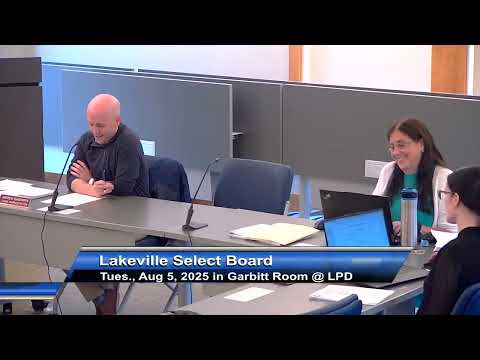
Planning Board members told the Select Board they need an in-house, full-time planner to monitor subdivisions, maintain subsidized-housing inventory and run master-plan implementation; Select Board and town staff discussed a near-term part-time/seasoned hire while preserving a posted full-time role.
Lede Members of Lakeville's Planning Board told the Select Board on Aug. 5 they are receiving a sustained surge of applications and administrative work that a single part-time or volunteer staffer cannot manage, and urged the town to fund a full-time planner to monitor subdivisions, oversee the housing trust fund and maintain the subsidized housing inventory.
Nut graf Planning board members said recent growth, the arrival of accessory dwelling unit (ADU) applications and multiple pending site plans require an in-house professional with the training and continuity to track approvals, manage peer review and pursue grants. Town officials acknowledged recruitment challenges and agreed to post a flexible part-time option (15-24 hours) while keeping the full-time planner posting active.
Body Michelle McEachern (remote planning board chair) and Planning Board member Dan Wilga described a heavier, more complex workload at the planning office than in prior years: ongoing subdivision monitoring (citing Bella Way), the need to protect the town's subsidized-housing inventory (SHI) units that will expire over the next decade, formation and administration of a housing trust fund, and master-plan implementation items that historically fall to a professional planner.
Wilga and other planning members said having an in-house planner also reduces the town's reliance on consultants and helps the town secure grants and manage state-mandated processes. Board members warned that without a planner, delays and frustration for applicants and residents will grow and that the town should not merely rely on ad hoc committee work.
Town Administrator Andrew and HR staff described recent outreach and recruitment: a full-time planner posting has been open since March 24 with few qualified applicants. Andrew characterized the local market as 'thin' for the mid-career professionals the town prefers: many applicants are either very junior or highly senior and demand higher pay. He proposed a pragmatic near-term approach: advertise a seasoned part-time planner (up to 24 hours) while keeping the full-time posting and considering a tiered solution (a part-time experienced planner plus a junior, full-time Planner I) if budget permits.
Board members and staff discussed benefits and trade-offs. Planning members stressed that monitoring subdivisions is time-consuming administrative work that could be billable to developers for peer review, but not for routine office time; they asked for clearer rules and a predictable legal/funding approach. The Select Board directed staff to adjust the part-time posting to allow up to 24 hours per week to increase competitiveness, and to return with an updated recruitment plan.
Ending Select Board members and staff agreed to circulate a revised job posting (15-24 hours) to test the market and to continue pursuing a long-term, full-time planning solution if recruitment and budget allow.