Get Full Government Meeting Transcripts, Videos, & Alerts Forever!
Get email alerts on the Grassland Maintenance topic
No spam. Unsubscribe anytime.
Toledo reduces mowing cycles and faces resident complaints about contractor quality and debris
Summary
City staff said the neighborhood mowing program was cut in 2025 and contractors now perform fewer scheduled cuts; residents told council the change and quality control problems have left sidewalks, parkways and demolition lots unsafe or messy.
TOLEDO, Ohio — City staff and residents discussed grassland maintenance at the Aug. 7 joint committee meeting, where the Department of Public Service described a reduced mowing schedule for 2025 and residents reported uneven contractor performance and debris left after demolition.
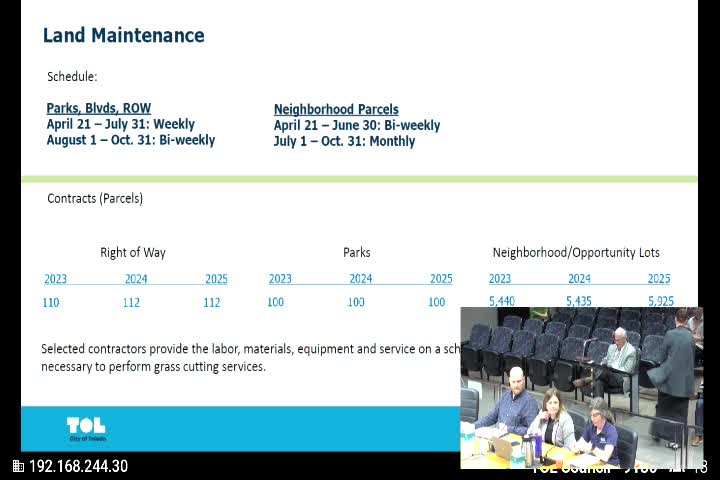
Sarah Stacy, urban beautification commissioner, told the committees the mowing season runs April 15 through Oct. 31 and described this year’s schedule: “For 2025, the neighborhood cyclical program had a general fund operating budget for nine cuts. This was approximately a 50% reduction from 2024, where 18 cuts were scheduled,” Stacy said. She added that parks, boulevards and right‑of‑ways were cut 20 times this year, and beginning in August the department moved many properties from weekly to biweekly cuts as growth slowed.
Stacy said the city contracts out about 100 right‑of‑way parcels, 100 parks and almost 6,000 neighborhood parcels; contractors bid on packages and are paid based on square footage invoiced through work orders. Nuisance properties are cut on a complaint basis and, by standard operating procedure, a property is added to the cyclical program after the city performs a third cut.
Residents told the committees that contracted work is inconsistent. Leslie Eve and other neighbors said contractors sometimes refuse to cut entry islands, fail to weed curbs, do incomplete work and do not display identifying markings on vehicles. Eve asked whether contractors must submit before‑and‑after photos to verify work; staff said contractors are required to submit photos and the city has quality control specialists who spot‑check jobs before payment.
Bianca Lanting and other speakers described sidewalk hazards and debris on former demolition sites that can dull blades and create safety issues. Councilwoman Williams and residents said contractors sometimes leave clippings and straw after cutting, which can complicate subsequent mowing and create slippery surfaces. “We have had contractors that… we have had to remove properties from their contract when they did not have the capacity to complete them,” staff said.
Staff acknowledged gaps and outlined improvements under consideration: more on‑site contractor training to show expected before/after standards, additional spot checks by quality control staff (QCs), and better resident reporting through the department’s forthcoming “Track My Truck” application. Stacy said the city is also working with the land bank and trying slow‑growth seed for some demo lots to reduce mowing frequency.
Council and residents also discussed payment and oversight: Stacy said invoices are tied to square footage from bid packages and that QCs oversee performance and verify invoices. Residents pressed for more public transparency and easier ways to report missed or substandard mowing; staff asked residents to continue reporting problems through Engage Toledo and said contractors and QCs would be asked to tighten quality control.
No formal votes were taken. Staff said they would follow up with council on contractor performance reviews, the Track My Truck rollout and specific complaint addresses provided by residents.