Get Full Government Meeting Transcripts, Videos, & Alerts Forever!
Get email alerts on the Trash And Blight topic
No spam. Unsubscribe anytime.
Toledo residents and council press Republic Services, city on rising bulk pickups and blight
Summary
City staff, Republic Services and residents discussed a rise in noncompliant bulk set‑outs, delays in pickup and neighborhood blight at an Aug. 7 joint committee meeting. Residents urged faster cleanups and the city outlined new reporting tools and processes.
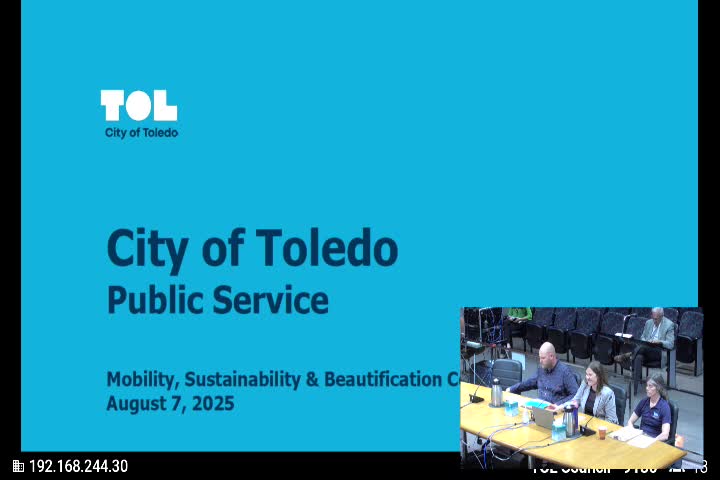
TOLEDO, Ohio — At a joint meeting of the Toledo City Council’s Mobility, Sustainability and Beautification Committee and the Housing and Community Development Committee on Aug. 7, city staff, Republic Services representatives and residents said noncompliant bulk set‑outs and property blight are increasing and creating public‑health and quality‑of‑life concerns.
Megan Robson, director of the Department of Public Service, told the committees the department operates three divisions — fleet and facility operations, the Division of Solid Waste (which oversees the Hoffman Road landfill) and Urban Beautification, which manages demolition, blight cleanup, alley maintenance, land mowing and forestry. “We typically run two to three blight crews per day focusing on collecting all of those noncompliant bulk set outs and property cleanups,” Robson said, and described the city’s workflow: Republic Services flags noncompliant bulk pick‑ups, the city logs requests in CityWorks, crews take before‑and‑after photos and staff create on‑site work orders for unreported problems.
Residents and council members said the system is not keeping up. Councilwoman Williams said she tracks bulk pickups in her district and reported a sharp rise in calls this spring: “In March, I had 594 pickups… in April, it was 604, and then in May, it was 692,” she said, adding that about 160 piles were repeat instances. Williams also said at least one resident, identified by Williams as Doug Johnson, was charged a nuisance assessment after a contested noncompliant determination.
Republic Services municipal sales manager Rochelle Bowen said the company attended to answer questions; Anujit Barwa, Republic’s general manager, called the situation “a bit of a challenging time for us” and offered to respond to specific operational questions. City and Republic staff said some bulk items are left because of safety or access problems — narrow streets, two‑sided parking, or items that are deemed unsafe to pick up — and that those cases can be turned over to city crews for removal.
East Toledo community builder Gary Lenhart told council he has tracked piles for years and provided the committee with his counts: “Presently, as of today, there are 1,331 total properties in East Toledo that I’m tracking. There are 1,002 open issues,” he said, and offered a printed packet of addresses and complaints for council and staff.
Residents described trash that attracts rodents, blocks sidewalks and creates hazards near schools. Leslie Eve and other speakers said they repeatedly clear alleys and islands themselves because municipal response is slow. Manuel, a resident who spoke, asked which agency residents should contact about rodent abatement; city staff said the Lucas County Health Department handles rodent control and the city coordinates abatement around demolition sites.
City staff described next steps. Robson and staff said the city’s blight teams follow a set timetable (the city’s crews work two days behind Republic’s garbage route and one day behind its bulk route), and they collect photographic evidence attached to CityWorks work orders. Public Service staff also said they are testing a resident application called “Track My Truck” that will allow residents to report set‑outs, request can exchanges and monitor status online; staff said they would follow up with council on whether district offices could view submitted requests.
Speakers offered operational suggestions. Gary Lenhart proposed the city operate its own regular neighborhood cleanups rather than rely on the contractor for all bulk pickups and suggested scheduling changes such as 10‑hour shifts to increase daily productivity. Several residents asked for better quality control of contracted mowing and bulk cleanup work and said contractors should provide before/after photos and visible vehicle identification.
The committees scheduled follow‑up work: staff will continue testing the resident reporting application, coordinate with the health department on rodent abatement around demolitions, and track specific repeat piles flagged in resident submissions. No formal action or vote was taken on the topic at the meeting.
The meeting’s public comment packet and residents’ printouts were submitted to the committees for review and follow up.