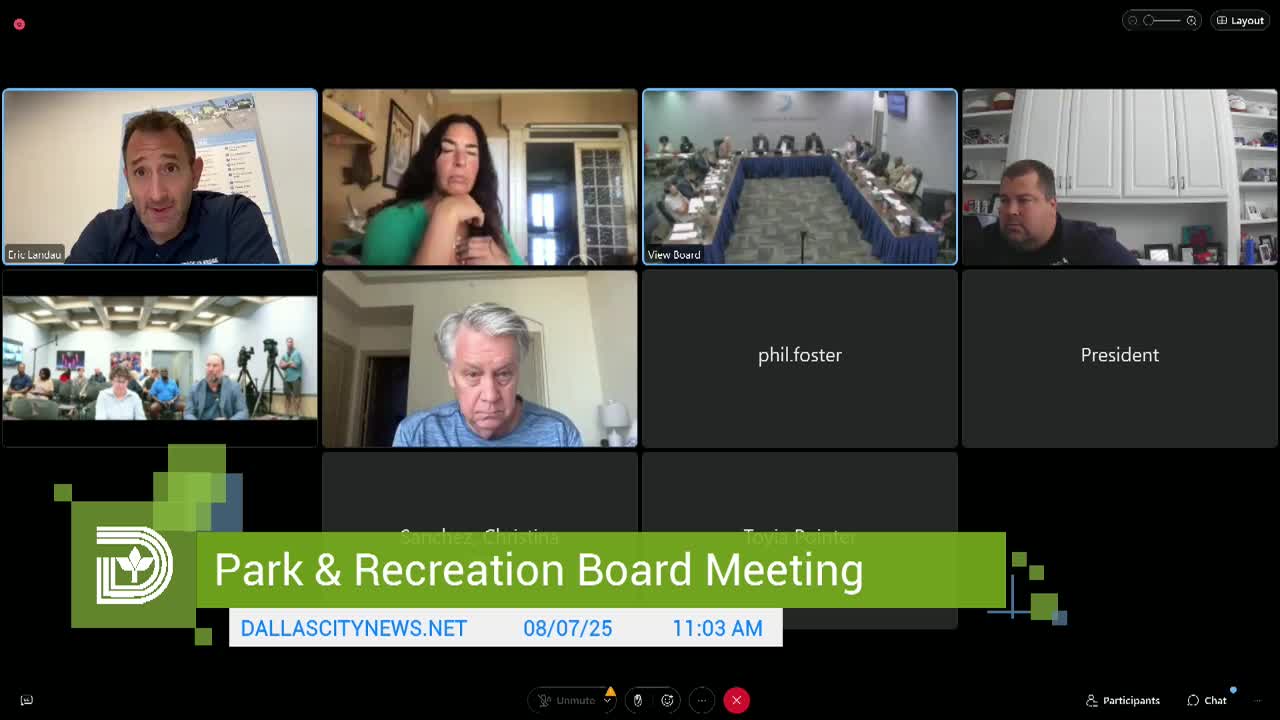
Guest speaker Eric Landau outlines Brooklyn Bridge Park’s public‑private financing model as Dallas considers new revenue options
Loading...
Summary
A visiting park manager presented Brooklyn Bridge Park’s model — private development on a small percentage of parkland underwriting operations for the majority of acreage — as Dallas staff said they will explore similar revenue strategies to sustain city parks.
City park staff briefed the Park and Recreation Board on options to strengthen parks’ long‑term finances and invited Eric Landau, president of Brooklyn Bridge Park Corporation, to describe his park’s funding model.
Staff framed the session as the first in a series of briefings aimed at identifying nontraditional revenue streams to offset flat general‑fund allocations and rising maintenance costs. Superintendent Robin (introduced at the meeting) told the board the department faces flatter budgets while operating costs tied to population growth and increased park use continue to rise.
Eric Landau described Brooklyn Bridge Park’s approach: the 85‑acre park is roughly 90% parkland and 10% private development, and lease/rental and PILOT payments from those private uses generate the bulk of the park’s operating revenue. Landau said, “Our annual operating budget was about $15,000,000. And our revenue was about $30,000,000,” a structure that allows the park to fund operations and set aside money for capital restoration and maritime expenses. He also described construction costs (about $400 million to build the park) and the city’s capital contributions and gifts that funded initial development.
Landau cautioned that concessions and event income alone are not enough; concessions provide park amenities and typically produce modest revenue, while the larger share of Brooklyn Bridge Park’s operating revenue comes from long‑term leases and payments from limited private development inside the park footprint.
Board members asked about parkland protection and the legal concept of parkland alienation. Landau and staff emphasized that Brooklyn Bridge Park was developed on former industrial piers that were not parkland before redevelopment; multiple board members stressed Dallas would not be endorsing permanent housing on existing parkland and urged caution on any approach that would convert current parkland to private use.
Staff said they will follow with further briefings on possible revenue strategies, including concessions, advertising, concessions and governance models, and examine how any model would interact with Dallas priorities and existing master plans.
Ending: The board directed staff to continue the series and return with concrete options and budget estimates for discussion at future meetings.