Get Full Government Meeting Transcripts, Videos, & Alerts Forever!
Get email alerts on the Public Safety Digital Forensics topic
No spam. Unsubscribe anytime.
Clermont County officials discuss JAG grant for digital forensics equipment; board pauses on signature
Summary
Ken Mullis, representing the coroner and prosecutor, asked the Board of Commissioners to sign pre-award conditions for a $147,731.30 JAG grant to buy digital-forensics equipment. Commissioners raised questions about costs, staffing, legal authority for device extraction and facility needs and did not approve a signature at the meeting.
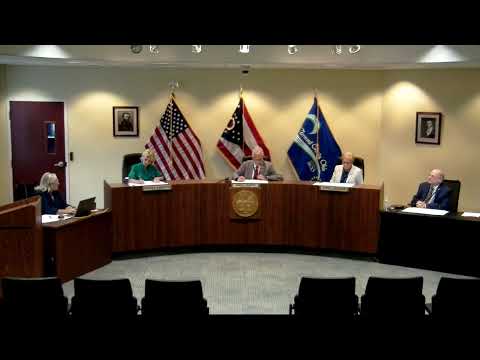
Ken Mullis, representing the Clermont County coroner's office and the county prosecutor, asked the Board of County Commissioners on Aug. 20 to sign pre-award conditions for a state JAG grant to buy digital-forensics equipment and software.
The grant, from the Ohio Office of Criminal Justice Services, is for $147,731.30 and "will basically buy every piece of digital forensics equipment we need, software, forensic computers," Mullis said. He told the board the equipment would support homicide investigations and Internet Crimes Against Children cases.
Mullis said the award was created after an earlier application was denied and that officials had "appealed that" and the state crafted a grant specifically for Clermont County. He asked the commissioners to acknowledge that the county met pre-award conditions so the state could issue the award; he planned to return to a later meeting for formal acceptance.
Why it matters: Mullis said the grant would let Clermont County build a local digital forensics capability that could lower violent-crime and Internet-crime metrics locally and for neighboring agencies. The county would also seek additional federal and state funding, including a community-projects allocation from Rep. Dave Taylor that Mullis said could add more than $400,000 and, together with other grants and asset forfeitures, could cover equipment and operating costs.
Board questions and cost details
Commissioners asked about timing, staffing and long-term costs. Mullis said the current grant runs through June 30 (the state-crafted award has an expiring performance period) and noted the grant now covers equipment but not all personnel costs. He said the office is targeting three forensic positions with starting salary estimates of about $80,000 per criminalist; with fringe benefits the three positions could raise the county cost to a high-ball figure of roughly $325,000, a figure Mullis described as a worst-case scenario if other funding sources do not materialize.
Mullis said two of the three targeted hires could be civilian employees (permitted by statute) and two reportedly did not require county-provided insurance because of spouses, which would reduce PERS and benefit costs. He said the hires could be staggered so the county's payroll exposure would begin with one position and expand over time.
On equipment and maintenance he said annual update costs vary and can be covered by targeted grants (for example, grants for Internet Crimes Against Children task forces). He also said once equipment is in place, the county could temporarily borrow equipment from partner agencies under memoranda of understanding while orders are fulfilled.
Legal and policy concerns
Commissioners raised legal and policy questions about device access and facility needs. Painter and Corcoran said the board needed more information before agreeing to any proposed rental of a large facility; Mullis acknowledged earlier plans had included renting a 16,000-square-foot facility in Union Township and said the board "would not be amenable to that." Mullis told the board the $147,731 figure would not buy some higher-end packages; he said that certain capabilities (unlocking iPhones) are provided by products such as GrayKey and Oxygen Forensics, and that any bypass of device security would occur only with "legal processes available" to investigators.
Mullis said the intended service would be free to Clermont County agencies and regional partners; he contrasted that with the Ohio Forensic Lab, which he said is limited by a "drug nexus" policy and will not perform all types of criminal forensic extractions under its grant-funded scope.
Next steps
Board members said they wanted more time to review the pre-award paperwork. The application packet had been received by the commissioners on Aug. 19, and Commissioner Corcoran said she wanted additional discussion because the grant package had only "just been dropped off." The transcript records no vote of approval or signature by the board on Aug. 20; Mullis said he would return to a later meeting for official acceptance after the pre-award conditions were acknowledged.
Participants and attribution
All direct quotations and attributions in this report come from speakers recorded in the Aug. 20 meeting transcript: Ken Mullis (representing the prosecutor's office and coroner's office), Commissioner David L. Painter (board president), Commissioner Corcoran, Commissioner Bachelor, and County Administrator Thomas J. Igel.
What remains open: the board asked for a fuller briefing on long-term staffing costs, facility needs, and legal authority governing device extractions before signing pre-award conditions; Mullis indicated he is seeking additional federal funding and intends to stagger hires and apply for recurring grants to reduce county operating exposure.