Get Full Government Meeting Transcripts, Videos, & Alerts Forever!
Get email alerts on the Public Safety Ems Funding topic
No spam. Unsubscribe anytime.
Brigham City tables proposal to impose availability charge for fire, ambulance services
Summary
City staff detailed rising costs, call volume and proposed availability charges for nonresident areas served by Brigham City Fire and EMS and asked the council to table a resolution while staff pursues reciprocal agreements and further outreach; council voted to table the item.
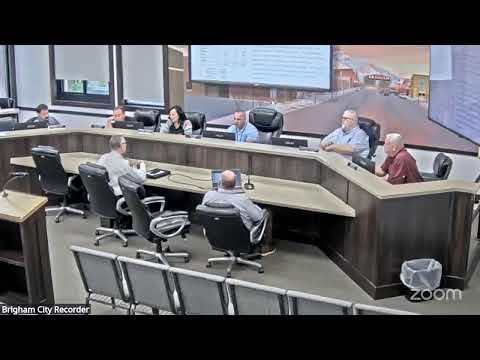
Brigham City on Sept. 18 tabled consideration of a resolution that would establish an availability charge (a cost-recovery measure) for fire and ambulance services provided outside the city’s corporate limits, following an extended staff presentation and questions from council members.
City staff said Brigham City’s emergency response system is covering a large geographic area and that rising personnel, equipment and facility costs have created a multi‑million‑dollar shortfall that is currently subsidized by Brigham City taxpayers. Staff recommended tabling the item so they can present the proposal publicly to neighboring jurisdictions and seek reciprocal agreements for mutual-aid billing.
Tom Euler, city administrator, and Brigham City Fire leadership outlined recent data and the staff proposal. Euler said the city responded to 2,706 incidents in the last fiscal year and that 74% of responses occurred inside Brigham City. Staff estimated an unrecovered subsidy of about $3,200,000 for fire and EMS services and added $600,000 in facility‑related cost allocation to illustrate full costs used in their calculations. “If we assign 74% of that subsidy to Brigham City, it leaves about $800,000,” Euler said as staff walked the council through the arithmetic and allocation method.
Fire Chief Lewis (first name not given in the meeting record) said Brigham City holds the licensure for a large ambulance coverage area and that the city’s ambulance responds well beyond the municipal boundaries, including unincorporated Box Elder County and distant sites such as Promontory Point. Chief Lewis said the city has moved to an all‑full‑time department in recent years and faces higher personnel and equipment costs, noting that a replacement ambulance this spring cost roughly $400,000.
Staff described the proposed methodology for allocating costs to outside jurisdictions: a model combining call volume, population and taxable property value to determine each entity’s proportionate share, consistent with a countywide consolidation feasibility study that Box Elder County previously commissioned. Euler said the city has been meeting with neighboring entities for more than two years and that Perry City has already reached a long‑term agreement with Brigham City.
Officials also discussed mutual aid and automatic aid distinctions. City staff explained that automatic aid triggers responses by multiple departments simultaneously through dispatch agreements, while mutual aid is requested and can be declined. Staff said some historic agreements are outdated and are being rewritten to reflect current operational needs.
The council and staff discussed legal and billing constraints. Staff noted state legislation governs ambulance billing rates and that the legislature recently enacted changes intended to standardize rates for governmental and private providers; staff identified House Bill 301 (as cited in the meeting) and related statutory provisions governing ambulance billing and mileage limits. Staff said those rates cap what municipal EMS providers can bill, and that insurance reimbursement remains a separate variable beyond the city’s control.
City administrators said staff plans to ask neighboring jurisdictions such as Willard and Corinne to adopt reciprocal availability‑charge resolutions so that when mutual aid is exchanged, the jurisdictions would bill one another rather than leaving costs to Brigham City taxpayers. Euler asked the council to table the matter to allow staff time to present the proposal at neighboring municipal meetings and coordinate timing for any reciprocal implementations.
Council member Hipp moved to table the action; Council member Jensen seconded. The council voted in favor and the motion to table passed.
Staff said Brigham City will continue to provide medical coverage under its existing license and contracts for the next two years while pursuing negotiated agreements. Officials said if long‑term contracts are not reached, state code would require the affected governmental entities to provide medical coverage (including going through a formal procurement process), at which point Brigham City would follow council direction about whether to submit a bid to continue providing the service.
The meeting moved on after the tabling vote and later entered a closed session under the Utah Open and Public Meetings Act for items unrelated to the tabling decision.