Get Full Government Meeting Transcripts, Videos, & Alerts Forever!
Get email alerts on the County Budget topic
No spam. Unsubscribe anytime.
Gratiot County officials warn wind- and solar-related tax valuations could flatten revenues; public hearing set for Sept. 16
Summary
Interim controller and county officials told commissioners that rising personal-property depreciation tied to wind and solar projects will likely keep operating revenue flat next year; administrators recommended conservative assumptions, a $1 million MERS contribution and a Sept. 16, 2025 public hearing on the 2025-26 budget.
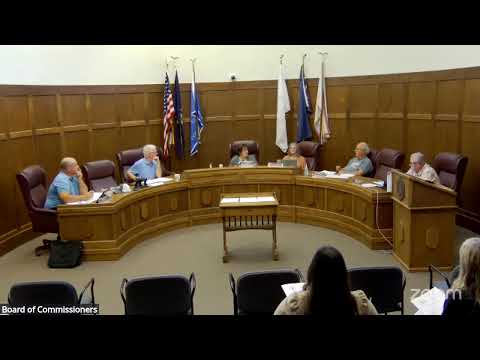
Gratiot County finance staff on Tuesday told the Board of Commissioners that the county’s reliance on industrial personal property tied to wind and solar projects is making long-term revenue forecasts uncertain and could hold operating revenue roughly flat for fiscal 2025–26.
Marianne Kornicksel, interim controller with the Woodhill Group, and Keegan, the county’s equalization director, briefed the board on a multi-page budget presentation and on how personal property associated with energy projects affects taxable value. Marianne Kornicksel said staff will present a draft of the 2025–26 budget on Sept. 2 and the full proposed document on Sept. 11 ahead of a public hearing scheduled for Sept. 16, 2025.
The presentation showed industrial personal property and utility values linked to wind and solar now make up a significant share of Gratiot County’s tax base. Keegan told the board that industrial personal property accounts for roughly $524 million of $739 million in personal-property value on one sheet of the county’s packet, and that industrial personal and utility values have produced “a significant” share of county taxable value in recent years.
Why it matters: property tax revenue funds most county services; staff said roughly two‑thirds of general‑fund spending is for wages and benefits. County officials warned that because wind and solar assets follow prescribed depreciation schedules, personal property valuation can fall over time unless new projects are added, producing years with net declines in taxable value even after new construction.
Key details from the briefing: Kornicksel described process and formatting changes to the budget book and said staff consolidated about 14 small funds into the general fund to simplify reporting. Keegan reviewed how agreements for solar projects work in Michigan and described typical PILT-style payments the county and townships receive: by Michigan practice explained to the board, an energy company payment is commonly calculated at $7,000 per megawatt plus an additional $3,500 per megawatt that is designated for townships’ community development. Keegan used an example: a Pine River Township 80‑megawatt solar farm would generate about $560,000 per year, with the county’s share at about 23.31% under current millage allocations.
Staff showed a scenario assuming 4% growth in real property taxable value and a 4.8% decline in personal property taxable value in the coming year; under those assumptions, operating revenue would be essentially flat. Kornicksel said that the county is planning a conservative budget that assumes no property‑tax revenue gain from property growth and that any upside would be a bonus.
Recommendations and options discussed: Kornicksel and Ryan Wood, county administrator, suggested the board consider several fiscal measures over time: maintaining a healthy fund balance, resisting large new ongoing expenditures that rely on uncertain personal‑property cash flows, and evaluating special‑millage levies. Kornicksel recommended transferring $1 million from the OPEB (other post‑employment benefits) fund to the county’s MERS pension plan, arguing that market returns and MERS’s investment structure would likely produce higher actuarial benefit for the county and help raise the pension funding level (the most recent valuation presented showed the defined‑benefit pension plan at about 87% funded). The board was told the OPEB unfunded liability is small ($23,344 in the last actuarial valuation) and the OPEB reserve could be used for a one‑time pension contribution.
Board members flagged risks: Commissioner Tim Gay and others noted the county’s experience in prior years when turbine valuations and changing depreciation schedules produced litigation and significant year‑to‑year revenue swings. Kornicksel and Keegan said the county is trying to avoid a repeat of what one speaker described as a “bait and switch” in earlier energy valuations, and urged cautious, multi‑year planning.
Budget timing and next steps: staff will provide commissioners with draft numbers on Sept. 2, the full budget document on Sept. 11 and hold the public hearing and budget adoption on Sept. 16, 2025. The board directed staff to proceed with the schedule laid out at Tuesday’s meeting.
Ending: Staff emphasized the county’s relatively healthy fund balances and recommended quarterly budget amendments going forward so elected officials can monitor variances with fewer year‑end adjustments. The board did not adopt a final 2025–26 budget at the meeting; a public hearing and final vote remain scheduled for Sept. 16, 2025.