Get Full Government Meeting Transcripts, Videos, & Alerts Forever!
Get email alerts on the Stewardship Districts topic
No spam. Unsubscribe anytime.
Clay County board signs off on feed-mill and Chateaune stewardship bills after split votes on letters of support
Summary
The board approved the statutory 'no-objection' resolution for the Feed Mill stewardship district unanimously, then split 3–2 on separate letters of support for the Feed Mill and Chateaune stewardship bills after residents and commissioners raised concerns about long timelines and developer control.
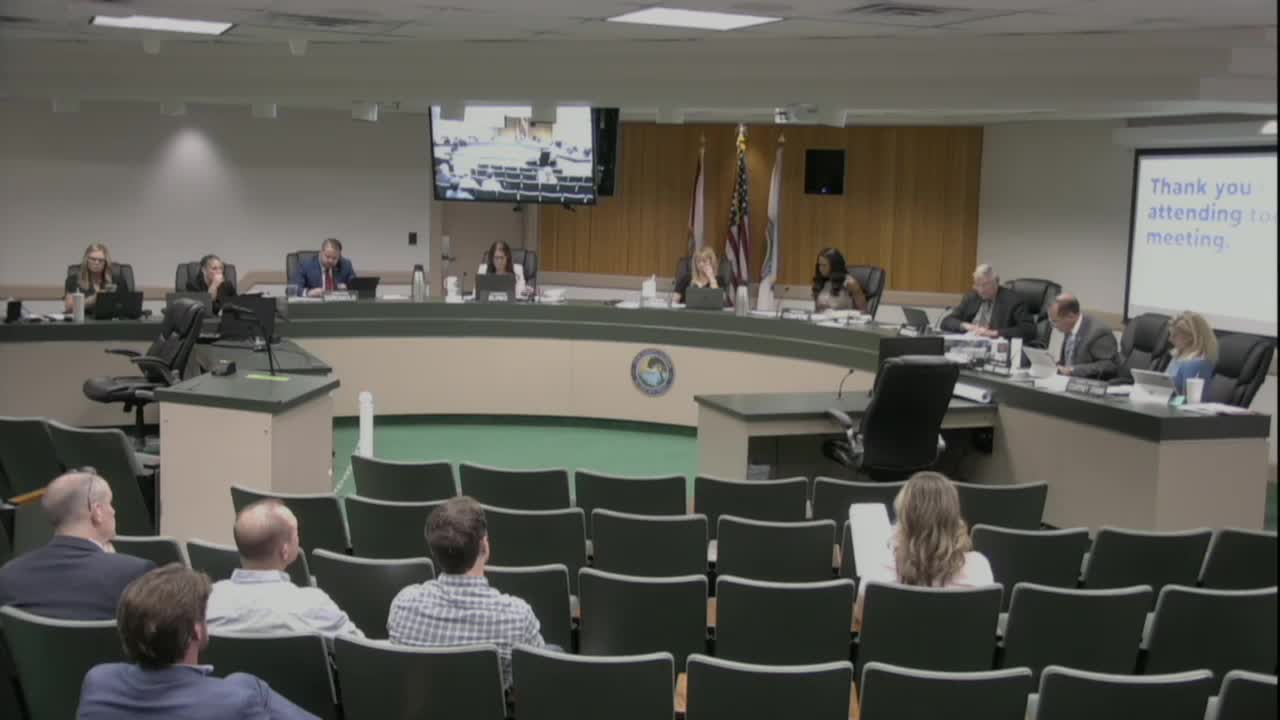
Clay County commissioners on Sept. 23 approved a statutory “no-objection” resolution for a proposed Feed Mill stewardship district and later voted to submit letters of support for two local stewardship bills — one for Feed Mill and one for a larger Chateaune (Chateaune/Chateaune) stewardship district — after several hours of discussion.
Commissioner Julie Burke, who represents the area where much of the planned development would take place, told the board the stewardship structure would allow a single governance body to maintain continuity and the long-term vision for infrastructure and amenities across a very large parcel of land. "These districts will be able to control and continue with that same vision that the county implemented many years ago through the Lake Asbury master plan," she said in remarks to the board, and she noted the landowner’s prior investments in Cathedral Oaks Parkway.
Some residents and commissioners expressed concern about the stewardship model because it preserves developer control for a longer period than a community development district (CDD) and can delay full home-owner control of the governing board for many years. Helena Cormier, who identified herself as a homeowner and realtor, asked the board to delay support until the county is confident that road connections, access and the definition of "landowner" in the local bill would not create unintended consequences for existing neighborhoods.
"What happens if somebody sells off some of this stuff or if it's someone different?" Cormier asked. "Those are the risks." She and other commenters urged the board to ensure there are clear interlocal agreements and protections for adjacent neighborhoods. Others — including the petitioners’ counsel and the applicants’ representatives — said the stewardship approach reduces duplication of administration, improves continuity for large master-planned communities and protects the county from long-term maintenance obligations.
Attorney Wes Haber, counsel for the petitioners, told commissioners the stewardship district mechanism is a financing and maintenance vehicle and does not change the local permitting process for roadways or other infrastructure. "The existence of those districts has no impact whatsoever on the approvals of roadways or other development within the boundaries," Haber said. He added that stewardship districts are intended to provide efficiencies and stable governance for very large developments.
The board approved the technical "resolution of no objection" for the Feed Mill bill unanimously (5–0), then voted 3–2 to forward letters of support for each local stewardship bill to the county’s legislative delegation. Commissioners who opposed the letters said they supported the required no-objection action under state procedure but did not want to provide an affirmative endorsement beyond the statutory step.
What the board decided and next steps
- Feed Mill stewardship district: statutory resolution of no objection — approved 5–0. Board later approved a written letter of support by a 3–2 vote and asked county legal and legislative liaisons to transmit the materials to the local delegation.
- Chateaune (Chateaune/Chateaune) stewardship district letter of support — approved by the board 3–2.
Staff and petitioners said they will continue to work with county planning, schools and the legislative delegation to clarify details in the local bills and to coordinate on infrastructure and mobility planning. The board asked the petitioners to provide ongoing updates and said staff should continue to involve the county’s school and transportation planners in early-stage discussions.
Provenance (evidence spans)
- Stewardship-district explanation by counsel and petitioners: evidence_excerpt: "The approval you are being asked to make is for the establishment of 2 separate stewardship districts... Those districts are a financing and operation and maintenance mechanism..." (transcript 13137.8–13149.245). reason_code:topicintro
- Public comment raising concerns on definitions and back access for Rolling Hills: evidence_excerpt: "When I saw the agenda... I was like, how did I miss that?... The back of our community is going into something that is not ours, and it's just it's complicated..." (transcript 12802.95–12842.355). reason_code:topicintro
Speakers (attributions used in article)
- Wes Haber — Counsel for stewardship district petitioners (first referenced 13137.8–13149.245) - Liam Riley — representative and planner for the petitioners (first referenced 15443.175–15461.24) - Commissioner Julie Burke — Clay County Commissioner (first referenced 861.75494–901.77 and throughout stewardship discussion) - Helena Cormier — resident and realtor (public commenter)
Clarifying details
- Stewardship districts vs. multiple CDDs: petitioners and counsel said stewardship structure reduces duplicative administration, preserves continuity and allows bond financing for phased infrastructure; opponents said it lengthens developer control and can delay full homeowner board turnover. - Votes: statutory "no objection" for Feed Mill passed 5–0; separate letters of support for Feed Mill and Chateaune passed by 3–2 each.
Community relevance
- Geographies: Lake Asbury master-planned area, Cathedral Oaks Parkway corridor, adjacent neighborhoods including Rolling Hills. - Impact groups: current and future residents, landowners, school planners and county infrastructure planners.
Meeting context
- Engagement level: multiple public speakers including neighborhood representatives and petitioners’ counsel; debate included policy-level questions about governance, developer control and long-term infrastructure responsibilities. - Implementation risk: medium; stewardships require state enabling legislation and interlocal agreements to address maintenance and roads.
Searchable tags: ["stewardship district","Feed Mill","Chateaune","Lake Asbury master plan","CDD","developer governance"]
Salience: overall 0.64 — important for the future shape of large master-planned areas and long-term infrastructure; debate reflects tradeoffs between developer-led continuity and homeowner control.