Get Full Government Meeting Transcripts, Videos, & Alerts Forever!
Get email alerts on the Stormwater topic
No spam. Unsubscribe anytime.
Hurst hears annual stormwater management report as new TPDES permit triggers extra reporting
Summary
City staff told the Hurst City Council on Sept. 23 that a new Texas Pollutant Discharge Elimination System (TPDES) general permit and a population reclassification mean the city must file two stormwater reports this year and expand several best-management practices.
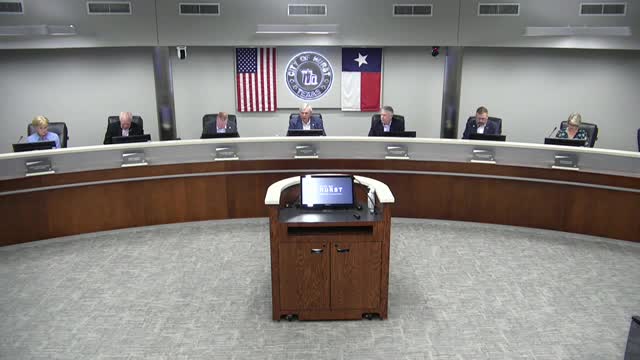
On Sept. 23, 2025, Hurst city staff presented the city council with the annual report on the city's stormwater management program, explaining new state permit requirements and the city's planned best-management practices to reduce runoff pollution.
The presentation, delivered by Dwayne (staff member presenting the stormwater report), centered on a newly issued TPDES general permit and the city's classification as a Level 3 municipal storm sewer system under state rules. Dwayne said the Texas Commission on Environmental Quality (TCEQ) issued the latest TPDES general permit in mid-August and that, because of the timing, Hurst must file two reports covering different permit standards this year.
Why it matters: the new permit sets the minimum program elements Hurst must report on and extends the city's permit term through 2029. Council members pressed staff on how long the first submittal would take and on which pollutants and activities staff will prioritize, including public education, illicit discharge detection, construction-site controls, post-construction inspections and pollution-prevention measures for municipal facilities.
Dwayne told the council the city submitted its Notice of Intent in February and that the new general permit was issued in mid-August. "It's all electronic," he said of the new submittal system, adding that the TCEQ's new process is "kind of prescripted. So it took them a while to get that up and running properly." He said the permit issued Aug. 18 will cover the city through Aug. 2029 and that Hurst will need to provide supporting documentation showing progress on specific best-management practices (BMPs).
Under the permit, Dwayne said, the program must address six minimum control measures. He described recent administrative changes that split public education/outreach and public involvement/participation into two separate measures and noted Hurst is adding volunteer water-quality monitoring (for example, participation in the Texas Stream Team) under public involvement. He also identified pollution sources of concern the city will target: PCBs (found in fish tissue), E. coli, nitrogen and phosphorus from urban runoff, oil residues from streets and parking areas, trash and construction-site sediment.
Dwayne said the city uses resources provided by the North Central Texas Council of Governments (NETCOG) for outreach materials and training, and that NETCOG participation counts toward the city's reported activities. He described other local implementation steps already underway or planned: inspection of construction erosion control, routine street sweeping, inlet maintenance, fleet fueling and wash-station containment, park litter pickup and development of municipal standard operating procedures.
Council members asked about workload and timing. A council member asked, "How long does that take you? I'm just curious." Dwayne answered, "over a couple of weeks, we get to..." and explained that compiling the report requires coordinating multiple departments but that the city will report progress annually.
Dwayne emphasized that, for 2025 only, the timing gap in permit issuance requires two submittals: one covering Jan. 1 through Aug. 17 under the old permit standard and a second covering Aug. 18 through Dec. 31 under the new standard. He said the initial submission will still require some paper documentation and that after 2026 annual electronic submissions will be due March 31.
Councilmembers and staff noted street sweeping and the service center's housekeeping as high-impact, ongoing actions. "A big benefit to keeping our stormwater clean is the street sweeping," Dwayne said. He also noted the city does not regularly encounter sanitary-sewer overflows and said the last major reportable overflow predated recent system rehabilitation.
The presentation closed with council acknowledgment of planned public outreach (including a planned volunteer cleanup event on Oct. 11) and with staff's commitment to continue developing and reporting on BMPs during the permit term.
The city did not take any formal vote on the SWMP presentation; staff said they will incorporate council feedback into the program and submit the required permit reports as specified by TCEQ.