Get Full Government Meeting Transcripts, Videos, & Alerts Forever!
Get email alerts on the Solid Waste Fees topic
No spam. Unsubscribe anytime.
Miami-Dade commissioners approve 0.7% rise in solid-waste collection fee after long debate
Summary
After hours of debate about staffing, illegal dumping and outreach costs, the Board of County Commissioners on Sept. 3 approved a 0.7% increase to the countys solid-waste collection fee, down from the 1% initially proposed. The vote was 7-5.
Miami-Dade County commissioners approved a 0.7% increase to the countys solid-waste collection fee on Sept. 3, after a lengthy public and board debate about department staffing, illegal-dumping enforcement and outreach expenses. The roll call vote was 7-5.
Why it matters: The solid-waste fee funds refuse collection and related services for about 360,000 residential accounts in unincorporated Miami-Dade and for the countys collection system. Commissioners and department leaders said the increase was intended to avoid deeper service cuts or a much larger fee hike next year, while critics pushed for steeper internal savings or alternative revenue measures before asking residents to pay more.
The vote and what changed Commissioner Gilbert moved to raise the fee; the board adopted an amendment offered during debate that cut the proposed 1% increase to 0.7%. The amended proposal passed 7-5 on a roll call. The administration said a 1% increase would have raised roughly $2.3 million to $2.4 million. Under the compromise, the county will collect less, but commissioners directed a set of accompanying changes to reduce the net impact on households.
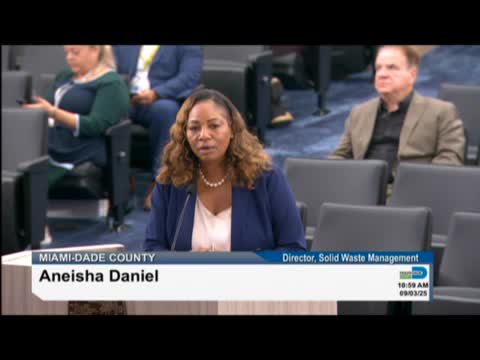
Measures attached to the fee - Advertising and outreach reductions: Department of Solid Waste Management director Anisha Daniel told the commission the departments total outreach/advertising budget included roughly $700,000 for collections work; about $450,000 of that is mandated (mailing and public-notice requirements). Daniel said she could cut roughly $85,000 from discretionary advertising and that $200,000 of education/engagement spending could be deferred for the year. - Illegal-dumping enforcement and fines: Commissioners directed staff to pursue higher illegal-dumping fines and to evaluate whether an annual CPI adjustment could be built in. Daniel reported the county collected roughly $210,000 last year from illegal-dumping fines; commissioners discussed raising fines by about a third to better deter dumping and increase collections. - Efficiency and vacancy review: Budget staff and department leaders told the board the Solid Waste Department had roughly 87 funded but vacant positions equal to about $8.3 million in budgeted salary and benefits. Commissioners asked the administration to identify whether some funded vacancies could be held longer or restructured without reducing core services; the board also heard the departments warning that eliminating more funded positions would increase overtime or reduce enforcement.
What commissioners said Commissioner Gilbert, proposing the increase, framed the vote as a choice between steady, modest adjustments and repeating larger spikes next year. "If you let the system get out of balance, the next year... You'll just face another headwind," Gilbert said, urging smaller, predictable increases rather than deferring costs.
Commissioner Regalado pressed for deeper internal savings and proposed the amendment that reduced the increase to 0.7%. She framed the compromise as a mix of modest fee relief and concrete spending cuts: "We could do 0.7% — cut ad spending and the educational line item, and raise fines — without damaging service levels."
Director Anisha Daniel told the commission the department had identified about $210,000 in illegal-dumping receipts and could trim discretionary outreach to help lower the fee request. "We were actually able to generate about $210,000 last year," Daniel said in explaining where additional revenue might be realized.
Board-level concerns Several commissioners warned that expanding community services or augmenting enforcement would still require long-term funding solutions, and they urged the administration to pursue new revenue streams that would not increase residential rates. Others said that the general fund and enterprise budgets had both been stretched in recent years and that modest, recurring fee adjustments would preserve services.
What happens next The commission approved the 0.7% increase as part of the countys assessment role and fee-setting actions taken during the Sept. 3 meeting. Staff were directed to return with follow-up work on: - A detailed proposal to increase illegal-dumping fines and an assessment of collection feasibility; - A plan to reduce discretionary outreach/advertising and to identify mandated notice costs that cannot be cut; - A vacancy review with recommendations where funded vacancies could be managed without degrading essential collection or enforcement services.
The board vote and procedural record Motion: Adopt collection fee increase at 0.7% (amendment to administration's 1% proposal) Mover: Commissioner Gilbert Second: Vice Chair Keoni McGee Roll-call outcome: Approved, tally 7 yes — 5 no.
Forward look Commissioners said they will monitor service levels, enforcement outcomes and the departments hiring progress. Several members pressed administration to deliver the vacancy and fines analyses ahead of the next budget cycle so the board can assess whether further rate changes or structural reforms are needed.
Ending For now, the 0.7% increase will take effect under the countys schedule for non-ad valorem assessments. Board members said they viewed the decision as a short-term balance between protecting collection services and limiting the cost burden on residents, while directing staff to pursue stronger enforcement and operational savings that could lower future rate needs.