
Tahoe Forest highlights gains on physician alignment, quality bundles; access-to-care remains a challenge
Get AI-powered insights, summaries, and transcripts
Subscribe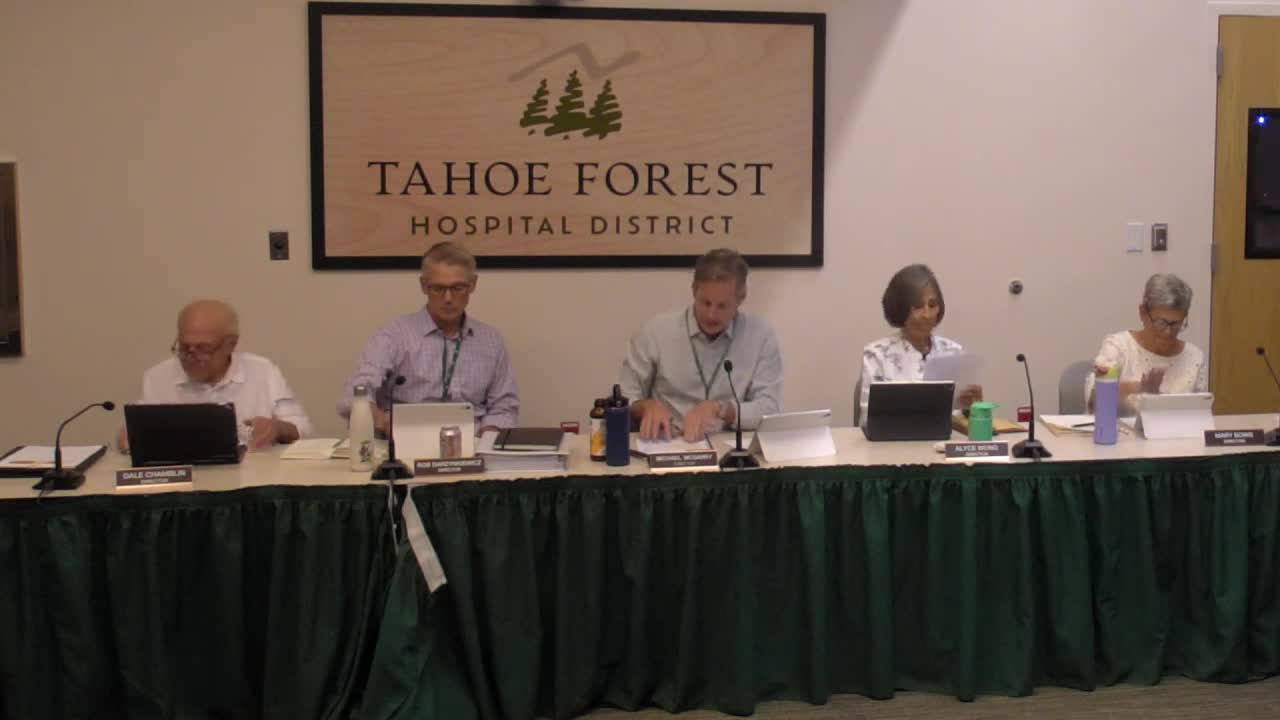
Summary
Tahoe Forest Hospital District leaders said physician alignment and clinical bundle compliance improved over the past year, while access-to-care metrics (third-next-available) remain well short of ambitious targets.
Tahoe Forest Hospital District leaders told the board they made measurable progress last year on several multi-year strategic goals but fell short on access-to-care targets.
At the meeting, Chief Executive Officer Anna Roth and Chief Operating Officer Louie Ward introduced a consolidated dashboard that aggregates the health system's five "peaks": community, service, quality, people and finance. The dashboard showed the system met several annual goals: community health initiatives increased, physician alignment rose from roughly the 10th percentile to about the 40th percentile (score rose from 3.1 to 3.7 on a 4-point scale), the hospital met CMS bundle compliance targets in most categories, patient satisfaction exceeded its goal (96.16% vs. a 95.55% target), and days cash on hand met the finance target (243 days at fiscal year-end prior to audit).
Access shortfalls: The board discussed access metrics at length. Using third-next-available appointment measures, the system missed ambitious access goals: new-patient waits targeted under 10 days averaged 47 days; established-patient waits targeted under 20 days averaged 44 days. Leaders and board members cautioned that the third-next-available metric does not capture same-day capacity and that focusing narrowly on the metric could unintentionally reduce same-day availability. Staff said they will seek patient input to define what "access" means locally and will bring a detailed plan to the board next month; they described the effort as a multiyear transformation that includes process improvement (Lean), template standardization and potential model redesign.
Physician engagement and quality: Medical-staff engagement and physician alignment were singled out as major wins. Dr. Brian Evans and others said the alignment work involved leadership changes, structured feedback mechanisms and enhanced physician leadership. The quality team reported achieving seven of eight clinical standard-work bundles tied to CMS star metrics, exceeding their annual target.
Nuka conference and community-driven models: A cross-functional team returned from the Southcentral Foundation (the Nuka system) conference in Alaska and described where the district could adapt ideas. Team members said Southcentral's model centers the community as "customer-owners," uses intensive onboarding and a leadership institute, operates a training/"learning" center, empowers staff on functional committees, and uses a robust data warehouse to support weekly operational decisions and panel management. Attendees suggested Tahoe Forest explore community-driven design, a local 'transformation/learning center,' clinician-led data teams and more systematic community engagement for service design.
Quotes from the meeting: "I'm not here to change you. I'm here to join you." — Anna Roth, CEO, describing alignment work with existing local priorities. "They refer to patients as customer owners." — Dylan Crosby, vice president of facilities, describing the Nuka model.
Next steps: Staff said they will return next month with a detailed access-to-care plan and more dashboard transparency; leaders also proposed piloting selected Nuka-inspired approaches and creating a cross-organizational implementation plan.