Get Full Government Meeting Transcripts, Videos, & Alerts Forever!
Get email alerts on the Water Quality Signage topic
No spam. Unsubscribe anytime.
City sustainability staff proposes small water‑quality signs at access points to supplement state testing
Summary
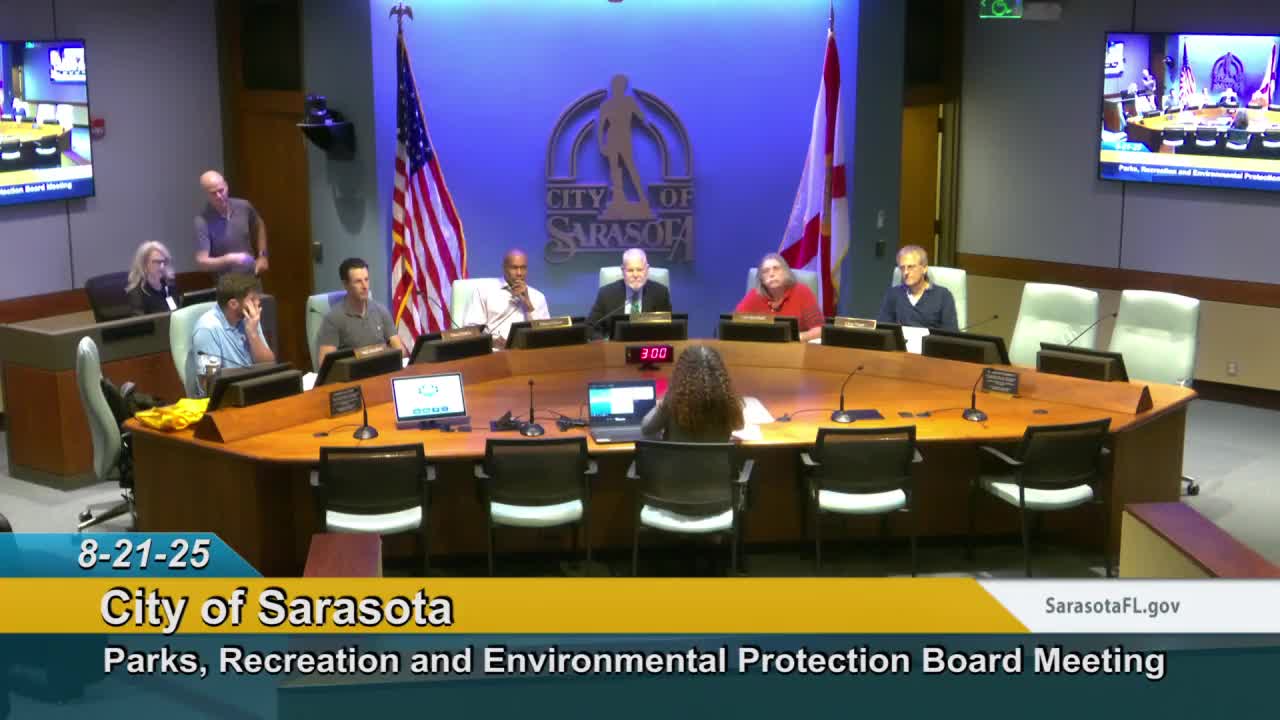
Aliyah Garrett, City of Sarasota sustainability and resilience manager, presented a draft water‑quality signage program to the Parks, Environmental Protection Board on Aug. 21, outlining two small sign types the city could install at bathing beaches and at smaller water access points to inform the public about testing and risk.
Aliyah Garrett, City of Sarasota sustainability and resilience manager, presented a draft water‑quality signage program to the Parks, Environmental Protection Board on Aug. 21, outlining two small sign types the city could install at bathing beaches and at smaller water access points to inform the public about testing and risk.
Garrett said the Florida Department of Health is the state agency that tests water quality at bathing beaches and noted a regulatory requirement that “they have to have 2 bad samples” before posting a no‑swim advisory, which can delay public notification. She said the city’s signs would clarify that the Department of Health does not test most water access points and would include a stormwater warning, a QR code linking to tested bathing beaches and other resources, and contact information for the Department of Health.
“I am not a big fan of sign pollution, so we have designed them in a way that they're small and could be integrated with other existing signs,” Garrett said, describing the proposed permanent 12‑by‑18 signs.
Garrett said she has shared draft language with the city attorney’s office and with local stakeholders including Suncoast Waterkeeper, the Sarasota Bay Estuary Program and the Lido Key Residents Association. She described two possible installation tiers: bathing beaches (e.g., Lido, which the Department of Health tests) and other water access points such as Bay Park and Bird Key Park.
On communications, Garrett said she drafted a standard operating procedure and social‑media messages for events such as spills, heavy storms or hurricanes and hoped the city communications team could push outreach “within 48 hours” when feasible. She said the city could not order people out of the water but can educate residents about increased risk after storms.
Board members asked about coordinating with county testing and outreach. Garrett said she has notified the county extension director and that the county “would probably loop in parks and other departments as well,” but she did not say the county had committed to adopting the same signage.
Other board members suggested specific local locations to include — for example, the Siesta Key north bridge launch area where people board glass‑bottom canoes — and raised concerns about how the signs and messages would be distributed and kept current.
Garrett also placed the signage idea within a broader parks sustainability agenda that includes waste reduction, canopy/heat‑mitigation planning and criteria for evaluating park projects by ecology, resilience and access.
Board members did not take formal action on the signage program during the meeting; Garrett said she would return for further input and coordination.