Get Full Government Meeting Transcripts, Videos, & Alerts Forever!
Get email alerts on the Appropriations Workforce topic
No spam. Unsubscribe anytime.
CareerTech presents FY‑27 funding priorities to expand technology‑center training; apprenticeship pilot enrolls 89
Summary
The agency presented a draft fiscal‑year 2027 appropriations request that seeks additional funding for the technology‑center funding formula, program supports, and regional expansion. Agency staff also reported that an ARPA‑funded 'teach‑to‑teach' apprenticeship pilot received 103 applications, approved 90 and enrolled 89 participants.
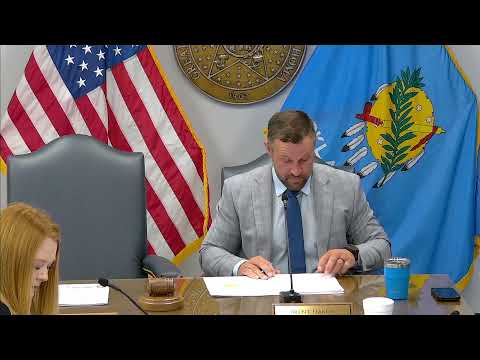
Director Hagan presented a first reading of the agency’s fiscal year 2027 appropriations request and outlined a set of funding priorities aimed at expanding technology‑center capacity and early career exploration.
Hagan said the agency asked for $41.65 million to support the technology‑center funding formula; she noted the legislature provided a $10 million increase the previous year and the agency is again seeking additional funding to expand capacity and reduce student waiting lists. She described the request as draft and said staff will follow up with technology center superintendents and finalize requests for the board in October.
Hagan identified specific items in the request: a statutory flex‑benefit allowance increase that she estimated will require about $1.3 million (for technology center teachers and support staff); continued program support for K‑12 CareerTech programs (support amounts reported to range roughly from $8,000 to $15,000 per program); a small K‑12 incentive for career‑tech teachers (reported at about $2,200 to $2,600); statutory pay for agricultural teachers as 12‑month employees (the agency covers two summer months); and a multi‑part effort to serve “white‑space” areas not currently inside a technology‑center district.
On expansion, Hagan described an incentive of $250,000 per school to accelerate the annexation of districts into technology‑center service areas and said bringing more schools into districts could make about $32 million in local ad valorem dollars newly available to technology centers if those areas annexed. She said the agency had used a similar $250,000 incentive successfully in Beaver County and that rural campuses can sometimes be established for modest construction costs compared with larger urban projects.
Hagan also proposed an outreach program for middle‑school career exploration (targeting roughly sixth and seventh graders) that would fund a technology‑center campus to operate a local “TAP” or exploration program; the agency estimated a $250,000 per campus funding level for that outreach model and said several centers already operate pilots at local schools.
Hagan and board members discussed program cost drivers. She said a recent estimate placed the annual cost to operate a full program at about $266,000 and that nearly all health‑care programs require small class sizes because of credentialing boards (for example nursing clinical ratios). Hagan described teacher‑cost ranges, saying an instructor’s total cost (salary plus benefits and related expenses) can approach $100,000 to $150,000 depending on experience and benefit costs.
Max McKnight, director of workforce training, reported on the state’s ARPA‑funded “teach‑to‑teach” apprenticeship pilot, which the agency applied for through the Oklahoma Workforce Commission and the Regional University System of Oklahoma. McKnight said the agency was awarded $1,125,000 for the pilot. The program partners with six regional universities — East Central University, Northeastern State University, Northwestern Oklahoma State University, Southeastern Oklahoma State University, Southwestern Oklahoma State University and the University of Central Oklahoma — to provide course work and credentialing for incumbent school paraprofessionals and aides who are pursuing teaching degrees.
McKnight said the agency received 103 applications, reviewed them and approved 90; one approved applicant later took a different job, leaving 89 apprentices currently in the program. Approved apprentices are eligible for up to $10,000 in tuition and book assistance and for certification‑exam support. McKnight told the board the workforce commission indicated it could consider additional funding if demand required it; he said actual grant use will vary by participant course loads and certification needs.
Hagan said the apprenticeship model is intended to enlarge the certified‑teacher pipeline by supporting employed school staff who otherwise could not afford to return to college. Board members asked whether larger universities were included; McKnight said the pilot targeted the RUSO institutions for this phase because they have large teacher‑preparation enrollments and the pilot was intentionally limited in scope.
Board members and staff said the appropriations request remains a draft: staff will gather surveys from technology centers, hold a superintendent Zoom call and return a more detailed request in September with a final review in October.
Votes at a glance • Approval of minutes from the July 17, 2025 regular board meeting — motion carried; recorded roll‑call votes: Michael Brown (yes), Peter Dillingham (yes), Shalyn Hanning (yes), Leonard McCullough (yes), Rob Seaman (yes). • Approval of revisions to the Salary Adjustment Committee policy and procedure — motion carried; recorded roll‑call votes: Michael Brown (yes), Peter Dillingham (yes), Shalyn Hanning (yes), Leonard McCullough (yes), Rob Seaman (yes). • Change meeting location for June 18, 2026 regular board meeting to Stillwater — motion carried; recorded roll‑call votes: Michael Brown (yes), Peter Dillingham (yes), Shalyn Hanning (yes), Leonard McCullough (yes), Rob Seaman (yes). • Change meeting location for July 16, 2026 regular board meeting to Stillwater — motion carried; recorded roll‑call votes: Michael Brown (yes), Peter Dillingham (yes), Shalyn Hanning (yes), Leonard McCullough (yes), Rob Seaman (yes).
Board members did not take action on the appropriations request at the meeting; the item was presented for first reading and feedback.