Get Full Government Meeting Transcripts, Videos, & Alerts Forever!
Get email alerts on the Bridges topic
No spam. Unsubscribe anytime.
Jenks Council approves design contract for Arkansas River pedestrian bridge repairs as engineers warn of critical deterioration
Summary
Garver Engineers presented a detailed condition assessment showing two stringers with near-complete section loss and recommended immediate repairs; council awarded a $732,600 design contract and appropriated the same amount while asking staff and the consultant to return with refined options within 60 days.
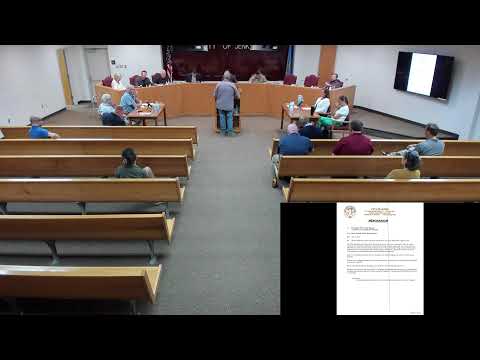
Garver Engineers presented the results of an in-depth inspection of the Arkansas River Pedestrian Bridge and the Jenks City Council voted to hire the firm to prepare full construction plans and bid documents for rehabilitation work.
In a presentation to council, Garver engineer Bradley Thompson said the April 2023 inspection found widespread deterioration in the bridge deck, floor beams and stringer ends and identified two stringer ends with “90 to 100% section loss” that are not fully connected to their floor beams. "Due to this critical section loss and loss of connection, they cannot transfer the loadings as originally designed," Thompson said, adding that if those conditions are not repaired the bridge “may have to be closed.”
The council approved an engineering design contract with Garver for $732,600 and a supplemental appropriation of the same amount from JPWA/OWRB funds to begin design and phasing of repairs. The vote on the design contract and the appropriation was unanimous.
Why it matters: Garver’s load-rating analysis found the bridge can currently carry up to 28,500 pounds for specific vehicular uses and about 90 pounds per square foot for pedestrian loads in most spans, but the two disconnected stringers (span 16, stringer F and a nearby location) are exceptions and are critical. Thompson said those two repairs must be completed first; otherwise safety and stability could be threatened. City staff and council repeatedly framed the decision as balancing near-term public-safety repairs and longer-term choices about whether to rehabilitate the existing 70+-year-old truss or replace it with a new structure with a 75–100 year service life.
Key findings and costs: Garver estimated full rehabilitation costs at roughly $23 million if done as one project (approx. 12–18 months), with critical early work packages focused on the two failing spans. A conceptual replacement option was estimated at about $26 million and would include removal of the existing truss (estimated removal cost about $1.5 million) and construction of a new pedestrian bridge on the existing alignment; Garver said the replacement would also require a full closure, roughly 380 days of construction. Garver recommended routine maintenance every 1–2 years and in-depth inspections every 4–5 years to avoid future critical repairs.
Council discussion focused on alternatives and sequencing. Vice Mayor Brown emphasized exploring alternatives and the option of funding only immediate critical repairs or work packages that enable the attached water line to be replaced. Brown noted the city may have an overlapping long-term project — a proposed low-water dam and possible new pedestrian crossing near 106th Street — that could change long-term needs. "We may not want to pour a ton of money into a 77‑year‑old bridge if another crossing is planned," Brown said. Mayor Box and other council members said they favored proceeding with the critical design work to allow the city to pursue repairs or replacement decisions once more detailed cost/option analysis is available.
Direction and next steps: Council instructed staff and Garver to return with refined scope and proposed amendments reflecting a phased or package-based approach and additional options for temporary versus full rehabilitation. The administration and consultant agreed to return in about 60 days with updated proposals and cost options. City Manager Shroud said staff will also assess actual pedestrian traffic counts to help prioritize investment.
The council approved: (1) award of the design contract to Garver Engineers ($732,600) and (2) a supplemental appropriation of $732,600 to cover the design work. Council also agreed to keep barricades in place on the eastern end of the bridge until critical repairs are completed.
The presentation and subsequent discussion included technical detail on deck deterioration (asphalt overlay trapping moisture, spalls with exposed reinforcing steel), corrosion and section loss in stringers and floor beams, peeling paint, damaged expansion joints and railing problems. Garver recommended breaking the rehabilitation into 11–13 work packages to match available funding and construction constraints; Garver cautioned that the truss configuration makes it infeasible to keep the bridge open during most construction activities.
Council members and staff emphasized public-safety obligations and the need to weigh long-term value: "From a public safety standpoint, it is really our only obligation," Mayor Box said, while others urged balancing the $23 million rehabilitation cost against the possibility of replacing the span or reallocating funds to the low-water dam project.
Ending note: Garver’s report and the awarded design contract set the city on a path to detailed construction documents and staged repairs; council asked staff to return with a narrower set of options and cost breakdowns for public discussion and final decisions.