
Enforcement technician pitches stop-arm camera program used in Orange County to Sullivan County legislators
Get AI-powered insights, summaries, and transcripts
Sign Up Free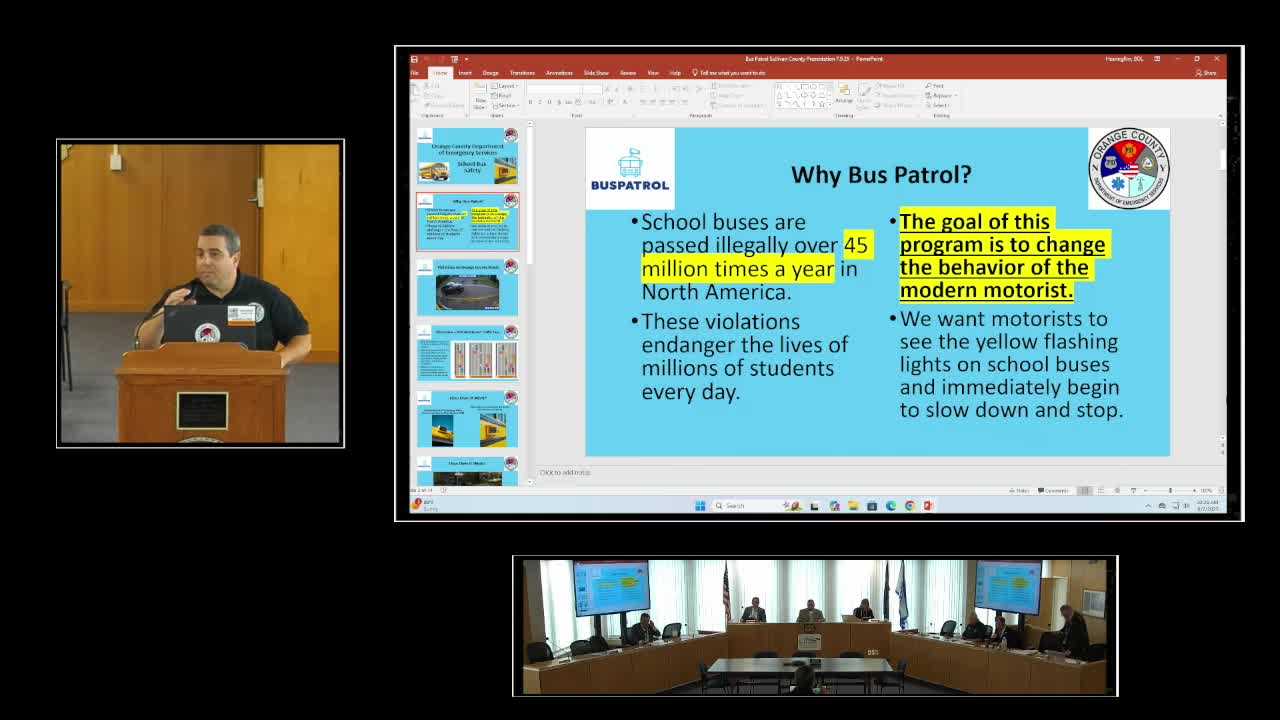
Summary
Michael Belgiovini of Orange County Emergency Services described a stop-arm camera program that records motorists who pass school buses with red lights activated, saying the system costs local governments nothing and produces civil citations mailed to registered vehicle owners.
Michael Belgiovini, an enforcement technician with Orange County Emergency Services’ school bus safety program, told the Sullivan County Legislature on Monday that a private company’s stop-arm camera system has produced thousands of civil citations and changed motorist behavior in Orange County.
Belgiovini said the system — deployed as a partnership with a company called Bus Patrol — uses video cameras, license-plate readers and artificial intelligence to identify vehicles that pass stopped school buses with red lights activated. "Basically what this company does is, it has technology that takes pictures of, records, and is issuing, notices of violation to people that pass school buses with the red lights on," Belgiovini said.
Belgiovini said Orange County began its program in September 2024 and by June had issued 17,358 citations after reviewing roughly 30,000 videos. He said the program cost no money to the county, school districts or bus companies; installation and operation are paid through a violator-funded cost-recovery arrangement in which fine revenue is shared between the vendor and the host county. "The way they do it is it's made possible through a violator funded cost recovery" he said.
He described the local review process: Bus Patrol’s systems identify candidate events and upload video and still images to a database; retired law-enforcement technicians review the recordings and either approve or disapprove citations. If approved, Bus Patrol mails a civil notice of liability to the registered owner on the vehicle registration. Belgiovini said the civil penalty structure used in Orange County was: first offense $250, second offense $275, third offense $300, with no driver license points assessed through the motor-vehicle system.
Legislators and others at the meeting raised questions about legal enforcement and who is held responsible. One legislator asked whether the registered owner — not the actual driver — receives the citation; Belgiovini responded, "That's correct, sir." He said people can plead not guilty and that a court process would be put in place for contested citations, although the court process was not yet fully implemented.
Public comment at the meeting raised concerns about revenue sharing if the state becomes involved, inconsistent timing of when buses activate lights, and civil liberties implications of automated enforcement. A member of the public warned that if the state later seeks a share of fine revenue, local receipts could fall.
Belgiovini, who said he is a Sullivan County resident and a retired New York State trooper, encouraged county officials to contact Bus Patrol for details if the county wishes to explore the program. "If Monticello wanted to opt in and say, hey, we wanted this on all of our buses," he said, "Bus Patrol would then say, okay, we're gonna put this district in and they'd show up there and start installing cameras."