Get Full Government Meeting Transcripts, Videos, & Alerts Forever!
Get email alerts on the Council Committee Structure topic
No spam. Unsubscribe anytime.
Portland councilors debate committee overhaul, committee-of-the-whole proposal
Summary
At an Aug. 4 work session, Portland city councilors debated shrinking and reorganizing committees, creating a standing "committee of the whole," and rules on chairs, co-chairs and district representation; no formal votes were taken.
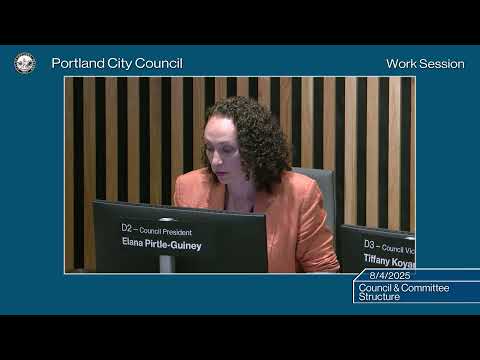
Portland City Councilors used a three-hour work session Monday, Aug. 4, to debate how to restructure council committees, including whether to reduce the number of policy committees, create a recurring committee of the whole for citywide issues, and change chairing rules. No formal votes or ordinance actions were taken.
Councilor Michael Dunphy, who presented a written proposal during the session, said his plan would reduce the number of policy committees "from 8 to 4" and add a committee of the whole to handle shared operational responsibilities, such as governance and budget preliminaries. "My proposal reduces the number of policy committees from 8 to 4," Dunphy said.
Why it matters: committee assignments and rules determine where administrative proposals land for public testimony and how council oversight is organized. Councilors and city staff repeatedly flagged predictability for the public and for bureau staff, the aggregate time city staff must support committee meetings, and the risk that too many short or ad hoc meetings can overwhelm bureau schedules.
The conversation split on several recurring themes. Councilor Carmen Avalos argued for a standing committee of the whole so all council members have a recurring, decision-facing space to review cross-cutting items: "Committee of the whole is when all counselors can meet together outside of formal hearings to dig into big picture or cross cutting issues," she said. Supporters said the format could be used to preview legislation, hear bureau briefings and take public input early in a process. Opponents warned a committee of the whole could duplicate existing work sessions or expand council time at the dais and reduce time councilors spend in their districts.
Councilors clashed over chairing models. Several councilors—including Novick, Murillo and Ryan—described positive experience with co-chairs on policy committees and argued co-chairs broaden perspectives and share workload. Others, including Zimmerman and Smith, expressed preference for a single chair and a vice chair, citing clarity and quorum complexity.
Land use, housing and climate also were focal points. Some councilors urged keeping land-use and climate-focused work together in a committee with sufficient meeting time because of the volume and technical nature of proposals. Others warned that combining too many responsibilities could lead to rubber-stamp outcomes or squeeze discussion of distinct priorities such as housing, climate resilience and the city’s unsheltered-homelessness response.
City staff and the city administrator flagged operational constraints. City Administrator Michael Jordan said staff prefer fewer, predictable meetings so they can plan and support council work: "If you asked all the staff, having fewer meetings to go to would be good," he told councilors. Councilor Laurie Green noted a prior extended budget session in May had cost about $30,000 and urged regular scheduling to avoid ad hoc overtime costs.
City Attorney Robert Taylor reviewed legal options for a committee of the whole under parliamentary rules and the city’s meeting rules, warning that different forms of a committee of the whole carry different effects on whether actions must later be ratified by full council. Taylor summarized three forms (formal, quasi, and informal) and advised councilors to choose which variant they would prefer.
Councilors also debated whether district representation on every committee should be a formal expectation. Some councilors urged making at least one member from each district present on every committee to improve equity and constituent access; others said that design should remain a leadership decision and not be rigidly codified.
The session ended without a decision. Council President (presiding) said the council will continue the discussion at a special council meeting next week; councilors who advanced written proposals said they will circulate refined drafts. The president also noted that all four committee-structure proposals distributed before the meeting are now posted on the clerk’s website for public review.
What’s next: council leadership plans a follow-up meeting next week to attempt to narrow choices and consider formal adoption of a new committee structure or interim operating practices.