Get Full Government Meeting Transcripts, Videos, & Alerts Forever!
Get email alerts on the Road Maintenance Budget topic
No spam. Unsubscribe anytime.
Grimes County commissioners review Road & Bridge budget, training and floodplain compliance needs
Summary
County engineers and Road & Bridge leaders briefed the Commissioners Court on requests for training, equipment and new staff to support a shift in road construction methods and to address 637 unpermitted structures in the county floodplain.
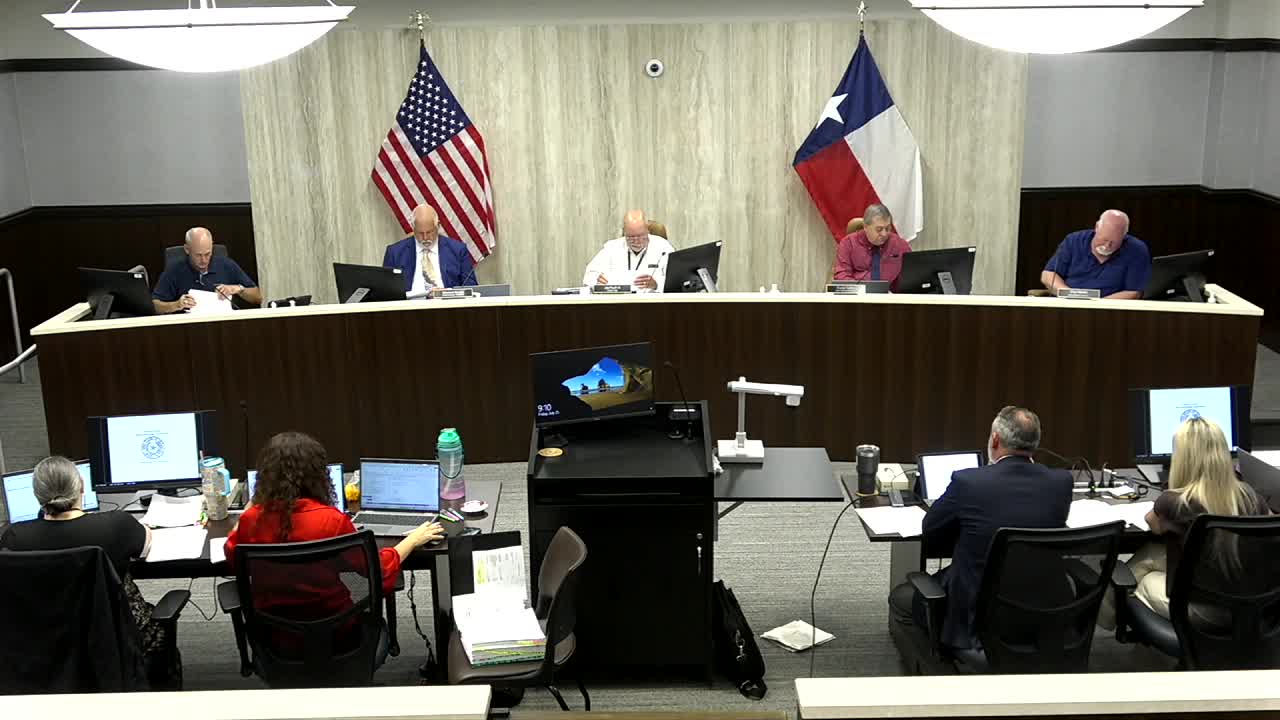
Grimes County leaders spent most of a July 25 budget meeting focused on the Road & Bridge Department’s fiscal 2026 requests, with department managers asking the Commissioners Court to restore training funds, approve targeted equipment purchases and consider one or more new positions to handle rising development and floodplain compliance work.
The discussion centered on three near-term needs: (1) a training program the department says will increase productivity and lower long-term maintenance costs, (2) equipment and machinery replacements prioritized by field staff, and (3) a proposed development/inspection technician to handle permit reviews and floodplain compliance tasks that staff say are growing rapidly.
Why it matters: Road material and labor costs have increased sharply in recent years, the department said, and county staff said better training and targeted capital purchases could stretch the county’s available funds to maintain more miles of road. County engineers also warned the court that state and federal floodplain requirements expose the county to potential loss of National Flood Insurance Program participation unless a backlog of unpermitted structures is addressed.
John Stiber, who identified himself as manager of the Grimes County Bridge Department and county engineer, told the court the department maintains about 600 miles of county roads and roughly 113 county bridges and assists five cities with about 76 miles of municipal roads. He and his staff outlined a move toward full-depth reclamation and subgrade stabilization techniques — using an asphalt zipper, reclamation equipment and binder materials — as a lower-cost alternative to building full new flexible base on every mile. Stiber gave an example showing that keeping a steady program of 15 miles of paving per year would require far larger future spending if material costs grow at historic rates; he said that a reclamation-based approach could reduce construction-material cost for 15 miles by roughly $2 million in his example.
Benjamin Napier, director of field operations, described recent and planned training: a weeklong motor-grader operator program, in-house TEEX simulator evaluation, CDL (FMCSA) training for operators and OSHA/excavation safety courses. Napier said in-person equipment training returned clear productivity gains and asked the court to restore the department’s training request. Commissioners and auditors debated how to code that money — as professional services, travel/training, or another line item — but multiple members repeatedly urged the court to “put the $12,000 back in” (the department’s requested training amount; separate figures of $12,000 and $12,700 were discussed during the meeting).
On equipment, Stiber said the department collected nearly $50,000 from a recent auction and proposed using those funds to buy a crack-seal trailer and other items. The department also prioritized a loader, a pad-foot roller for compaction, a grapple truck and a hydro-jet unit for cleaning culverts. Stiber said some heavy units at the North Barn are “at the point it’s almost unsafe” and asked the court to prioritize replacement. For machinery the department asked for about $843,000 in new equipment in its original request; the preliminary county budget reflected a reduced capital allocation of about $500,000.
Scheduling and overtime were a prominent topic. Commissioner discussion centered on the department’s summer 4/10 schedule (four 10-hour days) versus a five-day operation intended to keep heavy equipment working more days during extended daylight months. Stiber said the 4/10 schedule makes better use of daylight while preserving a weekday for equipment maintenance; other commissioners said equipment idle on Fridays is a visible public concern and urged planning toward keeping machines active five days a week by hiring more staff or using some overtime. For FY 2026 the department requested $74,000 for overtime; the judge’s preliminary budget included $32,010. Commissioners discussed whether to increase that amount now or leave a lower figure and, if needed, request fund-balance transfers after the year begins.
Stiber and other staff raised floodplain compliance as a separate workload pressure. He told the court the Texas Water Development Board’s recent community assistance visit identified 637 structures built in the county’s floodplain since the county’s 2012 floodplain order that do not have permits. Stiber said bringing those structures to documented compliance (letters, site inspections, permit reviews and re-inspections) is labor-intensive and will require additional staff time; he recommended hiring a development technician (plan reviewer/inspector) to work under the development coordinator. He and county staff said permit- and road-use-fee revenues collected so far (about $41,505 over seven months according to the presentation) could cover much of the position’s cost, and they asked the court to consider putting a technician on the add list with an estimated total first-year cost around $100,000 including vehicle and equipment.
On grants, Stiber said the county expects a Resilient Communities Program (RCP) award with no local match and is monitoring an FMA (Flood Mitigation Assistance) grant that, if awarded, would likely require roughly $49,000 in local match. He also identified ongoing bridge and flood-related grant work with GLO/CDBG and noted that FEMA reimbursement for disasters requires good documentation; staff requested county phones/GPS or camera equipment to improve claims documentation.
County Auditor Jesse (first name given in the transcript) confirmed the judge’s preliminary budget showed a roughly $2.1 million deficit at the time of the meeting. Judge and commissioners repeatedly described the preliminary budget as a starting point and asked department heads to prioritize additions and provide more detailed line-item breakdowns for professional services, training and proposed positions so the court could prioritize changes against the overall deficit.
Court action: No formal votes or final budget decisions were recorded in the transcript excerpt. Commissioners directed staff to compile prioritized add-back requests (training, professional services, equipment, and the development technician) and provide more detailed cost breakdowns for consideration as the court continues FY 2026 budget meetings.
The court recessed at roughly 12:00 p.m. with further budget sessions planned.