Get Full Government Meeting Transcripts, Videos, & Alerts Forever!
Get email alerts on the Blacktail Creek Riparian topic
No spam. Unsubscribe anytime.
DEQ unveils 30% remedial design for Blacktail Creek riparian actions; design funds set at $20.5 million
Summary
The Montana Department of Environmental Quality presented a 30% remedial design for Blacktail Creek, detailing dewatering, excavation and reconstruction plans. DEQ said it received $20,500,000 in settlement funds for the work and estimated about 135,000 cubic yards of material will be removed.
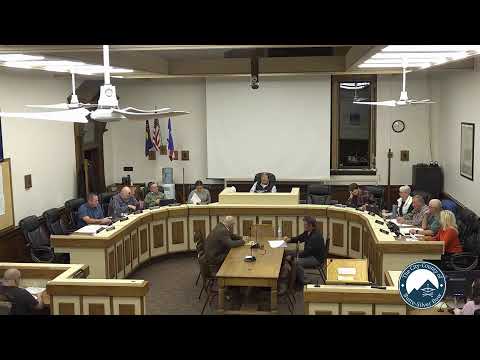
Alex Ruzovich, environmental project officer with the Montana Department of Environmental Quality, presented the 30% remedial design for the Blacktail Creek Riparian Actions at the Butte‑Silver Bow Council meeting on Oct. 22, saying DEQ will lead removal of contaminated mine tailings and restore creek and wetland habitat.
"DEQ received a settlement of $20,500,000 in order to implement the remediation," Ruzovich told commissioners, identifying Blacktail Creek as part of the larger Butte Priority Soils Operable Unit (BIPSU). He described two linked components: DEQ‑led waste removal and channel and flood‑plain reconstruction, and an Atlantic Richfield‑led groundwater hydraulic control system to capture and treat groundwater.
Design details and scope: Ruzovich said the project will lower the water table on the site by roughly 7 feet using extraction wells, perimeter trenching and localized pumping to allow excavation of contaminated materials. He estimated about 135,000 cubic yards of material — a mix of mine tailings, municipal waste and debris — will be removed and staged for transport to an EPA‑approved repository. "We're anticipating around 135,000 cubic yards of material coming off of the site," he said.
Excavation depths were described as roughly 20 feet in the southern portion of the site and about 13 feet in the northern portion; Ruzovich said the pre‑design investigation refined the remediation boundary and indicated some adjacent areas did not contain waste. Excavation verification will use handheld XRF analyzers to check metal levels in real time.
Dewatering and treatment: Dewatered water will be routed to a settling basin; if it meets surface‑water discharge standards it may be returned directly to creeks, otherwise it will go to the Butte Treatment Lagoon for further treatment. Ruzovich said the design anticipates protecting stream habitat during construction and reestablishing meanders and wetlands that will support fish and wildlife, including West Slope cutthroat trout.
Logistics and sequencing: Ruzovich said the project will require coordination with other BIPSU projects to avoid recontamination from upstream work and with the siting committee that will choose the off‑site repository and haul routes. He said the 60% design is expected in March–April 2026, a 95% and final 100% design by February 2027, and active construction in summer–fall seasons over roughly two years with final completion anticipated in 2028. He noted construction windows are expected to run roughly July through October each year.
Local concerns and siting: Commissioners asked about visual screening for a proposed staging/drying area near the interstate and about repository siting and transportation impacts. Ruzovich said traffic control and decontamination procedures will be part of the 60% design; repository siting is decided by a siting committee composed of Atlantic Richfield, Butte‑Silver Bow and subject to EPA approval. Director Hassler said the siting process has narrowed to two likely candidate repositories and that the project team is emphasizing transport mechanisms that minimize community impacts.
Next steps: DEQ plans additional field investigations, a 60% design submittal, continued coordination with Atlantic Richfield and other stakeholders, and incorporation of in‑stream sediment, wetlands and habitat data into the design.
Ending: Ruzovich said the finished project aims to restore functional wetland and riparian habitat while providing public recreational access as determined by landowners and to protect downstream water quality.