Get Full Government Meeting Transcripts, Videos, & Alerts Forever!
Get email alerts on the Large Scale Solar topic
No spam. Unsubscribe anytime.
Vanderburgh BZA rejects Bluegrass Creek large-scale solar special-use after hours of testimony
Summary
After four hours of testimony from developers, county negotiators and more than a dozen neighbors, the Vanderburgh County Board of Zoning Appeals denied a special-use permit for the 100-megawatt Bluegrass Creek solar project, 3-4, citing concerns about site suitability, local impacts and outstanding infrastructure agreements.
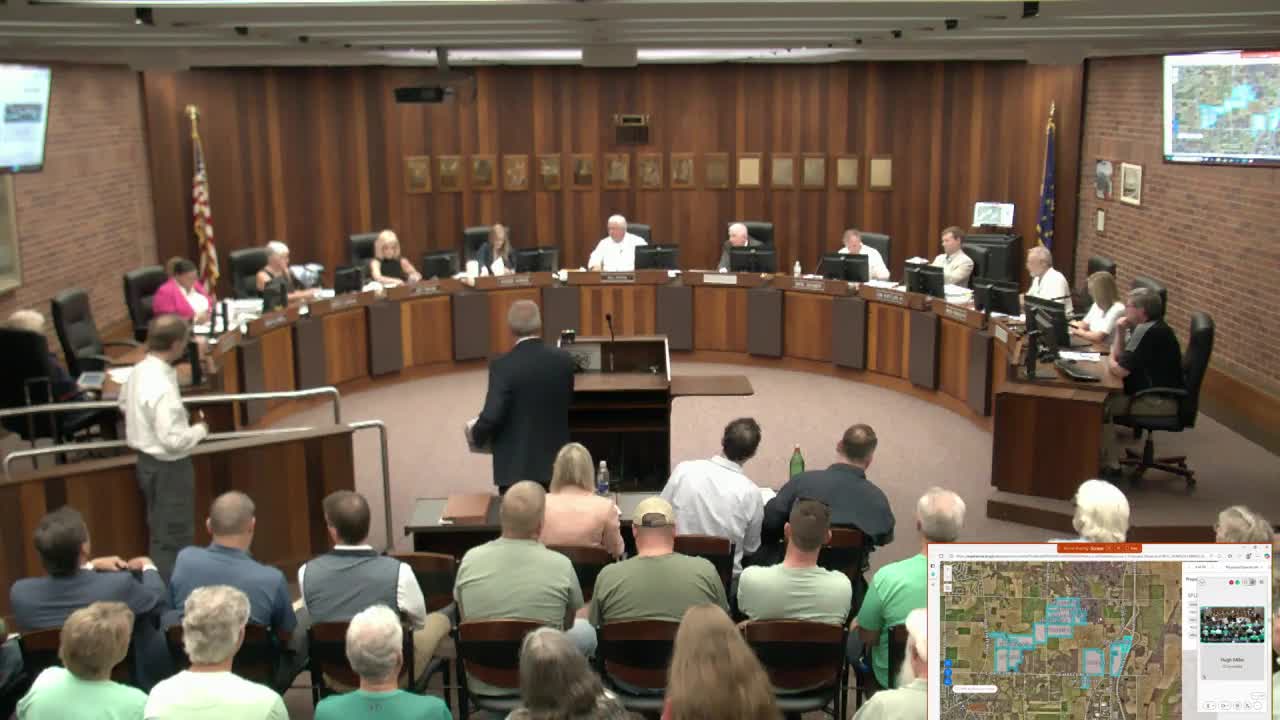
The Vanderburgh County Board of Zoning Appeals voted 3-4 on Aug. 21 to deny SPUDash2025Dash013, a request by Bluegrass Creek Solar LLC and Orion Renewables for a special-use permit to build a large-scale commercial solar facility north of Baseline Road between Old State Road and Interstate 69.
The decision followed more than four hours of testimony from the applicant’s team, county counsel and more than 30 residents and stakeholders who appeared for and against the project. The applicant described the proposal as a roughly 900‑acre participating footprint that would host about 300 acres of photovoltaic panels producing about 100 megawatts of nameplate capacity, paired with a roughly 21‑megawatt battery storage facility. Turner Hunt of Orion Renewable Energy Group said Orion had negotiated multiple agreements with county officials and planned to plant 4,200 trees, fund a $500,000 economic development package, post decommissioning bonds and run pre‑ and post‑construction soil and water testing.
“We will be making the case as to why the Bluegrass Creek solar farm is deserving of a special use permit,” Turner Hunt said in his opening remarks. The applicant’s materials and on‑the‑record presentation stated the project would pay what the developer estimated as about $35 million in property taxes over the life of the project (a figure the applicant described as roughly $1 million per year under the negotiated tax treatment), and that construction would generate local jobs and avoid the long‑term public infrastructure costs associated with new housing or industrial parks.
Opponents — represented in part by attorney Joshua Claiborne and residents of nearby Bennett Pointe condominiums — argued the site is largely prime agricultural land and said independent reports and local testimony showed risks to property values, water supplies and safety in the event of a battery fire. “The decision before you all today is whether this project with these plans on this particular site meet what’s required by the code,” Claiborne told the board. He urged the board to deny the special use, arguing the application failed one or more of the six findings the zoning code requires for approval.
Residents and the condominium association, represented by Crystal Lockyer and Donna Todd, focused on traffic, the location of access points, parking reductions in a nearby proposed apartment project and potential effects on groundwater and property values. Todd said the neighborhood already experiences traffic concerns on Burkhart Road and said residents feared spillover parking and safety problems. “A 170‑plus parking‑space reduction is a big ask,” Lockyer told the board, describing the condominium association’s position.
The applicant presented a set of four agreements it said provided protections the board and county could enforce: (1) voluntary additional conditions the applicant offered the BZA; (2) a roadway‑use agreement with performance bonds ($150,000 per mile of paved road affected) and a traffic management plan; (3) a decommissioning agreement with a bond set at 120% of estimated decommissioning costs and requirements for disposal and recycling of panels and equipment; and (4) an economic development agreement that the applicant said would net roughly $500,000 to the county over five years and a negotiated tax depreciation floor to mitigate the effect of Indiana’s recent SB1 changes.
Reed Schmidt of Dentons, outside counsel for the applicant, and Mary Soliday, who participated for the county negotiations, described the agreements as standard safeguards and said the agreements set a higher bar than many earlier projects in other counties. “These documents create a legal framework protecting and safeguarding the county,” Schmidt said. The applicant also provided expert reports on property‑value impacts, public health and safety, glare, noise and pollinator‑friendly ground cover; Dr. Chris Olsen testified on environmental health and said the project’s noise and chemical‑release risks were low if the proposed safety and testing measures were implemented.
Opponents questioned several technical points the applicant’s experts addressed: where wash and firefighting water would be stored or supplied, whether battery storage containers needed permanent water tanks, and whether adequate recorded easements and signed roadway agreements existed now. Hiller fire expert Sergeant Bobby Ruiz told the board that modern battery‑storage fire guidance (NFPA 855 and related standards) requires planning and, in some cases, on‑site water staging for large battery installations; he said jurisdictions have adopted different requirements and that detailed operational plans must be coordinated with the authority having jurisdiction. The applicant and its experts told the board they would work with the fire chief and follow NFPA guidance; opponents noted that no final, signed roadway or decommissioning agreement appeared on the commissioners’ agenda before the BZA meeting.
Supporters included some owner‑landlords in the project area who said leasing a portion of their family farms would provide long‑term income that could preserve the farm for future generations. Tom Wheeler, an owner who said his family farm qualifies as a Hoosier Homestead property, told the board the leases had been negotiated with neighbor protections and buffers in mind.
The board discussed procedural and technical points after the public record closed. A motion to approve the special use subject to the applicant’s proposed conditions (the applicant had filed a set of proposed conditions with staff; the board asked staff to confirm a final, technical version during site review) failed on a roll call vote: Miss Cabell, Miss Kasia and one other member voted yes; Miss Payne, Mr. Rudolph, Mr. Shetler and Mr. Zayner voted no. The chair announced the motion failed 3‑4 and the special use was denied.
The board’s written minutes and the area plan commission’s files will contain the full set of conditions the applicant offered, the staff revisions, and the applicant’s expert reports. Following the vote, the applicant’s counsel signaled that it would take the denial into account while deciding whether to revise the proposal or pursue other administrative or legal options.
The project drew substantially more public turnout and comment than most items on the agenda and will likely be the subject of follow‑up discussion at the county level as the economic development and decommissioning agreements are finalized by county officials or revisited by the applicant.
Ending: The board’s decision means Orion and Bluegrass Creek Solar LLC cannot begin construction under the BZA special‑use approval. The developer and county negotiators indicated several of the agreements discussed would remain available for future projects or revised proposals, but the applicant will need to decide whether to revise the plan and resubmit or pursue other administrative paths.