Get Full Government Meeting Transcripts, Videos, & Alerts Forever!
Get email alerts on the Economic Development topic
No spam. Unsubscribe anytime.
Commission reviews city economic-development framework, discusses incentives and tools to grow workforce
Summary
City staff presented an economic development framework emphasizing workforce growth, housing access, wage growth and neighborhood nodes; commissioners discussed metrics, permitting, incentives and partnerships with the mill, IU and community groups.
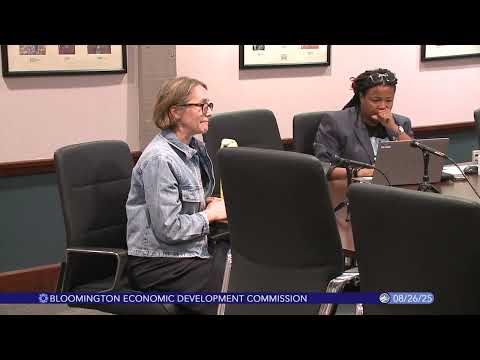
City economic-development staff presented a draft economic development framework and an accompanying incentives reference for review at the Economic Development Commission meeting on Aug. 26 in the McCloskey Conference Room.
The draft framework, described by staff as a “living document,” lists broad goals including: grow the workforce population; increase wages; reinforce Bloomington’s economic base by building on sector strengths; and activate distinct commercial nodes across the city. Staff said the framework will be followed by action plans and measurable tactics developed by the Economic and Sustainable Development (ESD) Department.
“We want to work as co-creators with our community,” said Jane, Economic and Sustainable Development Department staff, describing city values embedded in the framework. Jane said the administration’s goals include making government more accessible, increasing responsiveness and telling a clearer story about Bloomington’s identity as a center for innovation, arts and sustainability.
Staff highlighted several priorities tied to workforce growth: reduce barriers to housing production, expand early-learning and child-care capacity (referred to in the document as “early learning”), and strengthen ties to Indiana University to retain graduates. The presentation noted Bloomington’s daytime population increases by roughly 16,000 commuters and cited a need to tailor small-business supports to weekday patterns.
Commissioners pressed for the next step to include concrete tactics and measurable benchmarks: clear permitting improvements, explicit incentive uses, outcome targets for business attraction and metrics to judge success. Commissioner Esac (first name not specified in the transcript) urged a short list of tactical projects and success metrics; Commissioner Tim Hagen said he wanted to see permitting benchmarks and tools listed side-by-side with the goals.
Commission members discussed specific implementation tools and funding sources named in the incentives document, including tax abatements, economic development revenue bonds, the state Residential Infrastructure Fund (RIF), opportunity zones and new markets tax credits. Staff noted that 52% of Bloomington properties are tax-exempt, and that tax-abatement programs must be considered in that context.
Staff and commissioners also discussed the shift in local income-tax distribution scheduled through 2028, when the current configuration ends and the tax structure will move to a county-administered flat allocation; staff said that will affect local revenue available to support some incentives.
Commissioners and staff suggested several near-term items for ESD to develop: a short tactical list with measurable outcomes; a permitting “fix list” and a UDO (Unified Development Ordinance) guide or ombudsman to navigate approvals; and a public-facing, searchable incentives portal (staff proposed an AI-backed chatbot fed by incentive links and program text to help applicants identify applicable tools).
Staff identified federal- and state-level programs the city is tracking for potential use, including new and expanded opportunity-zone resources and new markets tax credit provisions made permanent in recent legislation. Staff said the IFA Residential Infrastructure Fund is a potential resource for utility infrastructure, though existing program focus on smaller communities may limit Bloomington’s share.
Commissioners recommended the department produce follow-up action plans with benchmarks and to make the incentives material more user-friendly for developers and small businesses. Several commissioners volunteered to help draft or review the tactical plans between meetings.
The meeting closed with staff noting the materials would be refined and made available online as part of a forthcoming website update and branding work being done by the mayor’s office.