Get Full Government Meeting Transcripts, Videos, & Alerts Forever!
Get email alerts on the Landfill Rezoning topic
No spam. Unsubscribe anytime.
Henry County planning body tables rezoning request for possible landfill expansion after aquifer and wetland concerns
Summary
A Henry County land-use body voted unanimously to table a rezoning request that would allow landfill activity on an upper portion of a large parcel, citing outstanding questions about groundwater, wetlands and setbacks.
A Henry County planning body voted to table a rezoning request that would change zoning on a large parcel to allow additional landfill operations after commissioners and residents raised concerns about groundwater, wetlands and required setback distances.
Members said they need written groundwater and aquifer information and input from the Blue River Conservancy before making a recommendation to county commissioners. One member recommended tabling the request until that information is provided; the motion to table carried unanimously.
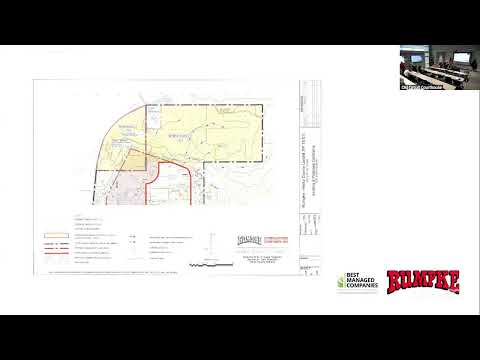
The rezoning request covers a multi-parcel tract described in the meeting as roughly 100 to 180 acres, including an upper roughly 80-acre area and smaller 40-acre portions. The applicant currently uses part of the site for cattle grazing and formerly used a portion — described in the meeting as a “paint barn” area — for dumpster refurbishment. The applicant’s representative said equipment and old vehicles have been removed and that some soil sampling has been completed to assess suitability for use as cover or cell construction.
Residents and nearby landowners told the planning body they were concerned about potential impacts to local water resources and wetlands. A public commenter, Bill Fribley, said: "A lot of people have a not my backyard attitude, and they are in my backyard." Several speakers said an underground water source or aquifer underlies part of the parcel and feeds wells and downstream water features, and they asked for documentation showing the site is not an "aquifer of significance." Meeting discussion referenced an existing wastewater treatment agreement for landfill leachate with the Newcastle treatment plant.
A planning staff or applicant representative described typical landfill construction and monitoring measures, saying that landfills are built with compacted clay, a synthetic welded liner, a drainage layer to collect leachate, and monitoring wells drilled around the facility that are sampled regularly. The representative said a state inspector (named in the meeting as Mike Sonnefeld) conducts spot inspections and that, if an "aquifer of significance" is present, regulations require additional measures such as a double-liner system or increased separation between the landfill bottom and the water table.
Speakers also discussed setback distances read from state guidance during the meeting: 600 feet from potable water supply wells (600 feet can be reduced to 600 with a waiver described in the meeting), 100 feet from classified wetlands, 200 feet from flowing rivers or streams, and 1,250 feet from a hospital. A number presented during the meeting for public-school setbacks was cited but unclear in the record. Participants raised concerns about a nearby pond, mapped flood areas that could back up toward the pond during heavy rain, and the possibility of future sale or different use if the entire parcel is rezoned now.
Several options were discussed to limit potential future expansion if the commissioners recommend approval, including parcel-splitting or a conditional approval (a Conditional Area Use or CAU) that would restrict development to the area the applicant proposed. Multiple speakers urged limiting rezoning so that only the portion the applicant presently intends to use would be subject to industrial zoning.
After discussion, the planning body voted to table the rezoning recommendation and asked staff to collect written hydrological information, obtain input from the Blue River Conservancy, and return the item at a future meeting (members referenced the possibility of taking it up at the September meeting). The motion to table was moved and seconded; the meeting record shows the motion passed unanimously.
The planning body said additional engineering work and permitting — including stormwater permitting and specific landfill design and state permitting — would be required before any physical expansion could occur. They also noted that state permitting (and possibly IDEM oversight) controls many technical standards and that the planning body's recommendation to county commissioners is one step in a multi-step process.
The planning body closed the item without taking a final position on rezoning and scheduled follow-up once staff and outside agencies supply the requested documentation.