Get Full Government Meeting Transcripts, Videos, & Alerts Forever!
Get email alerts on the Special Education Supports topic
No spam. Unsubscribe anytime.
State education center warns federal funding instability threatens special education supports and professional development
Summary
The State Education Resource Center (SERC) executive director said SERC relies on federal discretionary funds for 98% of its operating budget and warned that reduced federal grants would curtail professional development, library services and technical assistance that support special education statewide.
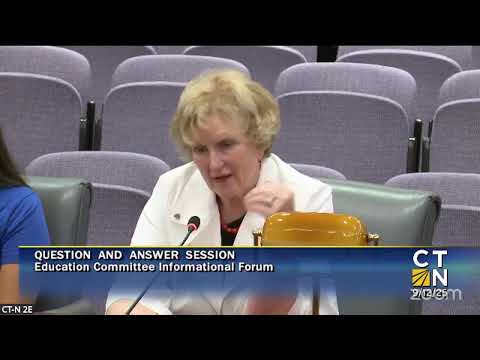
Dr. Ingrid Canady, executive director of the State Education Resource Center (SERC), told the Education Committee that roughly 98% of SERC’s funding comes from discretionary federal sources and that reductions in those grants have repeatedly forced staff layoffs and program reductions.
“Having a quasi public that is 98% dependent on federal funding creates uncertainty every single year,” Canady said. She described SERC’s work — maintaining a statewide library of tests and resources, providing technical assistance and professional development, and coordinating special education and school reform supports — and warned that cuts would reduce districts’ access to low‑cost testing resources, training and targeted interventions.
Canady traced SERC’s evolution from the Special Education Resource Center (est. 1969) to a quasi‑public entity and said the agency currently operates a library of more than 4,000 resources. She said the organization once employed about 100 staff, was reduced to roughly 39 after prior funding contractions, and that board planning had set a modest target of about 50 staff while federal funding remains uncertain.
She and legislators at the forum urged the legislature and the department to consider more stable state support for prevention‑focused work — early intervention, multi‑tiered systems of support, and professional development — that can reduce later special education placements. Senator McCrory urged the committee to consider a stable state line item or other sustained funding to preserve the center’s capacity to provide statewide prevention and intervention services.