Get Full Government Meeting Transcripts, Videos, & Alerts Forever!
Get email alerts on the Academic Performance topic
No spam. Unsubscribe anytime.
State Education Department: statewide test scores and chronic absenteeism show broad improvement
Summary
Connecticut officials reported year‑over‑year gains in statewide assessments across English language arts, mathematics and science and a third consecutive year of declines in chronic absenteeism, but leaders cautioned the state has not returned to pre‑pandemic performance levels.
The Connecticut State Department of Education told members of the legislature’s Education Committee that statewide results on 2024–25 end‑of‑year assessments showed gains across English language arts, mathematics and science and that chronic absenteeism declined for the third consecutive year.
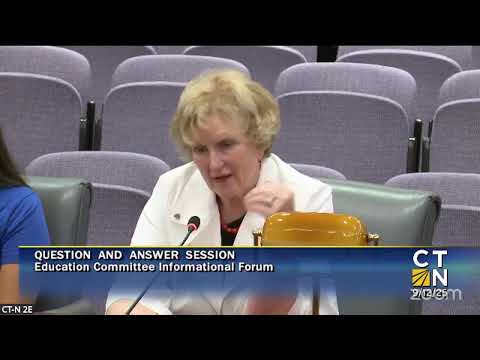
“We are seeing after the ’24–’25 year overall improvement in English language arts, mathematics, and science on our state end of year assessments,” Rajeev Gopalakrishnan, chief performance officer, said during the informational forum. “For the first time in a decade…we're seeing improvement in all student groups, all grades, across all these subjects.”
The department said alliance districts — the state’s 36 high‑need districts — accounted for much of the progress: 28 of 36 alliance districts showed year‑over‑year improvement in ELA and 26 of 36 improved in mathematics in 2024–25. The department also reported that chronic absenteeism fell from a 2021–22 peak and estimated about 34,000 more students were attending school regularly compared with that high point.
Commissioner Charlene Russell Tucker credited a suite of state investments and evidence‑based supports for the gains, including a model curriculum, scientifically aligned reading instruction, no‑cost interim assessments, the LEAP home‑visiting program and high‑dosage tutoring. “There are lots of good things we're investing in that we have evidence to show that it works,” the commissioner said.
Officials cautioned, however, that the state as a whole has not returned to pre‑pandemic achievement levels dating to 2014–15. They also highlighted persistent challenges in high school attendance and the continuing gap between high‑need student groups and the general population. The department said it would make district‑level data available through the EdSight portal for further review.
Superintendents invited to a department press event were recorded on a closing slide describing how district‑level use of state resources — for example the Science of Reading master classes and behavioral health pilots — is contributing to instructional gains, according to the commissioner.
Connecticut education leaders said the results provide momentum for continuing or scaling investments targeted at proven strategies while acknowledging more work remains to reach pre‑pandemic outcomes.