Get Full Government Meeting Transcripts, Videos, & Alerts Forever!
Get email alerts on the Enterprise Budgets topic
No spam. Unsubscribe anytime.
Appropriations Committee reviews enterprise fund budgets: seaport, aviation, housing, RER/DERM, libraries, water and sewer
Summary
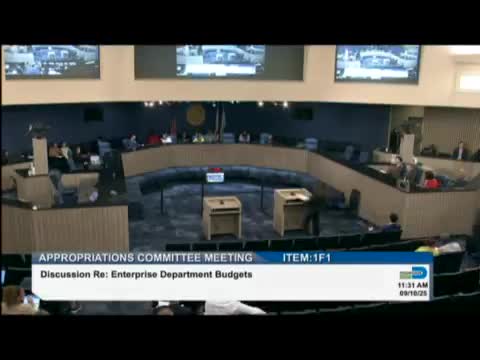
Directors of Miami‑Dade County enterprise departments presented proposed budgets, staffing and capital programs to the Appropriations Committee; commissioners questioned vacancies, overtime, capital plans and select marketing line items.
Miami‑Dade County’s Appropriations Committee spent substantial meeting time reviewing enterprise (proprietary) department budgets—departments that do not draw on the county general fund but operate on fees, leases and federal grants. Directors from Seaport, Aviation, Housing and Community Development, Regulatory and Economic Resources (RER)/DERM, Libraries and Water & Sewer presented revenue, staffing and capital plans and answered commissioners’ questions.
The presentations emphasized that enterprise departments remain accountable to the board even though they operate outside the general fund, and commissioners pressed directors on vacancies, overtime, capital projects and certain advertising/marketing line items.
Seaport
Heidi Webb, director of the Seaport Department, described the seaport as a self‑funded proprietary operation and gave the department’s projections and key metrics. “We are the number 1 cruise port in the world. We had 8,200,000 cruise passengers that came through our Port Of Miami last year,” Webb said. She reported the department projects guaranteed revenues of about $346,000,000 from long‑term contracts and leases and described a combined projected revenue next year (including reserves and contractual guarantees) of about $768,000,000. Webb said the seaport plans roughly $368,000,000 in capital spending next fiscal year, including revenue‑generating cruise and cargo projects and an eight‑year North Bulkhead rehabilitation.
Webb said the seaport employs 518 full‑time positions, with 427 filled and 91 vacancies; “74 of these 91 vacancies … have not been filled in the last 6 months,” she said, and noted the department’s hiring was affected in part by a mayoral hold earlier this year. Webb highlighted the seaport’s reserve position and said the department remains focused on cost control and daily review of expense lines.
Aviation
Ralph Couture, director of Miami‑Dade Aviation Department, gave an overview of airport performance and budgets. “We’ve had our third straight year of record breaking passenger volume, which concluded with 56,000,000 passengers last year,” Couture said, and he listed large operational and capital budgets: an operational budget of about $1,274,000,000 and a $699,000,000 capital program for the year, with a longer‑term capital program running into the billions to accommodate projected growth. Couture said the airport is a residual model (self‑supporting with a mix of aeronautical and non‑aeronautical revenue), is projecting 77,000,000 passengers by 2040 and aims to reduce overtime by filling positions; he said the department expects to eliminate about $8,100,000 in overtime by hiring requested staff.
Public housing and vouchers
Nathan, a Housing and Community Development representative, described four funding “pillars”: public housing (about 6,000 units housing roughly 10,000 residents); housing choice vouchers (about 22,000 vouchers, with ~19,000 tenant‑based); community development (surtax and HUD CDBG programs); and redevelopment (RAD/project‑based vouchers and infill). Nathan explained that the department faces recurring federal funding mismatches for vouchers as rents have risen. “HUD’s funding assumptions have not matched our rent inflation,” he said, and described a national funding shortfall for vouchers; he said Miami‑Dade has worked the shortfall down from an earlier federal projection of about $77,000,000 to approximately $45,000,000 through local measures and engagement with HUD and federal lobbyists.
RER / DERM and resilience marketing
Lourdes Gomez of RER outlined permitting and staffing challenges; she said RER has roughly 296 vacancies with about half open more than six months, a result in part of a mayoral hiring pause. She highlighted three persistent hiring pressures: structural engineers, hydrogeologists (for pollution remediation and well‑field protection) and IT staff. Several commissioners pressed for detail on marketing and advertising budgets tied to resilience and Biscayne Bay initiatives. Staff provided line items cited in the meeting: a $300,000 watershed‑study consultancy, $500,000 for a back‑bay study, $100,000 for Biscayne Bay marketing and $250,000 for an extreme‑heat public outreach campaign; commissioners asked for a written breakdown and for staff to identify duplications across departments.
Libraries
Ray Baker, director of Miami‑Dade Public Library, said the library is funded by a special district millage, not general fund, and that the system’s budget is largely stable. He reported head count growth from 634 to 662 over several years and said about 288 of roughly 817 positions are part time. Baker outlined capital projects and outreach programs, and said the system had brought in more than $39,000,000 in grant funding over the last decade.
Water & Sewer capital funding and rates
Water & Sewer staff summarized a proposed capital financing plan that initially sought a 6% across‑the‑board rate increase to support roughly $560,000,000 in capital needs. After discussion and identification of recurring savings, the department reduced the proposed increase to 3.5%, a change staff said would still meet bond covenant coverage requirements. Staff presented customer impacts — for example, a small monthly increase for minimum users and under $1 per month for an average single‑family home under the reduced proposal — and warned that further reductions to the plan would require cutting capital projects, many of which staff said are mandated by consent decrees or ocean outfall legislation and are already behind schedule.
Fire boats and port contribution
Commissioners discussed whether the Port should contribute toward specialized fireboats. Fire Chief Ray Jadalla said the operating cost for a 24/7 fireboat is in the ballpark of $5,500,000 annually and that some port‑area vessels were designed to meet special cruise‑ship firefighting criteria; he deferred to the board on whether the port should pay toward the boats. Port staff later noted a docking/rent figure the port pays for fire services and suggested the board consider treating the port’s existing rent/docking payments as the port’s contribution toward fireboat costs.
Follow‑up requests and board direction
Multiple commissioners asked staff for written follow‑ups on advertising and marketing line items, staffing vacancies, vacancy timelines and the rationale for fund allocations. Commissioners also asked for briefings or documentation from the Biscayne Bay Watershed Advisory Board and other task forces referenced in the presentations. Staff said they would compile answers and provide them in writing ahead of further budget deliberations.
Ending
Directors framed the enterprise budgets as fiscally robust in several departments but highlighted persistent operational challenges — hiring for technical positions, federal voucher funding mismatches and large capital programs that must proceed on schedule. Committee members directed staff to provide written follow‑ups on specific questions about vacancies, marketing/advertising spending and water & sewer project timing ahead of the board’s final budget vote.