
Trussville City Schools holds first public hearing on 2025–26 budget; board approves consent and personnel items
Get AI-powered insights, summaries, and transcripts
Subscribe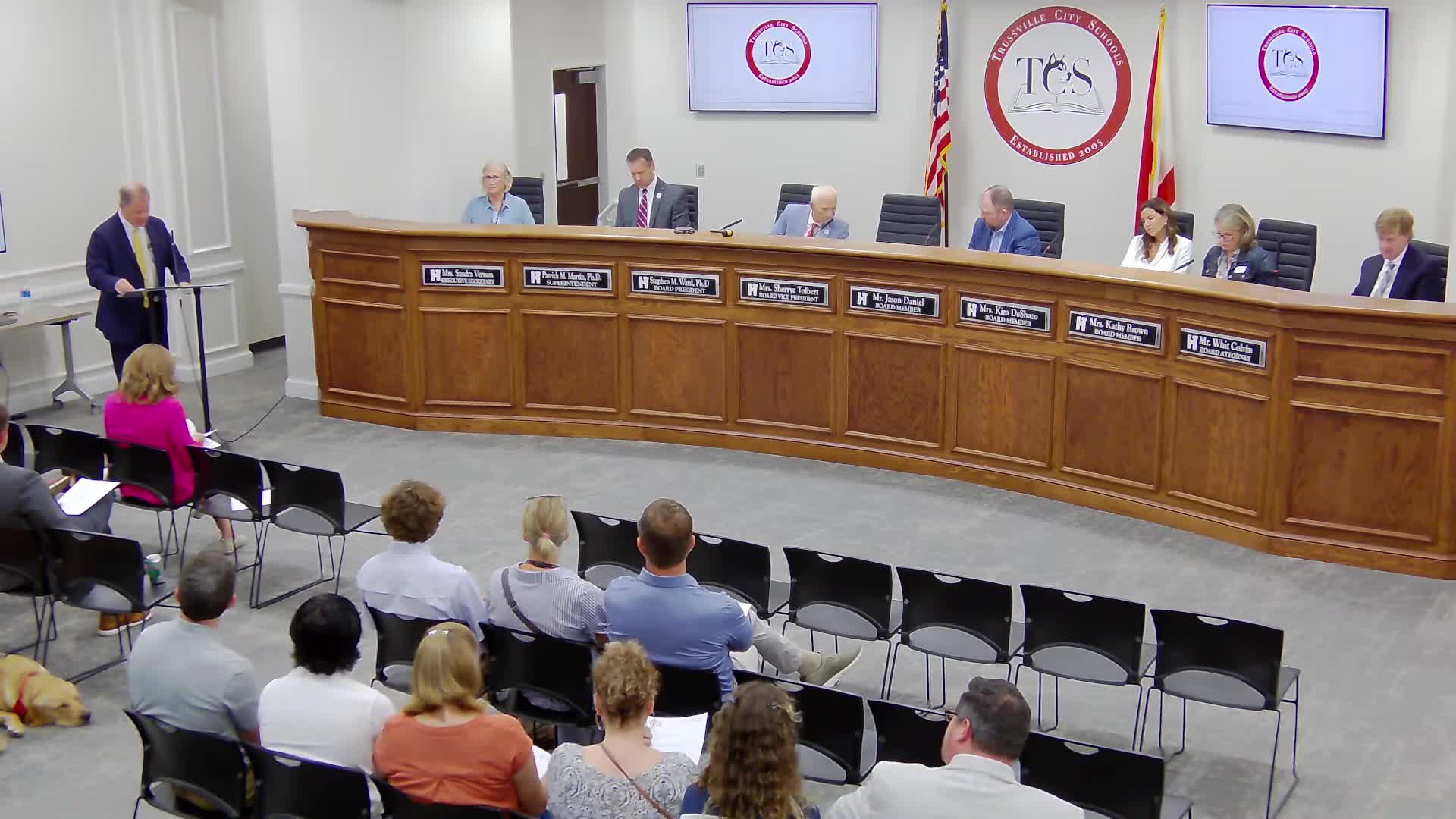
Summary
At an August meeting, the Trussville City Schools board heard the first public hearing on the proposed fiscal 2025–26 budget, reviewed capital projects and transportation issues, heard an overview of district debt and special education funding, and approved the agenda, consent agenda and personnel report by voice votes.
Trussville City Schools on Wednesday held the first required public hearing on its proposed fiscal year 2025–26 budget, during which district staff reviewed revenue sources, capital projects and transportation needs and outlined debt and special-education spending. The board then approved routine business including the consent agenda and the personnel report by unanimous voice votes.
The budget presentation outlined projected revenues and expenditures across the district’s fund types and explained that state funds make up a majority of the district’s revenues. "For all of our fund sources and fund types, state [funding] is $39,400,000, or 52.1%," the presenter said, and local sources account for about 45.9% of the total. The presenter also summarized line-item trends and drivers, including an increase in fringe-benefit costs tied to a higher medical-insurance rate set by the provider board.
Why it matters: The hearing begins the formal public-review period required by state law before the board adopts a final budget; district leaders used the presentation to flag operating pressures (rising benefits costs), near-term capital needs and transportation challenges that could affect spending priorities.
Board members and staff described the district’s major capital projects and bus procurement timeline. The presenter said the district has 17 buses on order, five of which have been awaiting delivery for nearly two years and face a more-than-200-day backorder; those deliveries should raise the district’s fleet-renewal funding when completed. Ongoing capital projects cited included a new softball competition field (final inspection expected next week) and stadium turf/track work nearing completion. A multi‑phase classroom wing addition at the high school began this summer and is expected to finish around December 2026, the presenter said.
State Representative Danny Garrett addressed the meeting and described recent changes in state education funding. "We radically changed the funding formula that's gonna give additional money to all systems based on their student needs," Garrett told the board, describing an effort to allocate an additional pot of money tied to measures such as poverty, English-language learners and special-education needs. Trussville City Schools, Garrett said, will receive an additional $560,000 for programs and roughly $350,000–$360,000 earmarked for special-needs funding as a result of the change.
The presenter also reviewed special-education funding and district cost-sharing: the district spends just under $5,000,000 from state sources for special education, about $1,700,000 from local funds and just under $1,000,000 from federal funds. The presenter noted that federal funding typically covers roughly 12%–13% of special-education costs while the district bears the remainder.
Debt and capital planning were discussed in detail. The presenter listed four bond issues on the school side totaling approximately $32.9 million and additional city debt that is connected to school projects; when combined with city-held debt tied to school projects, the presenter said about $72 million in debt is attributable to the Board of Education. The presenter also said the district will present a draft five‑year capital plan at the September meeting and that several smaller projects are planned using time‑sensitive state capital-outlay and technology allocations.
After the budget presentation, the board voted on routine business. By unanimous voice vote the board adopted the meeting agenda, approved the consent agenda (which included facility-use agreements, field-trip requests and construction change orders), and approved the personnel report (which included hires, transfers, resignations and other personnel actions). The meeting included multiple recognitions of staff and students earlier in the agenda, and the board set a second public hearing on the budget for the next scheduled meeting.
Votes at a glance: - Adoption of meeting agenda — approved by voice vote (ayes recorded). - Consent agenda (74 items) — approved by voice vote. - Personnel report — approved by voice vote. - Motion to adjourn — approved by voice vote.
The board will hold its second required budget public hearing at the next regular meeting; the budget may be adjusted before final adoption.