Get Full Government Meeting Transcripts, Videos, & Alerts Forever!
Get email alerts on the Municipal Budget topic
No spam. Unsubscribe anytime.
San Marcos council approves first reading of $371.1 million budget, sets maximum tax rate at 67.69¢
Summary
On first reading the San Marcos City Council approved the city’s FY2026 operating budget and set a maximum proposed property tax rate of 67.69¢ per $100 of taxable value, a move staff says will provide $2.3 million in recurring revenues and $1.3 million in one‑time funds for capital and community priorities.
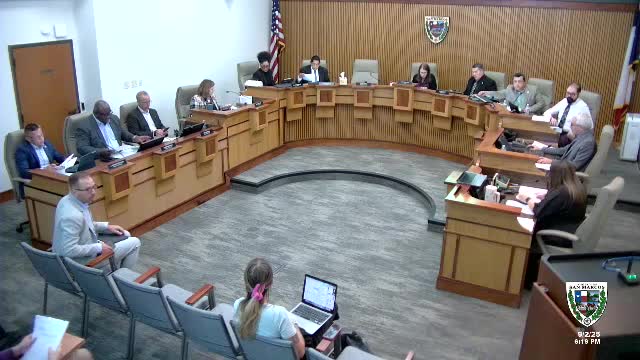
San Marcos — The San Marcos City Council on Tuesday approved on first reading an operating budget for fiscal 2026 and set a maximum proposed property tax rate of 67.69¢ per $100 of taxable value, measures council members said are intended to preserve city services and create limited one‑time funding for deferred needs.
The council approved ordinance 2025‑36 on first reading to adopt an operating budget staff outlined at roughly $371 million for the fiscal year beginning Oct. 1, 2025, and set the maximum proposed tax rate under ordinance 2025‑37 by a 7‑0 vote. Council members said final adoption of the budget and a final vote on the tax rate are scheduled for Sept. 16, 2025.
Why it matters: City staff told the council that property and sales tax revenues have not kept pace with growing costs and that several state bills under consideration could further limit local revenue growth. Staff said the 67.69¢ rate would generate about $3.5 million more than the current rate and provide approximately $2.3 million in ongoing capacity and $1.3 million in one‑time funding to address deferred capital and community priorities.
Budget and tax highlights
- Proposed operating budget (FY2026, first reading): approximately $371,102,562. - Staff figures discussed during the presentation: estimated total revenues of about $372.3 million, total expenses of roughly $371.0 million and an ending fund balance estimated near $143.0 million. - Proposed capital improvements program (figures shown in presentation): staff referenced a multiyear CIP and figures presented for planned projects. - Tax rate: council set the maximum proposed rate at 67.69¢ per $100 of taxable value for FY2026; council must vote again on second reading Sept. 16. Staff said the average homestead would see a $137 annual increase at that rate (about $11.48 per month).
Staff and council discussion
City staff framed the budget around rising personnel and operating costs and several large cost drivers. “The city’s two main revenue sources are property tax and sales tax, and they’re just not keeping pace with the expenses of the city,” Reyes, a city staff member leading the budget presentation, told the council during the hearing. She said the city is also watching pending state legislation — including references to House Bill 73 and Senate Bill 10 discussed in the presentation — that could cap local spending and reduce long‑term flexibility.
A major new local cost was highlighted during the meeting: changes to emergency medical services in the region. Reyes told the council staff currently estimates an additional roughly $2.0 million annually will be needed to stand up local EMS services after a regional partnership winds down; staff described that figure as an ongoing baseline cost and said start‑up or first‑year expenses could be added on top of it.
Citizen comments and social services funding
Several residents used the citizen comment period to urge the council to increase support for social services. “I think increasing the budget to that $750,000 funding is going to be essential to move forward as a city,” said Casey Baker, a San Marcos resident, urging larger allocations for the Human Services Advisory Board programs. Maxfield Baker, another resident, told councilors “our budget is a moral document” and urged a community‑focused approach to incentives and operating priorities.
Staff said the proposed budget includes an existing recurring allocation of $200,000 for the Human Services Advisory Board and that, at the 67.69¢ tax rate, about $1.3 million in one‑time funding could be made available for deferred capital projects or short‑term community needs. Staff emphasized that one‑time funds could be used to seed pilot programs or participatory budgeting, but recurring service increases would require a recurring revenue source or cuts elsewhere.
Next steps and votes
- The city held the statutorily required first public hearing on the budget and will hold a second hearing Sept. 16, when council will consider final adoption of the FY2026 budget and a final vote on the tax rate. Staff emphasized that, if the council does not adopt a tax rate, the tax rate would default to the lower of the current or no‑new‑revenue rate and additional cuts would be required.
Votes and formal actions (summary): - Ordinance 2025‑36 (FY2026 budget) — motion by Mister Scott, seconded by Mister Mendoza; first reading approved 7‑0. - Ordinance 2025‑37 (set maximum proposed tax rate at 67.69¢) — motion by Miss Rodriguez, seconded by Mister Mendoza; first reading approved 7‑0.
What councilors said they will watch next: councilors asked staff to return with more detail on options for EMS delivery models and startup costs, on a participatory budgeting pilot for one‑time funding, and on clarifications for how one‑time versus recurring allocations would be handled in FY2027. Staff said a second public hearing on Sept. 16 will include additional materials, and that several line‑items depend on the final tax‑rate decision.
Ending: The council’s Sept. 16 meeting will include the second public hearings and the final votes to adopt the budget and set the FY2026 tax rate. Until then, staff will continue to refine the budget documents and provide the additional cost and operational detail requested by council members.