Get Full Government Meeting Transcripts, Videos, & Alerts Forever!
Get email alerts on the Mental Health Services topic
No spam. Unsubscribe anytime.
Regional mental-health centers describe expansion, workforce needs and new CCBHC funding
Summary
Representatives of Marion County’s four community mental-health centers told the City-County Public Safety Committee on Aug. 27 that access has grown but workforce shortages and housing instability limit capacity.
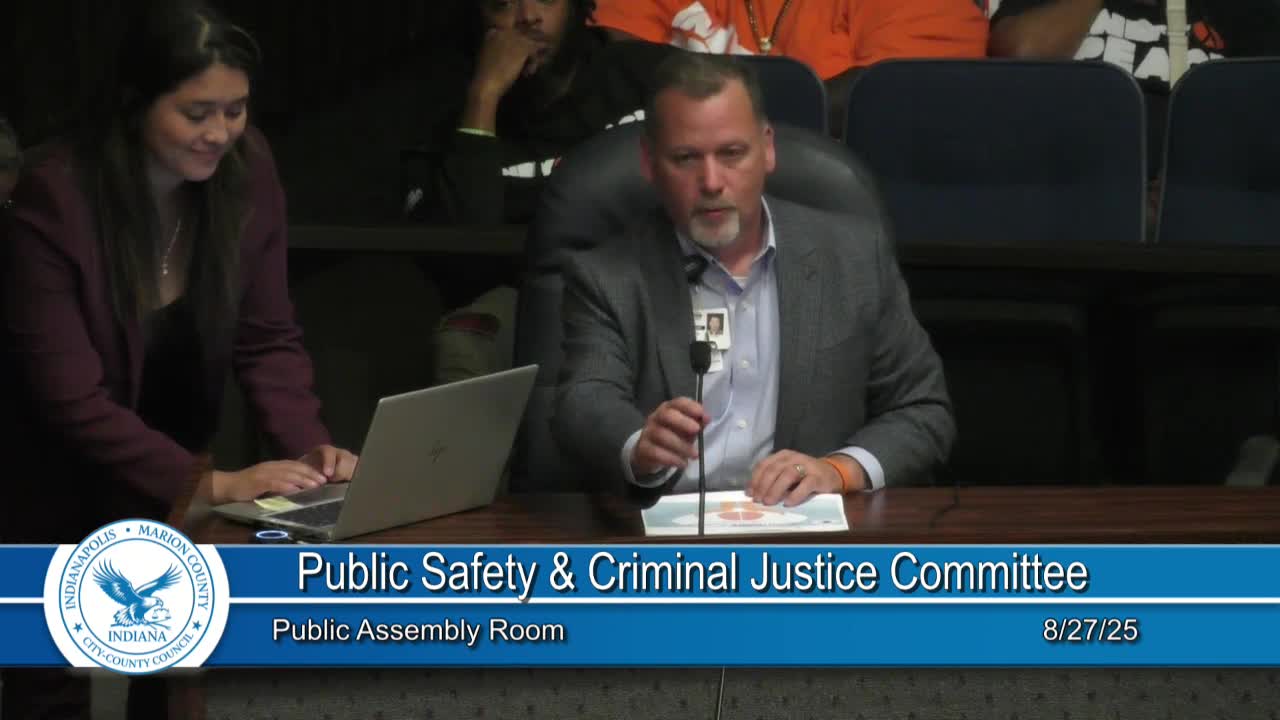
Four regional community mental-health providers briefed the City-County Public Safety Committee on Aug. 27 about treatment access, workforce challenges and a federal-state program to expand behavioral-health funding.
George Hurd, vice president for behavioral health at Community Health Network, represented the group and described county funding rules and braided revenue streams that community mental health centers (CMHCs) use to serve higher-need patients. Hurd said county tax levies that support centers are set by state code and estimated county funding in this budget cycle at about $8.7 million, but warned that those dollars usually are combined with state and federal funding to provide full-service care.
Hurd said the state’s CCBHC (Certified Community Behavioral Health Clinic) demonstration program — a federal/state-backed financing model that pays centers on a cost-report basis rather than strictly fee-for-service — should expand access and improve workforce pay. Two Marion County providers were early CCBHC demonstration sites and the group urged continued local support to take advantage of new funding streams.
Service size and gaps: The providers reported serving more than 61,000 individuals last year across outpatient care, medication-only services, intensive community-based care and residential services. The four centers said they provided more than $28 million in charity care and that treatment demands were expanding for both mental-health diagnoses and substance-use disorders. Centers also noted substantial housing instability among clients — roughly one-third of clients reported residential instability on intake, according to the presentation.
Workforce and training: The speakers told councilors CMHCs together employ roughly 2,300 staff in Marion County and that workforce recruitment and retention remain their primary operational constraint. Hurd and others described a Behavioral Health Academy and pathways to grow and train clinicians, including care-coordinator career ladders and partnerships with area universities, to fill clinical roles.
Outcomes and system goals: Hurd said CCBHC reimbursement models elsewhere have shown improved access for children, uninsured people and people seeking substance-use care and that better funding could let local centers scale mobile crisis teams, school-based services and crisis stabilization without driving down staff pay or service quality.
Why it matters: Mental-health and substance-use services are closely tied to community safety, homelessness and reentry outcomes. Committee members asked how the centers coordinate with OPHS, hospitals and mobile crisis teams; Hurd said the centers collaborate and use county dollars as local match to pull down additional state and federal funds.
Ending: Councilors thanked providers and encouraged improved data collection and coordinated approaches to workforce development and residential capacity.