Get Full Government Meeting Transcripts, Videos, & Alerts Forever!
Get email alerts on the Public Health And Safety Budget topic
No spam. Unsubscribe anytime.
Office of Public Health and Safety outlines $27.97 million 2026 budget, highlights violence-reduction and tenant aid
Summary
The Office of Public Health and Safety presented a 2026 budget of $27,974,790 to the City-County Public Safety Committee, emphasizing the city’s gun violence reduction strategy, eviction-prevention work and expansion of crisis-response services. Staff and public speakers urged continued funding for tenant legal aid and immigrant legal services.
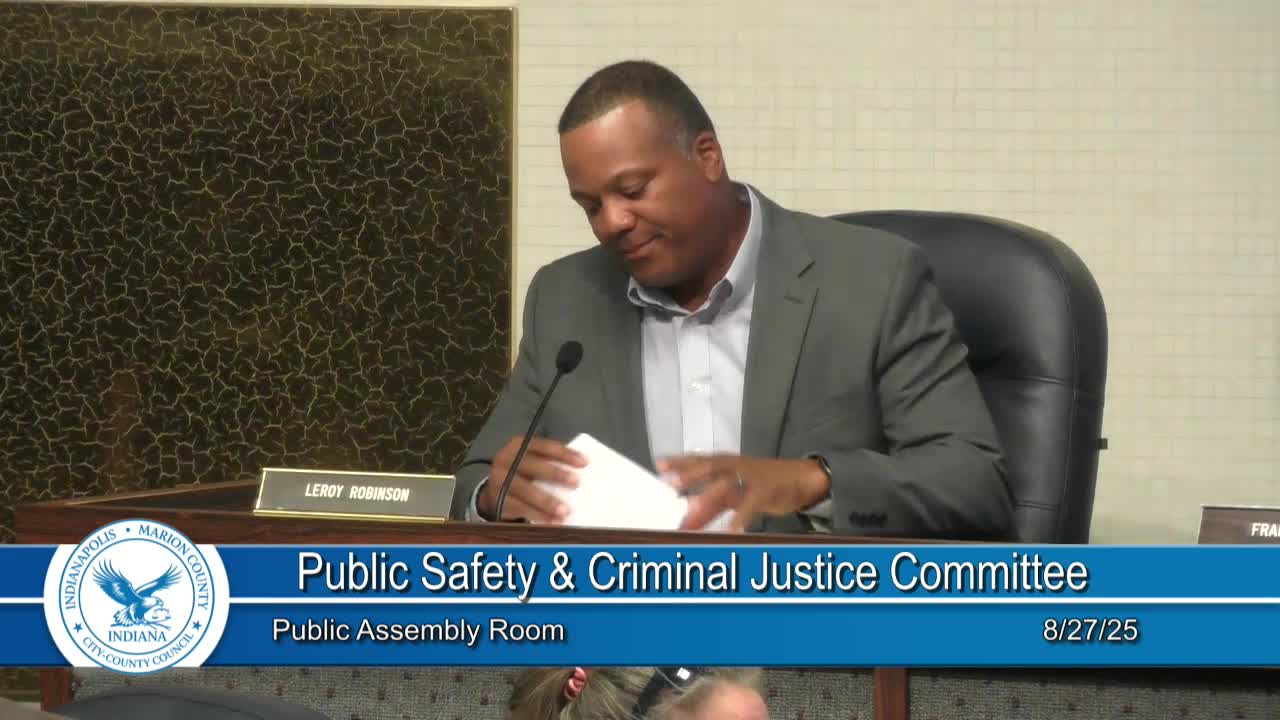
The Office of Public Health and Safety (OPHS) presented its 2026 budget proposal to the City-County Public Safety Committee on Aug. 27, asking the committee to approve a $27,974,790 package of consolidated county funds, federal grants and opioid-settlement dollars while describing program outcomes and planned priorities.
Carla Duffy, OPHS chief financial officer, told the committee the total introduced budget by fund is $27,974,790, comprised of $22,504,231 in consolidated funds, $4,470,559 in federal grants and $1,000,000 in opioid settlement dollars. Duffy said the introduced 2026 budget represents an overall reduction from 2025 of about 2% (roughly $516,002), or nearer 4% if an approved TAP request of $500,000 is excluded.
Director Andrew Merkley said the agency’s portfolio includes violence-reduction programs, reentry services, the Assessment and Intervention Center (AIC), the Release Lobby at the Community Justice Campus, food-access programs and eviction/tenant assistance. Merkley highlighted the city’s Gun Violence Reduction Strategy (GVRS), noting a reported 50% reduction in murders and nonfatal shootings in the city since the program’s launch; he credited coordinated investments, partners and targeted outreach.
What OPHS asked for and will spend: Duffy described key program budgets and shifts. - Consolidated county funds: $22.5 million (primary operating fund). - Federal grants: $4.47 million (including Byrne grants supporting behavioral health and NDPs activities). - Opioid settlement funds: $1.0 million (to support behavioral-health data infrastructure and services). - FTE: OPHS proposed no change to its staffing count (35 FTEs), though Duffy said some titles and grades were being adjusted for equity.
Program highlights and outcomes: OPHS reported that its divisions collectively provided tens of thousands of contacts last year — an OPHS summary cited more than 65,000 behavioral-health and crisis contacts and more than 61,000 unique individuals served across the county by the four community mental health providers. The agency said it provides 162 school-based behavioral-health services locations, 27 outpatient clinics, 151 acute psychiatric beds, detox and residential capacity and a countywide grocery-access program (LIFT) that has helped more than 169,000 household food deliveries.
OPHS also described a county-run Tenant Advocacy Project (TAP) and eviction-avoidance work. Merkley and Duffy said TAP is being expanded and the 2026 introduced budget includes an additional $500,000 for the tenant program. OPHS said the Release Lobby — which opened 24/7 in 2022 to give people released from custody access to transportation, hygiene supplies and navigation services — has connected people to housing and employment; reentry staff have worked with landlords willing to accept people with justice-involvement backgrounds.
Crisis response and behavioral-health expansion: OPHS noted progress in building mobile crisis capacity and electronic health records for the Assessment and Intervention Center and the clinician-led community response teams; Duffy said a federal Byrne behavioral-health grant will fund a new data platform to coordinate services between AIC, REC, CLCR and MCAT teams.
Budget pressure and priorities: Duffy said character-3 contract and services spending was reduced by roughly $584,946 from 2025. The Rubin/Assessment and Intervention Center consolidated budget was shown with a $1 million reduction offset by $1 million in opioid settlement funds. OPHS plans to continue community-oriented procurement and to build more rigorous program-level data collection and outcome tracking, Merkley said; he added OPHS will administer grants including Byrne awards and Elevation grant funds managed by partners.
Public testimony and community reaction: Several representatives from legal aid programs and food-system nonprofits addressed the committee after the OPHS presentation. Speakers urged the council to preserve or increase city funding for tenant legal assistance, immigrant legal-services grants and food-access programs. Highlights of public comment included: - Tracy Pappas, managing attorney, Indiana Legal Services: said TAP provides tenants with representation and helps prevent cascading harms from eviction. She cited that eviction disrupts families, school and health and said legal counsel in court levels the playing field. - John Florencic, Indianapolis Legal Aid Society: said the TAP program connects eviction prevention to broader public-safety outcomes by reducing instability and overcrowding. - Hannah Cartwright, Mariposa Legal (immigration legal services): urged the council not to cut the $100,000 immigrant legal-services fund, warning of immediate impacts if funding falls.
Council response and next steps: Councilors praised many of OPHS’s programs but expressed concern about budget cuts and asked for additional detail in some areas. Councilor Carlino said the proposed reductions give her pause given OPHS’s role in violence prevention. Councilor Perkins asked about OPHS’s internal culture and whether the department was prepared to implement program changes; Merkley responded that leadership had worked to rebalance workloads, regrade positions and improve data capacity. Several councilors asked OPHS to return with more program-level data and clarified plans for winter-contingency sheltering, eviction diversion and Streets2Home housing placements.
Why it matters: OPHS oversees programs that city leaders say address root causes of violence, homelessness and food insecurity. The proposal includes spending tied to both immediate services and investments intended to expand coordinated crisis-response and housing capacity; councilors will consider the introduced budget as part of the full city-county budget process.
Ending: OPHS will provide additional program-level data and follow up with the committee on winter contingency plans, TAP program metrics and the operational details behind the budget adjustments.