Get Full Government Meeting Transcripts, Videos, & Alerts Forever!
Get email alerts on the Police Policy topic
No spam. Unsubscribe anytime.
Public safety committee rejects changes to General Orders Board and curfew fines
Summary
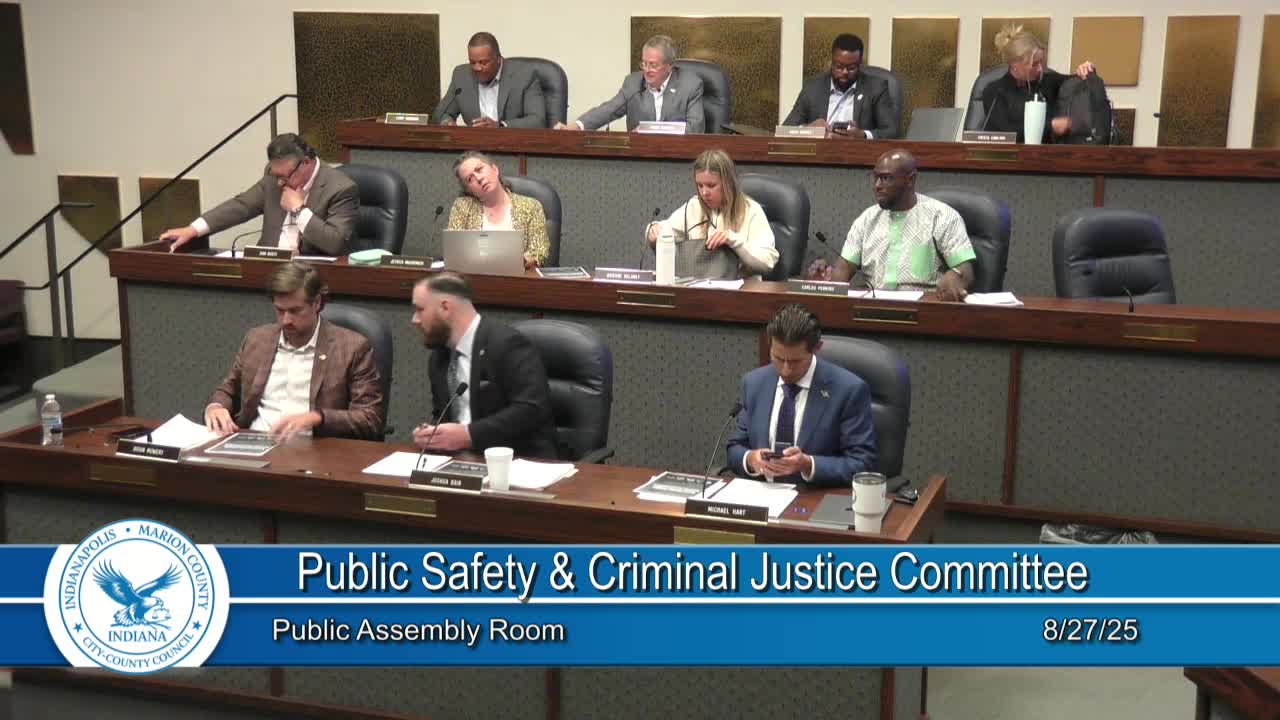
The Indianapolis City-County Public Safety Committee voted down two measures on Aug. 27 that would have changed oversight of police general orders and added civil fines for parents of juveniles who violate curfew.
Proposal outcomes: The Indianapolis City-County Public Safety Committee on Aug. 27 voted down two measures that would have changed oversight of Indianapolis Metropolitan Police Department policy-making and added civil fines tied to juvenile curfew violations.
The committee rejected Councilor Michael Paul Hart’s ordinance to convert the General Orders Board into an advisory board so the police chief would have final authority to create, amend or rescind general orders. Councilors debated officer morale, community voice and the board’s origin in 2020 reforms. Councilor Hart, the proposal’s sponsor, said the changes were requested by rank-and-file officers and community leaders and were intended to “give the chief the agility to adapt when things do arise.” Councilor Hart added that officers had told him they “feel that their hands are tied, unable to act decisively, when circumstances demand it.”
Opponents said the 2020 board created a public check after national protests and that changing it would remove a formal community role. Councilor Carlos Perkins opposed the measure, saying the board was created in 2020 in response to national calls for accountability and that “if the concern is about quorum, it is my understanding that under this new leadership this year, when the board have met, that they have had quorum.” Councilor Krista Carlino, who helped lead establishment of the board, said the board preserved community oversight while allowing the chief to act in emergencies.
Chief of Police Randall Bailey, who addressed the committee, said he would follow whatever law the council adopts and stressed his desire for “transparency, accountability, and collaboration, both for our community and our officers.” He told the committee that modernization of the department’s policies is a priority and warned that long gaps between board meetings had hampered operations in the past.
Vote on the General Orders Board proposal (2-44-2025): The chair called for a roll-call vote. The clerk recorded a 3-yes, 8-no result and the motion failed. Named recorded votes in the transcript: Yes — Councilor Boehm, Councilor Michael Paul Hart, Councilor Maury. No — Councilors Boots, Krista Carlino, Kelsey Delaney, Keith Graves, Frank Mascari, Jessica McCormick, Carlos Perkins, Leroy Robinson. (Motion outcome: failed.)
Juvenile curfew enforcement and parental fines: Councilor Hart’s second proposal would have added an enforcement sequence to the juvenile curfew ordinance: a written notice for a juvenile’s first offense, a civil fine of $500 for a second offense and $1,500 for a third offense, with citation and court processes available for repeat cases. Hart said the intent is to create “a level of parental accountability” after the council recently adjusted curfew hours.
Opponents called the fines regressive and potentially discriminatory. Councilor Kelsey Delaney and others urged caution and asked for data showing repeat offenders; Hart acknowledged that existing data are limited because officers historically did not cite many curfew cases and said the new ordinance would help create records going forward. Several councilors and public commenters suggested alternatives such as mandatory parenting classes, expanded diversion, or stronger prevention and youth programming rather than steep fines.
Vote on the juvenile curfew amendment (2-45-2025): The committee took a roll-call vote after public comment and discussion; the motion failed on a committee vote. The transcript records the final outcome as “motion has failed to pass 2-45-2025.” The clerk’s roll-call read portions of the vote; the transcript does not contain a complete, verified tally for every member. (Motion outcome: failed; final vote tally not fully specified in the committee transcript.)
Why it matters: Both measures were framed as responses to rising concerns about public safety, officer recruitment, and youth violence, but they prompted conflicting views about where accountability should sit — with elected leaders and community representatives, or with the police chief and department leadership. The council’s decisions preserve the existing structure and pause imposition of the proposed fines while signaling appetite for further study and possible state-level interest, according to Councilor Hart.
What’s next: Sponsors suggested continued work and outreach. Councilor Hart said he would pursue further conversations and warned the state legislature was watching the local debate. Several councilors asked for more public input, firmer data on curfew incidents and possible alternatives to fines.
Votes at a glance (formal actions recorded in the committee transcript): - Proposal 2-44-2025 (amend Chapter 2.79, Division 9 — General Orders Board → advisory): Mover/second not specified in transcript. Vote recorded in committee transcript: 3 yes, 8 no — outcome failed. - Proposal 2-45-2025 (amend Chapter 3.81 — juvenile curfew, parental enforcement fines): Mover/second not specified in transcript. Committee outcome recorded as failed; full roll-call tally not specified in the available transcript.
Public comment and context: Public testimony at the meeting included supporters of empowering the chief (including a letter cited by Hart from several business leaders) and opponents who urged preserving community oversight and caution about civil fines for families. Several speakers, including local legal-aid attorneys, later addressed eviction diversion and tenant advocacy during a separate budget presentation (see separate coverage). The police chief said he was not advocating a particular structure but emphasized the need for predictability, training and prompt policy updates.
Documentary evidence: The committee transcript shows the proposals introduced and the roll-call action; excerpts and the clerk’s roll-call statements are in the meeting record.
Ending: The committee’s votes preserve the current General Orders Board structure and defer action on civil parental fines for juvenile curfew violations, while members on both sides urged further outreach, data collection and continued debate.