Get Full Government Meeting Transcripts, Videos, & Alerts Forever!
Get email alerts on the Climate Change topic
No spam. Unsubscribe anytime.
Hawaii County committee reviews climate chapter of 2045 general plan; postpones final action
Summary
Planning staff presented the draft climate-change chapter of the 2045 Hawaii County General Plan. Council members pressed for clearer priorities, benchmarks, cost figures and implementation roles; a motion to postpone further action to Sept. 17 passed 7–0 with two absences.
Planning staff presented the draft climate-change chapter of the Hawaii County 2045 General Plan and fielded extensive questions about implementation, funding and measurement before the Policy Committee voted to postpone further consideration to Sept. 17.
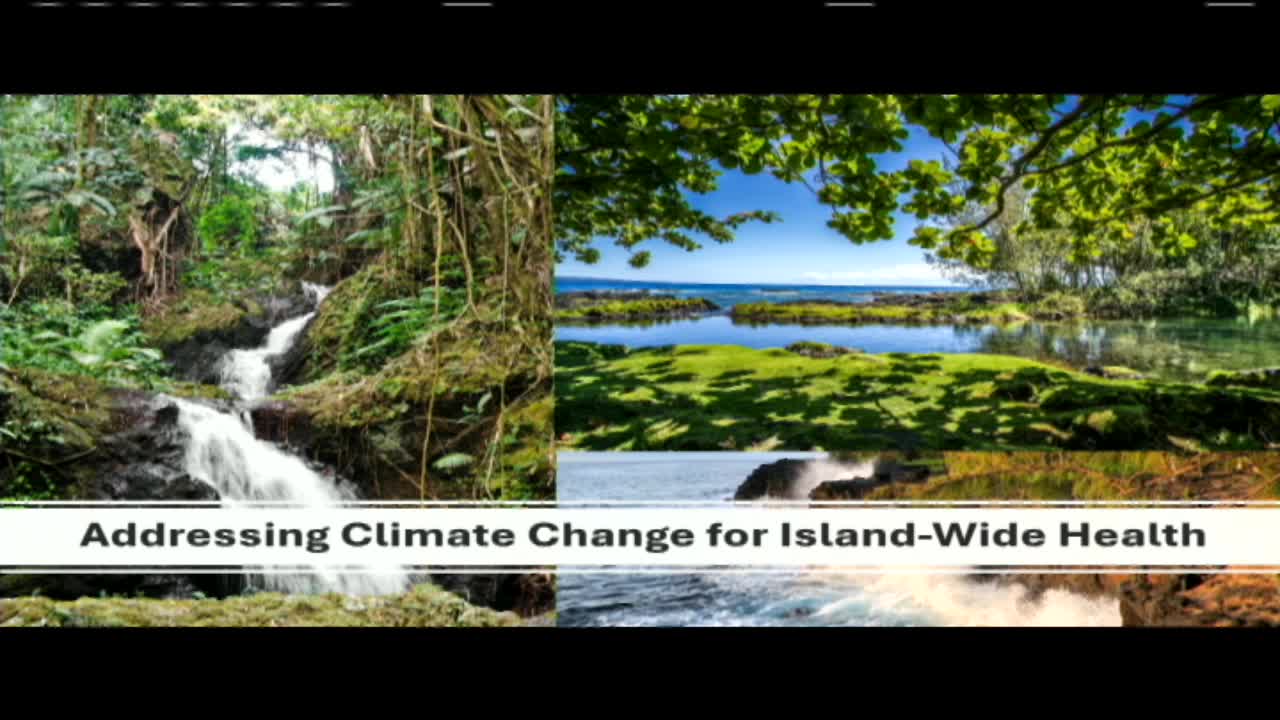
The presentation was given by Bethany Morrison, long-range planning program manager in the county Planning Department, who said the new chapter “has one goal, to ensure a just transition to a climate resilient island by addressing the causes and impacts of climate change through incorporating equitable climate mitigation and adaptation priorities into policies, programs, infrastructure, and decision making.” The chapter pairs climate mitigation (reducing greenhouse-gas emissions) with adaptation (reducing vulnerability to sea-level rise, drought and other impacts) and ties those priorities to transportation, energy, water, waste and land-use sections of the plan.
Committee members and staff repeatedly pressed for details about how the chapter would be implemented. Councilmember Kirkowitz and others asked who would maintain the monitoring dashboard and how often progress reports would be produced; Morrison said the plan calls for progress via the mayor’s annual report and a five-year implementation status report, and that the planning director will provide that status report. Director Jeff Darrow said the original annual reporting requirement proved “overwhelming to the department” and that the five-year status report and annual mayoral reporting are the practical monitoring approach going forward.
Members said the chapter contains many action-style items without clear priorities or funding. Councilmember Kirkwitz asked how the plan would prioritize actions over a 2–20 year horizon; Morrison pointed to a four-phase approach in the implementation chapter that places code amendments and CIP (capital improvement program) reforms in Phase 1, programmatic actions in Phase 2 and longer-term items in Phases 3–4. She added that exact phasing depends on departmental capacity and available funding.
Several council members urged clearer, measurable benchmarks. Councilmember Kimball, who worked on the statewide 2017 greenhouse-gas inventory, recommended that the chapter include explicit metrics and reporting benchmarks tied to budgeting, saying the draft lacks “metrics and benchmarks” needed to assess progress. Morrison and staff said many actions will be refined during implementation and that the plan is a high-level policy document.
Committee members also raised specific technical and operational concerns. Councilmember Connelly Kleinfelder reported that the photovoltaic system on the West Hawaii Civic Center building was offline when checked during the meeting and said that failure to track and maintain county-installed solar installations undermines broader energy goals. Kleinfelder said, “That cost taxpayers $4,000 a month” while the system was offline. Morrison pointed to Action 7.k, which assigns responsibility to Public Works and Finance to “develop and implement a streamlined framework to report annual energy use of all county facilities,” as the mechanism to track facility energy performance.
Administrator Laura Ocasio of the Office of Sustainability, Climate, Equity and Resilience told the committee that work to incorporate place‑based and traditional knowledge into county planning is ongoing but that the county lacks a permanent civil‑service position dedicated to that role; she said some earlier contracts were not renewed and that the office is exploring creating a permanent position. “Fundamentally, we need to build capacity around having folks with this kind of knowledge in decision making,” Ocasio said.
Other technical topics discussed included electric‑vehicle charger planning (an action to develop a station network map and identify regional gaps), vulnerability mapping for infrastructure (an action to conduct detailed vulnerability mapping of existing and planned assets), and wastewater/solid‑waste opportunities including an existing methane‑recapture system at the Pu‘u Wanahulu waste facility. Committee members asked for clearer linkages between policies and actions in the chapter and for corrections and clarifications to several figures and phrasing (for example, the chapter’s greenhouse‑gas references and the treatment of on‑ and off‑grid energy were questioned).
Corporation counsel clarified the plan’s legal status: the general plan is a policy document that is used as a binding reference by the Planning Department in permitting and other reviews, but actions listed in the implementation tables are described in the draft as nonbinding, implementation‑oriented guidance that will be refined in the implementation process.
After extended discussion about content, prioritization and format, the committee approved a motion to postpone further deliberation on the chapter until Sept. 17. The motion passed 7–0 with two members absent. Planning staff said the draft will be made available in Word by chapter to enable council members to prepare amendments and recommended edits before the next meeting.
The committee’s next steps include: staff to provide pending cost figures for the general-plan update work; planning staff to supply the chapter Word documents and mapping files; departments to review action feasibility and implementation capacity; and committee review of draft amendments and the draft implementation/monitoring approach at the Sept. 17 meeting.