Get Full Government Meeting Transcripts, Videos, & Alerts Forever!
Get email alerts on the Accessory Dwelling Units topic
No spam. Unsubscribe anytime.
Norwalk planning commission approves ADU ordinance amendment, opts for smaller setback standard
Summary
The Norwalk City Planning and Zoning Commission on Aug. 25 approved a zoning amendment to conform the city's accessory dwelling unit rules to a recent state law, choosing the city's accessory-structure setbacks (the less restrictive standard) for siting ADUs.
NORWALK, Aug. 25, 2025 — The Norwalk City Planning and Zoning Commission on Monday approved a zoning amendment that rewrites the city's accessory dwelling unit (ADU) rules to conform with a recent state law and applies the city's accessory-structure setbacks (the less restrictive standard) when siting ADUs on single-family lots.
The change, approved by roll call after a public hearing, replaces Norwalk's ADU definition and rewrites Section 175A of the zoning ordinance to mirror the state code. Commissioner Samuelson moved the amendment and Commissioner Thompson seconded; commissioners recorded votes in favor during a roll call.
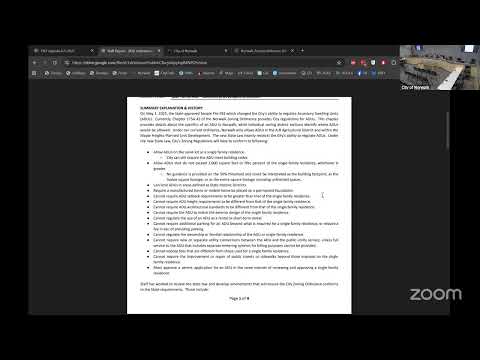
Planning staff said the state legislature passed a new senate file earlier this year that narrows what cities may regulate about ADUs. Elliot, community development staff, told the commission the ordinance 'cleans that up so that we'll be in conformance with the state code' and that one substantive choice for the city was whether to require ADUs to meet principal-building setbacks or the less restrictive accessory-structure setbacks.
Elliot described the two options to the commission. Under the principal-building setbacks described in staff materials the R-1 standard could require, for example, side setbacks roughly similar to the principal dwelling footprint, while Norwalk's existing accessory-structure standard calls for 5-foot side and rear setbacks and a minimum 10 feet between the accessory structure and the main house. Elliot said adopting the accessory-structure setbacks 'would allow more lots to fit an ADU.'
Commissioners asked about other limits the city could impose. Thompson and others raised height and use questions; Elliot said the state law restricts local control on several points. He told the commission the state code 'does say that we cannot regulate the use of an ADU as a rental or short-term rental' and that the city cannot impose height standards for ADUs that differ from the single-family residential height limit. Elliot noted the city's single-family height is 35 feet and that, in theory, the state language could allow a taller accessory unit if it met the ordinance's overall size limits.
Commission discussion around setbacks centered on balancing ease of siting ADUs against concerns about overly large structures near property lines. Several commissioners favored the accessory-structure setback standard to 'give people as much space as possible to make it look nice,' saying overly tight siting could produce poor outcomes. Elliot also offered a middle option: staff could draft specific ADU setbacks (for example, 10 feet from rear and side lot lines) for the council to consider if the commission preferred a compromise.
During the motion the commission approved the zoning amendment with the accessory-structure setback standard; the clerk conducted a roll call with recorded ayes from Samuelson, Forrest, Eaton, Henderson and Reagan. The ordinance language approved by the commission also adds ADUs as an allowed use on single-family lots in R-1 districts and substitutes the state's definition for the city's previous definition.
Elliot said the ADU permitting process will remain a building-permit process: applicants must pull building permits, submit site plans for staff review, and pass inspections. Staff noted the city can require separate metering for utilities but cannot require a separate service connection to the city main. Elliot said that, practically, ADUs have been infrequent: staff identified one or two existing ADUs in the jurisdiction and said nearby Des Moines had seven ADUs built since 2019.
The commission closed the public hearing and directed that the amendment, with the chosen setback standard, be forwarded to the City Council for consideration.
What the amendment does
- Replaces the city's ADU definition with the state's definition and rewrites Section 175A to mirror the state code. - Allows ADUs on lots whose primary use is a single-family dwelling in R-1 zoning districts. - Applies the city's accessory-structure setbacks (5-foot side/rear; 10-foot separation from principal structure) rather than the principal-building setbacks, per the commission's motion. - Leaves ADU use restrictions (including short-term rental regulation) to state law limitations and retains building permit/inspection requirements.
Votes at a glance
- Motion to approve the zoning amendment as drafted but using the accessory-structure setback standard: Moved by Samuelson; seconded by Thompson; recorded ayes from Samuelson, Forrest, Eaton, Henderson and Reagan; motion approved.
Next steps
The commission forwarded the amendment to the City Council for ordinance consideration. Staff said applicants will continue to apply through the building-permit process and that staff can return with clarified setback language if the council requests narrower or intermediate standards.