Get Full Government Meeting Transcripts, Videos, & Alerts Forever!
Get email alerts on the Land Use Zoning topic
No spam. Unsubscribe anytime.
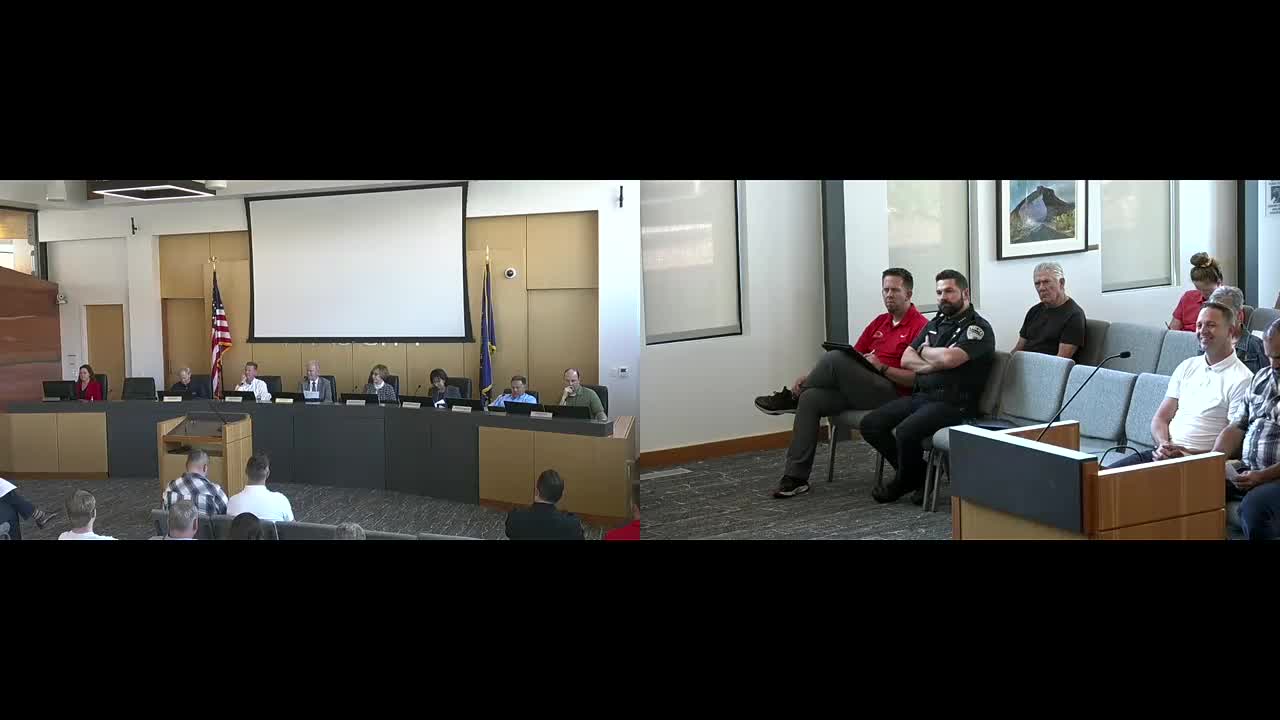
Ivins council delays vote on Best/Lofts rezoning after hours of public comment, asks developer for binding development agreement
Summary
After a lengthy public hearing and extensive public comment about traffic, parking and affordability, the Ivins City Council continued Ordinance 2025-18 and directed staff to work with the applicant on a development agreement and revised concept plan.
The Ivins City Council on Aug. 21 continued action on Ordinance 2025-18, a proposed map and zone change for roughly 13.02 acres near 290 South and 100 West, sending the item back to staff and the applicant for a binding development agreement and a revised concept plan.
The proposal before the council — filed by Lofts Development LLC on land owned by the Best family — would change the general-plan land use from medium-density residential and a small corner of neighborhood commercial to high-density residential and rezone the property from RA-1 (one-acre minimum) to R-1-5 (single-family, 5,000-square-foot minimum lots). The applicant presented a concept showing mostly detached single-family homes; the developer told council they intend the project to provide “missing middle” or “attainable” housing, not multifamily rentals.
The matter drew a full public hearing and more than a dozen residents who said the location next to Unity Park is not suitable for the proposed density. Residents repeatedly cited existing parking and traffic spillover from the park’s events, nighttime field lighting, and concerns about water supply. Christine Haddad and several neighbors asked the council to keep the land use as medium density. “We are not against high density,” resident Lisa German told the council. “We just think this is the wrong area to do it.”
Several speakers urged that rezoning to smaller lots would not produce genuinely affordable housing. Scott Cottom, who addressed the planning commission earlier, cited Ivins’ 2022 moderate-income housing plan and said the proposed homes were unlikely to meet the city’s affordability thresholds. “I can’t imagine these homes are going to be affordable,” Cottom said during the hearing.
Developer representatives responded to those concerns. Duane Schellenberg, one of the applicants, thanked the public and said the team was seeking “transparency” by bringing both the land-use and zone-change requests together. Later, developer Dave Nasal told the council he was “willing to commit to single-family detached” homes and said his firm would consider reducing lot counts to reach medium-density thresholds if required. Nasal also said the team would be open to moving a drainage basin and adding internal parking if the council made such requests.
Council members aired several technical and policy concerns during the meeting: consistency with the city’s general-plan map, the precedent set by approving a land-use change for a single parcel, parking and road cross sections, buffering between new smaller lots and adjacent larger-lot neighborhoods, and how to ensure the developer’s stated single-family intent would be binding. Councilmember Sharon Gillespie said she favored a careful, enforceable approach. “If we change this land use to high density, that opens the door to uses we may not want in that location,” Gillespie said during deliberations.
After extended discussion and an apparent straw poll in the chamber, the council voted to continue the ordinance to a future meeting and directed staff to work with the applicant on a development agreement and a revised concept plan that would: require single-family detached homes, consider feathering larger lots along 100 West, evaluate 7,500-square-foot lots adjacent to 10,000-square-foot homes, incorporate earth-tone architecture and desert landscaping, and address parking and basin relocation. The motion asked staff to return the item with a draft development agreement and a refined concept plan for council consideration.
Mayor Hart and council members emphasized that the continuation was not a rejection of the project but a request for specifics and enforceable commitments. Nasal said his team would pursue the development agreement and was open to many of the council’s suggestions, including reducing counts to about 69 units to match medium-density entitlement if necessary.
What’s next: staff will work with the applicant on a development agreement and revised concept plan, and the council will consider the amended ordinance and agreement at a future meeting. The council directed the applicant to return with a concept plan attached to any future ordinance and development-agreement packet. The timeline for returning to council was not specified at the meeting.