Get Full Government Meeting Transcripts, Videos, & Alerts Forever!
Get email alerts on the Municipal Budget topic
No spam. Unsubscribe anytime.
Dickinson council reviews FY2025–26 budget; discusses EMS reorganization to boost second-ambulance coverage
Summary
At a city council workshop, Dickinson officials discussed the proposed FY2025–26 budget with extended discussion of an Emergency Medical Services reorganization intended to put a second ambulance into service more often, staffing changes across departments, and capital requests for police radios and vehicles.
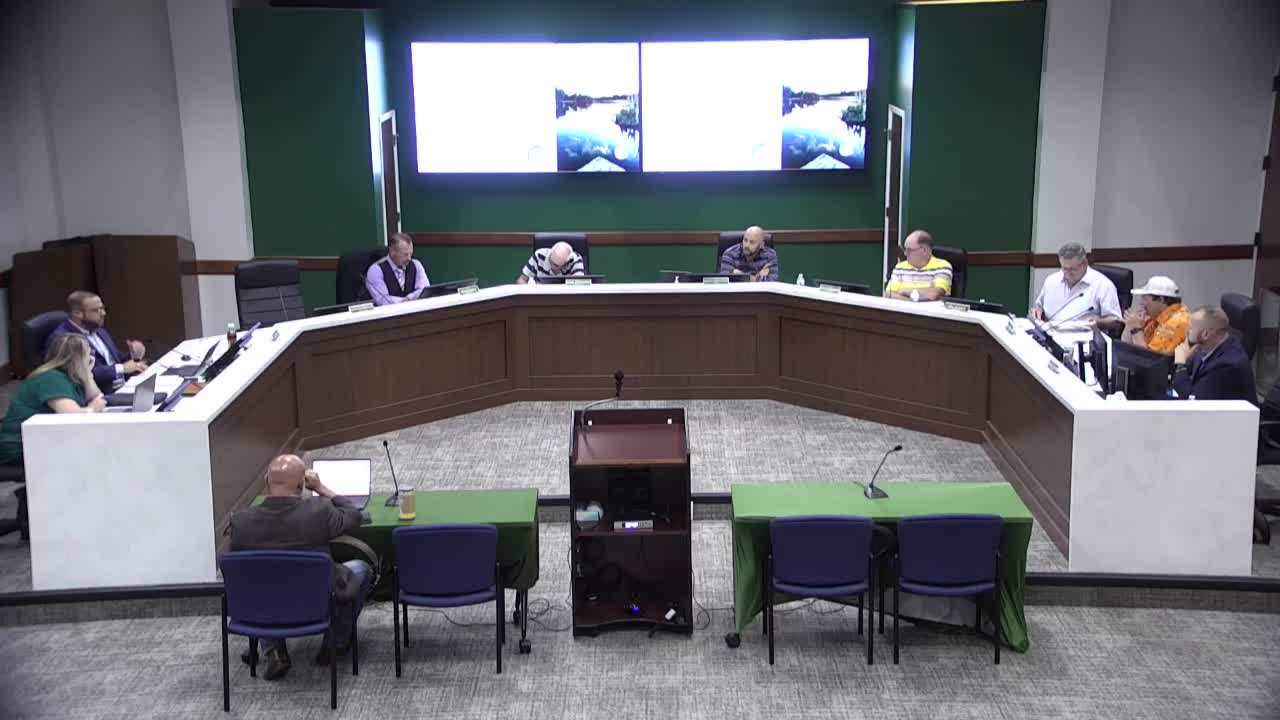
Dickinson city officials met in a workshop to review the proposed fiscal year 2025–26 budget and spent significant time on a proposed reorganization of Emergency Medical Services (EMS) intended to make a second ambulance available more often, while also reviewing staffing changes and equipment costs across departments.
The budget workshop opened with a public comment from Wally Dietz of Dickinson, who urged councilors to be transparent about property-tax revenue increases tied to rising property values and to restore a dedicated sales-tax allocation for streets and drainage projects. “People are looking at…how much are my taxes going up due to my property values going up, even though you keep the tax rate the same,” Dietz said.
City staff then led a department-by-department presentation of the proposed budget. Finance director Sarah Clark said the numeric documents distributed to councilors reflected no substantive changes since the prior materials, with the exception of moving vehicle replacements into a separate vehicle replacement fund and possible EMS staffing adjustments. “I did move the vehicle replacement into the vehicle replacement fund, but that is a net effect,” Clark said.
EMS reorganization
Assistant City Manager Matt Magdaleno described a restructure of the EMS chain of command recommended after a third‑party assessment. Magdaleno said the city plans to eliminate two captain positions (one full‑time, one part‑time) and one lieutenant position and instead staff a director, an administrative assistant and one lieutenant (supervisor) per shift. Magdaleno said that configuration would yield roughly 13–14 total EMS positions and allow the city to place a second ambulance in service more frequently.
“It allows us to take that supervisor role, pick up one part‑time employee, and create a second ambulance,” Magdaleno said, adding the department expects some days with two ambulances and other days without, rather than staffing a second ambulance full time.
Interim EMS director Captain Robbins said the department is recruiting four paramedics (one for each shift), has hired one so far and scheduled interviews for additional candidates. Robbins said increasing the part‑time pool and hiring will reduce overtime and mutual‑aid reliance over time. “We’re scheduling to have the four EMTs put on the ambulance. We have one already hired. We got three interviews for next week,” Robbins said.
Staff and councilors discussed the difficulty of predicting exact cost savings. Magdaleno said the city will budget conservatively for mutual aid in the near term — even while hoping mutual‑aid costs will fall — because past budgets had underestimated mutual‑aid expenses. “We are budgeting for the use of just…we are budgeting to continue the same trend for mutual aid, but we’re hoping and I’m betting on we’ll see that number go down,” he said.
Budget line‑item clarifications
Councilors and staff reviewed several line items tied to the EMS proposal. Council member Mark Townsend and others pressed for clarity on the headcount shown in budget documents; staff confirmed the tally should read 14 positions after a revision. Councilors also discussed increases to the EMS overtime line (presented in the workshop materials as an increase to about $250,000 from a previously budgeted $50,000), a proposed reduction in fuel expense for EMS from approximately $17,000 to $12,000, and that some capital and vehicle replacement costs were moved to the city’s vehicle replacement fund.
Police, collective bargaining and capital
Police staffing and equipment also featured in the workshop. Council members and police leadership discussed a capital package that staff said will be largely funded through the Dickinson Management District (DMD) and includes vehicles and radio replacements. Staff identified about $605,000 for vehicles and related items that will be transferred to DMD and about $245,000 proposed for replacement handheld radios. Councilors discussed a 6% cost‑of‑living adjustment (COLA) proposed for civilian employees; staff noted language in the police collective bargaining agreement that could make certain citywide pay adjustments applicable to the police association.
Information technology, OEM and the UAV
Information Technology staff described a planned upgrade to the city firewall and related systems, with part of the package coordinated with DMD funding. Emergency management and facilities staffing plans were described as still evolving; Assistant City Manager Magdaleno said staff are evaluating whether to retain a larger unmanned aerial vehicle (UAV) purchased under prior administration authority. Magdaleno said he has not yet decided whether the city should keep the UAV and that the city is incurring an approximately $9,000 annual subscription tied to it. “I’m not prepared to give you a recommendation on what to do with this UAV quite yet,” Magdaleno said.
Library, community development and animal services
Councilors reviewed budget requests from multiple departments. The library asked to fill two vacancies and to support staff tuition for required librarian credentials should population thresholds trigger different staffing requirements; staff noted the city’s population and library service population metrics may push staffing needs sooner than census counts indicate. Community Development requested one additional position (a plan reviewer / assistant building official) and said enforcement is currently handled by one dedicated code enforcement officer plus inspector support.
Animal Services manager Nina described workload and said the shelter has reduced intake through rescue partnerships and increased STAR (donor) fundraising, which staff said had raised roughly $41,000 year‑to‑date for higher‑cost medical needs. Nina said the shelter needs an additional supervisory position at the front counter to free her to manage operations and coordination with rescues and volunteers.
Next steps
Council members agreed to continue line‑by‑line budget review at a follow‑up meeting. Staff said they will provide additional clarifications on EMS cost estimates, mutual‑aid assumptions, the UAV’s status and other revised line items at the next session. Council scheduled a continuation for a future meeting (staff indicated a planned Tuesday 5:30 p.m. follow‑up specific to line items).
The session included no formal votes on the budget at the workshop; councilors asked staff for follow‑up information before final adoption.